10 best outbound AI sales agents in 2026: Ranked and compared
29 May 2026
10 best outbound AI sales agents in 2026: Ranked and compared
The outbound AI sales agent market has expanded to the point where every tool in the category claims to do the same thing. Most don't. Apollo, Outreach, Clay, Lilian, and 11x are routinely compared in the same listicle despite solving fundamentally different problems for different buyers.
Sales reps already spend 70% of their time on non-selling tasks. The question isn't whether your team needs help with outbound, it's which category of tool actually addresses the problem you have. This guide ranks the ten best options in 2026, explains what separates them, and gives you the framework to pick the right one.
What an outbound sales AI agent actually means in 2026
The phrase covers three distinct product types that are routinely compared as if they're equivalent. Which category fits your situation determines which tool belongs on your shortlist.
Three types sit under the outbound AI umbrella:
Autonomous digital workers: these agents run the full prospecting-to-booking workflow without an SDR operating each step. They source leads, write personalised messages, sequence follow-ups, and book meetings independently. The relevant financial comparison is against the cost of a human SDR hire, not against other software licences.
Sequencing and engagement platforms: these tools automate outreach execution, but a human SDR still loads the contacts, defines the sequences, and interprets performance. They make existing reps more productive. They don't replace headcount.
Enrichment and research agents: these are data orchestration layers. They aggregate contact data from dozens of sources, generate personalised research snippets per prospect, and feed output into a separate sequencing tool. They don't send outreach autonomously.
How we ranked these tools
The ten tools below are ranked using five criteria applied consistently across the category.
Autonomy level: how much of the outbound workflow runs without SDR involvement, from lead sourcing through to meeting booking
Data quality and deliverability: whether the tool includes its own verified contact database or requires an external provider, and what the deliverability consequences are either way
Personalisation approach: whether outreach is built from static profile data or from live signals such as job changes, funding events, and hiring activity
Setup and ops overhead: how long before the tool generates pipeline, and what internal resource it requires to stay operational
Cost relative to SDR headcount: evaluated as a build-vs-hire decision rather than a software-vs-software comparison
Mid-market teams wanting an all-in-one outbound agent
Email, LinkedIn
From $280/mo
Yes
Apollo.io
Engagement platform
Teams building outbound from scratch on a budget
Email, Phone
From $49/user/mo
Partial
Outreach
Engagement platform
Enterprise teams with 30+ reps and RevOps capacity
Email, Phone, LinkedIn
From $100/user/mo
No
Salesloft
Engagement platform
Teams wanting rep coaching and pipeline visibility
Email, Phone, LinkedIn
From $75/user/mo
No
Clay
Enrichment layer
RevOps teams building highly personalised outbound data
Feeds sequencers
From $167/mo
No
Reply.io
Engagement platform
10–50 seat teams needing multi-channel sequencing
Email, LinkedIn, Phone, SMS
From $49/user/mo
No
Instantly.ai
Engagement platform
High-volume email campaigns across multiple inboxes
Email
From $30/mo
No
Lemlist
Engagement platform
Teams prioritising inbox differentiation
Email, LinkedIn
From $79/user/mo
No
Detailed breakdowns for each tool follow below.
What the best outbound AI sales agents have in common, and where they fail
Across the autonomous agent category, the tools that consistently produce pipeline share four characteristics. The tools that don't share all four tend to underdeliver regardless of how strong the demo looked.
Verified contact data with deliverability protection: domain reputation determines whether outbound emails reach the inbox or the spam folder. Teams running high-volume sends without warm-up infrastructure, sender rotation, or waterfall email verification routinely see elevated bounce rates that trigger spam filters and can permanently damage the sending domain. The strongest outbound AI agents include this infrastructure from day one, rather than leaving it to the team to manage separately.
Real-time signal-based targeting: agents that personalise outreach from static profile data produce different results from agents that track live signals; job changes, funding rounds, new hires, tech stack shifts. The latter produces outreach that arrives when a prospect has a reason to respond. The former produces outreach that arrives whenever the campaign fires, regardless of whether the timing is relevant.
Minimal ops overhead after onboarding: tools that require a dedicated RevOps resource to build and maintain workflows are not autonomous agents. They're sophisticated manual systems. The distinction matters because ops overhead translates directly into time-to-pipeline and total cost of ownership.
Tightly defined ICP as a prerequisite: this is where most outbound AI deployments fail. Every tool in this category performs better when the ICP is specific. Vague targeting — "B2B SaaS companies, 50 to 500 employees" with no further qualification — produces low-relevance outreach, high unsubscribe rates, and degraded inbox placement, regardless of how capable the agent is. The teams that see the clearest results have already defined exactly who they're targeting and why that person would respond to outreach today.
The most common failure mode is not the tool itself. It's buying an autonomous agent, pointing it at an underspecified ICP, and concluding that AI outbound doesn't work.
Outbound AI agent vs. human SDR: the real cost comparison
The economic argument for autonomous outbound agents only holds if the comparison is made honestly. Here's what the numbers look like.
Outbound AI Agent vs Human SDR — Cost Comparison
← Scroll to see more →
Dimension
Human SDR (US)
Autonomous outbound AI agent
Annual cost
$75,000–$110,000 base salary
Significantly lower than SDR base salary advantage
Benefits & overhead
Adds materially to base salary cost
None advantage
Ramp time
3–4 months before full productivity
Immediate advantage
Working hours
Standard business hours only
24/7 advantage
Attrition risk
High — SDR roles carry significant turnover
None advantage
Languages
One
80+ advantage
Leads engaged/month
Pipeline output scales slowly through ramp period
Up to 2,000 from day one advantage
The comparison shifts depending on what the agent is replacing. If the goal is to add pipeline capacity without hiring, the autonomous agent wins on every dimension above. If the goal is to make an existing team of SDRs more effective, an autonomous agent is not the right tool; an engagement platform or enrichment layer is.
83% of sales teams using AI saw revenue growth versus 66% of teams without AI. That gap reflects teams that matched the right tool to the right problem in their outbound motion, not just teams that bought more software.
The 10 best outbound sales AI agents in 2026
1. Vector Agents' Lillian (Best overall outbound sales AI agent)
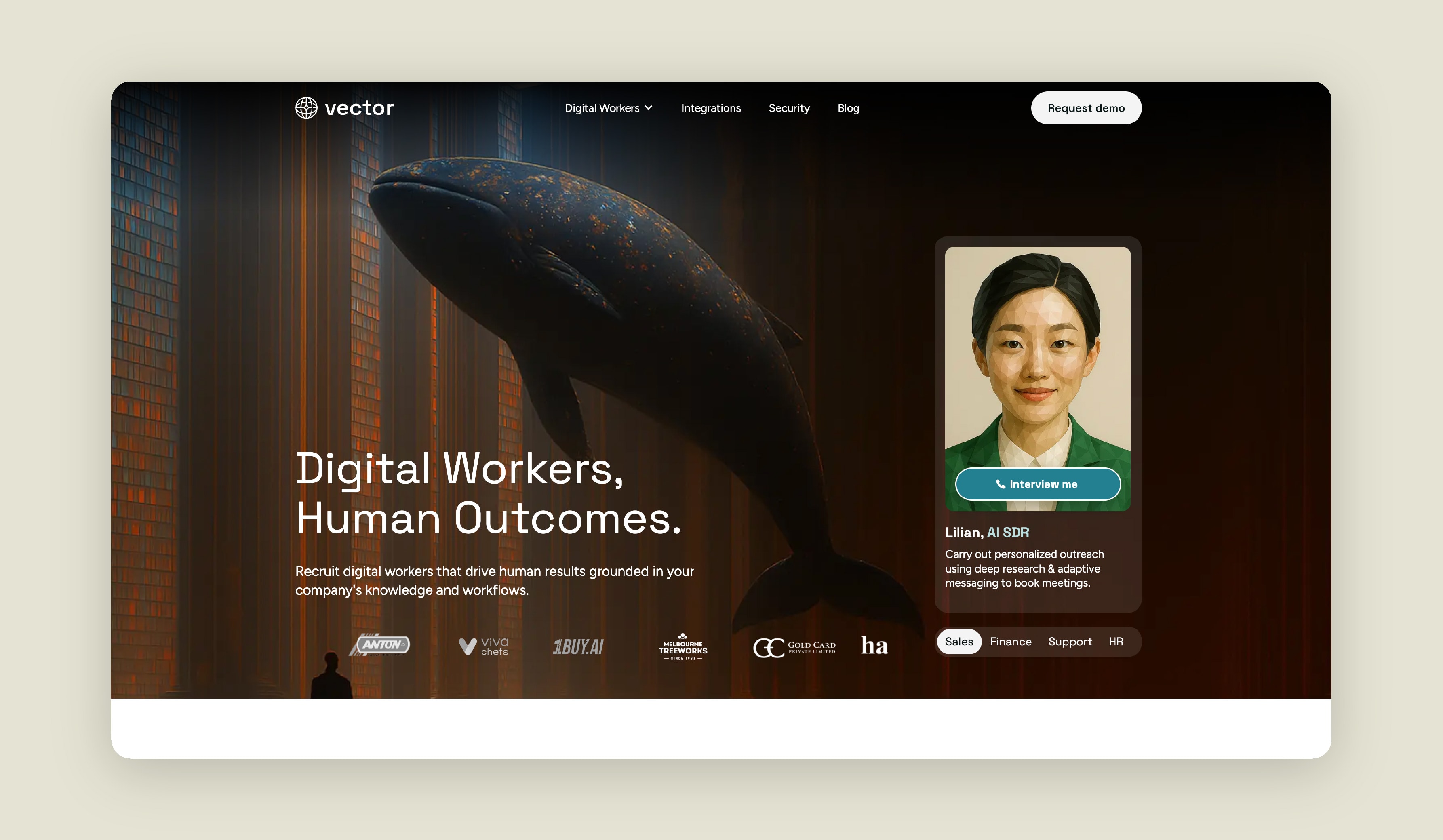
Lilian is a fully autonomous outbound sales agent that handles the complete prospecting-to-booking workflow without an SDR in the loop. She sources leads, runs deep prospect research across various sources, writes personalised email and LinkedIn outreach, sequences follow-ups, and books meetings directly into the calendar. All with a huge cost reduction, no ramp period, no attrition risk, and no limit on productive hours.
Best for: B2B companies with 50–500 employees that need to add pipeline capacity without adding headcount; teams that have accumulated domain reputation damage from high-volume spray-and-pray outreach and need deliverability protection built in from day one
Channels: email and LinkedIn, with waterfall email verification and Microsoft and Google server sending to protect domain reputation
Autonomy: full — prospect research, message writing, sequencing, and meeting booking all run without SDR involvement; ~2,000 leads engaged per month from deployment
Pricing: no annual commitment required to start
Watch out for: native CRM integration is on the roadmap but not yet live; data syncs via export in the interim
2. 11x (Alice)
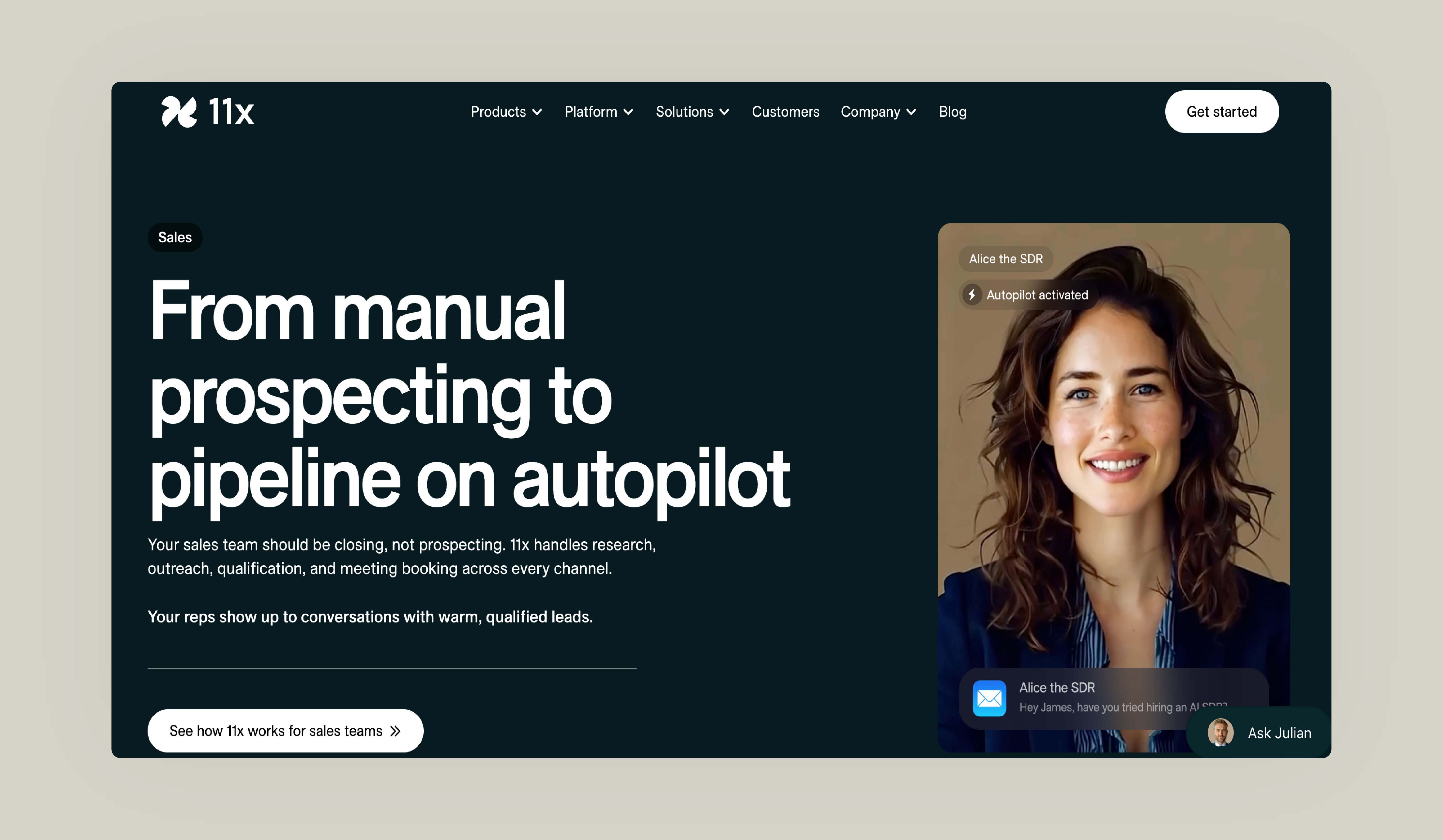
Alice is 11x's autonomous AI SDR, built for enterprise sales organisations replacing or augmenting human SDR teams at scale. She handles email prospecting, LinkedIn outreach, reply management, and meeting booking. Julian, a separate voice agent, extends the motion to inbound phone qualification. The platform includes a proprietary contact database, website visitor tracking, and multi-channel sequencing. The trade-off is price and commitment: 11x does not publish pricing publicly, but external estimates place Alice at around $5,000/month annualised, making the minimum annual spend roughly $60,000.
Best for: mid-market to enterprise teams with RevOps capacity and a budget to match; organisations replacing multiple human SDRs simultaneously
Autonomy: full for outbound; Julian handles inbound voice qualification separately
Pricing: custom; external estimates from ~$5,000/month annualised with implementation fees on top; no self-serve trial available
Watch out for: pricing requires a sales conversation to confirm; personalisation reported as less effective at very high volume; no free tier
3. Artisan (Ava)
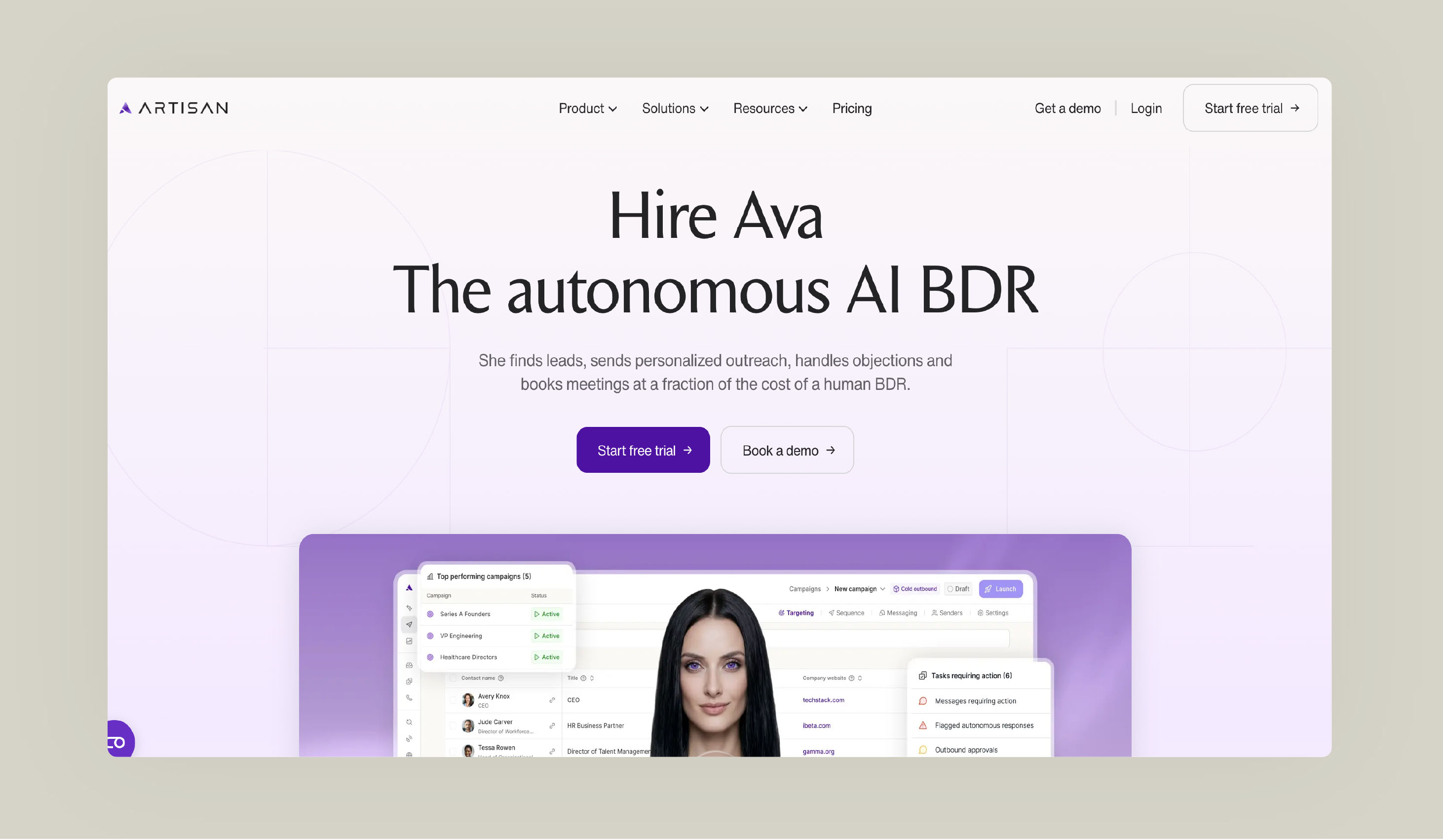
Artisan positions Ava as automating roughly 80% of the outbound workflow within a single consolidated platform. The built-in contact database means teams don't need a separate data provider. Ava handles email sequences, AI-written personalised outreach, and LinkedIn messaging. LinkedIn automation capabilities were restricted in early 2026, which narrows the multi-channel story. Entry pricing starts at $280/month on published tiers; enterprise contracts are custom and require a sales conversation.
Best for: B2B sales teams at startups and mid-market companies that want to reduce manual SDR workload without stitching together multiple tools
Channels: email, LinkedIn (restricted capabilities since early 2026)
Autonomy: partial — Ava automates roughly 80% of outbound; some human oversight remains in practice
Pricing: from $280/month (published Growth tier); enterprise pricing custom
Watch out for: LinkedIn restrictions reduce multi-channel value; personalisation quality reported to drop at high volume without unique signal context per prospect
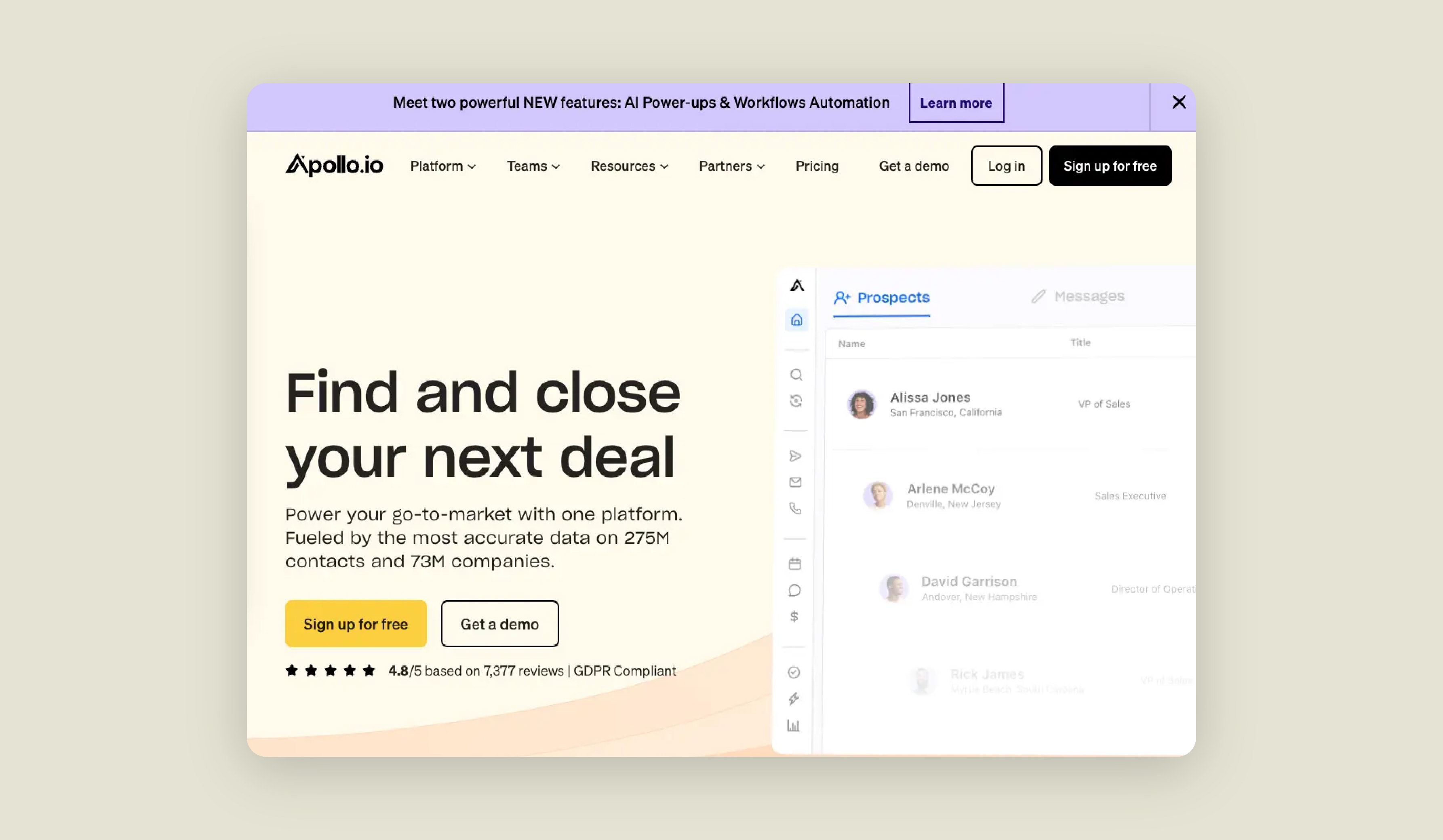
4. Apollo.io
Apollo is the most cost-effective entry point for teams that need both contact data and outreach capability in one product. Its database covers hundreds of millions of B2B contacts with filters across industry, company size, job title, and intent signals. Sequences are built and operated by the SDR; Apollo doesn't run outreach autonomously. At $49–$119/user/month, it's significantly cheaper than autonomous agents, but an SDR is still required to operate it. Contact data decay is Apollo's most documented limitation; older records require active list hygiene to avoid elevated bounce rates that affect domain reputation.
Best for: early-stage or budget-constrained teams building outbound sales AI capacity from scratch; teams that need data and sequencing without a separate data subscription
Autonomy: partial — sequences require human setup and management; AI assists with personalisation suggestions
Pricing: from $49/user/month (Basic); $79/user/month (Professional)
Watch out for: data decay requires active list hygiene; sequences require ongoing SDR management
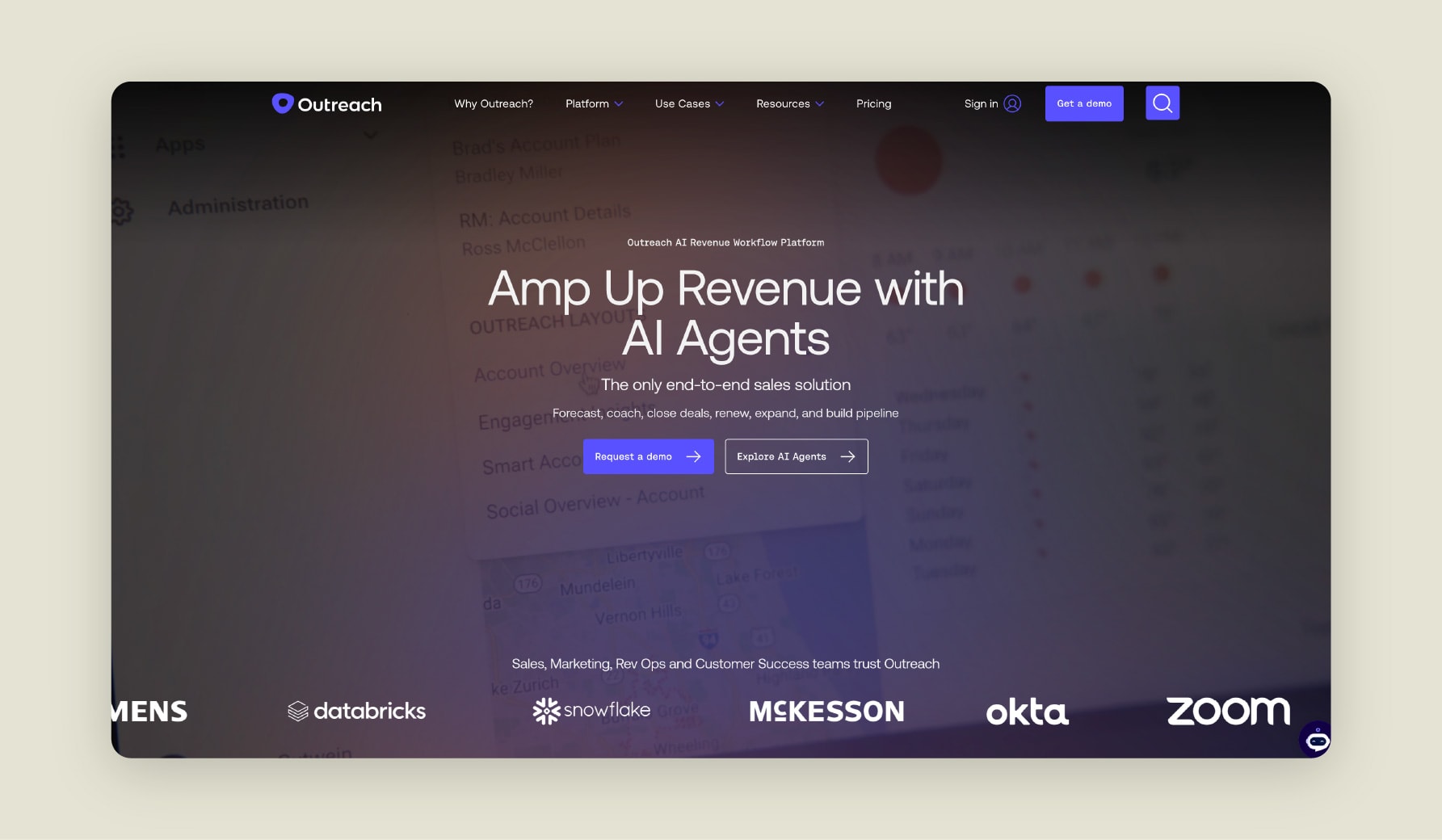
5. Outreach
Outreach is built for enterprise sales teams with 30+ reps, established RevOps capacity, and complex multi-stage sales cycles. It provides multi-channel sequences with AI-assisted prioritisation, deal coaching, pipeline forecasting, and deep Salesforce integration. It does not include a native contact database, so teams need a separate data source — typically Apollo or ZoomInfo — adding meaningful annual cost on top of the platform licence. Implementation typically requires a RevOps partner and several months before the system operates at full capacity.
Best for: enterprise teams running complex outbound and inbound motions where rep coaching, forecasting, and CRM integration are as important as sequencing volume
Channels: email, phone, LinkedIn
Autonomy: no — sequences are SDR-operated; AI assists with prioritisation and coaching
Pricing: from $100/user/month; annual commitment standard
Watch out for: no native contact database; implementation cost and timeline are significant; HubSpot integration has consistent UX complaints in recent reviews
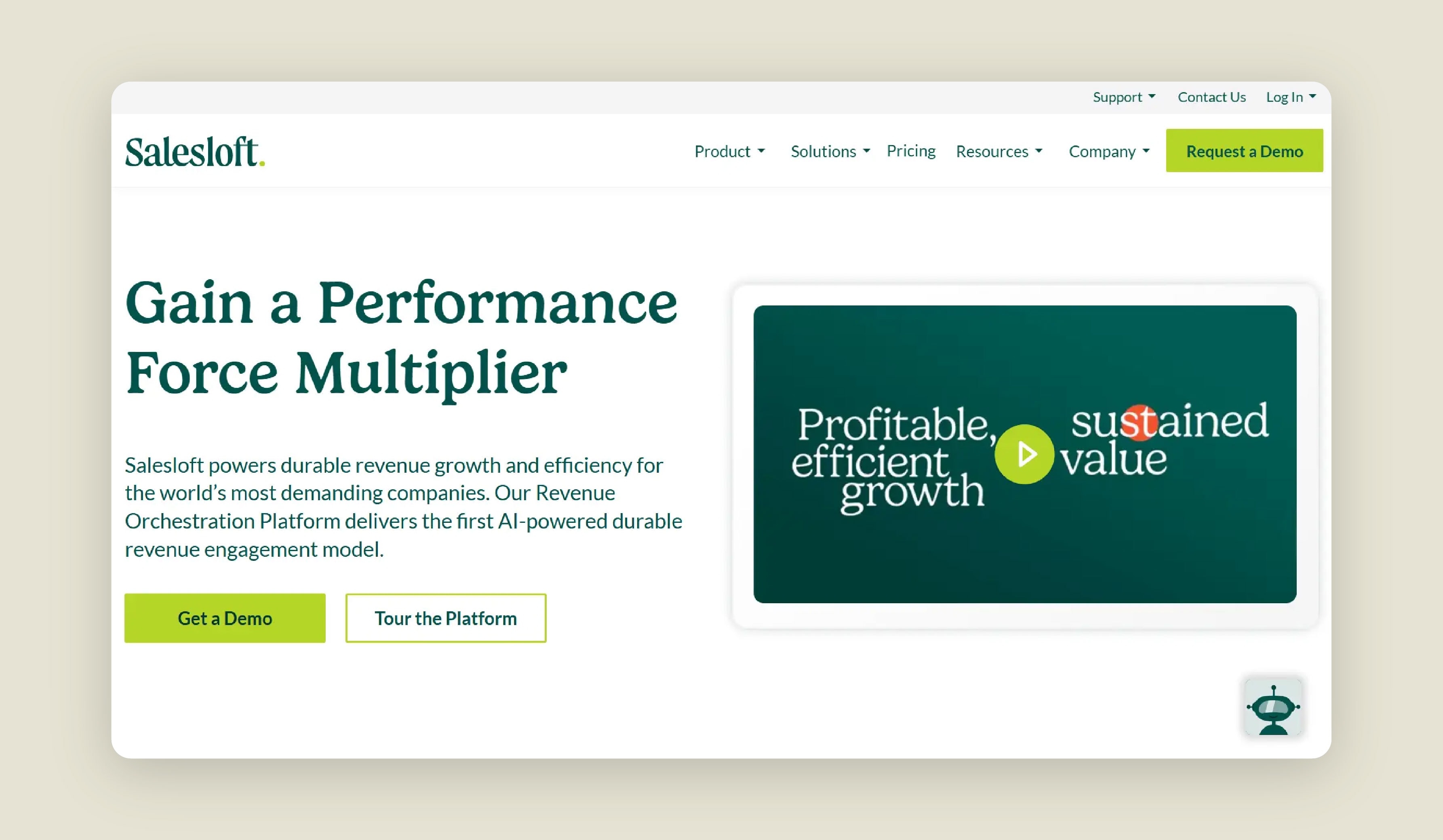
6. Salesloft
Salesloft acquired Drift in 2024 and completed a merger with Clari in late 2025, repositioning itself as a broader revenue platform rather than a sequencing tool. Its core strength is ease of use and rep adoption — it consistently scores higher than Outreach on G2 ease-of-use and ease-of-setup ratings. The Clari merger adds forecasting capability natively, which makes it a stronger choice for teams that want pipeline visibility alongside engagement. Like Outreach, it requires a separate contact data source.
Best for: teams that want rep coaching, pipeline forecasting, and sequencing in one platform; organisations where SDR adoption speed matters more than sequence complexity
Channels: email, phone, LinkedIn
Autonomy: no — human-operated sequences with AI-assisted prioritisation
Pricing: from $75/user/month; custom at enterprise
Watch out for: no native contact database; the Drift and Clari integrations have introduced UX inconsistency that hasn't fully resolved
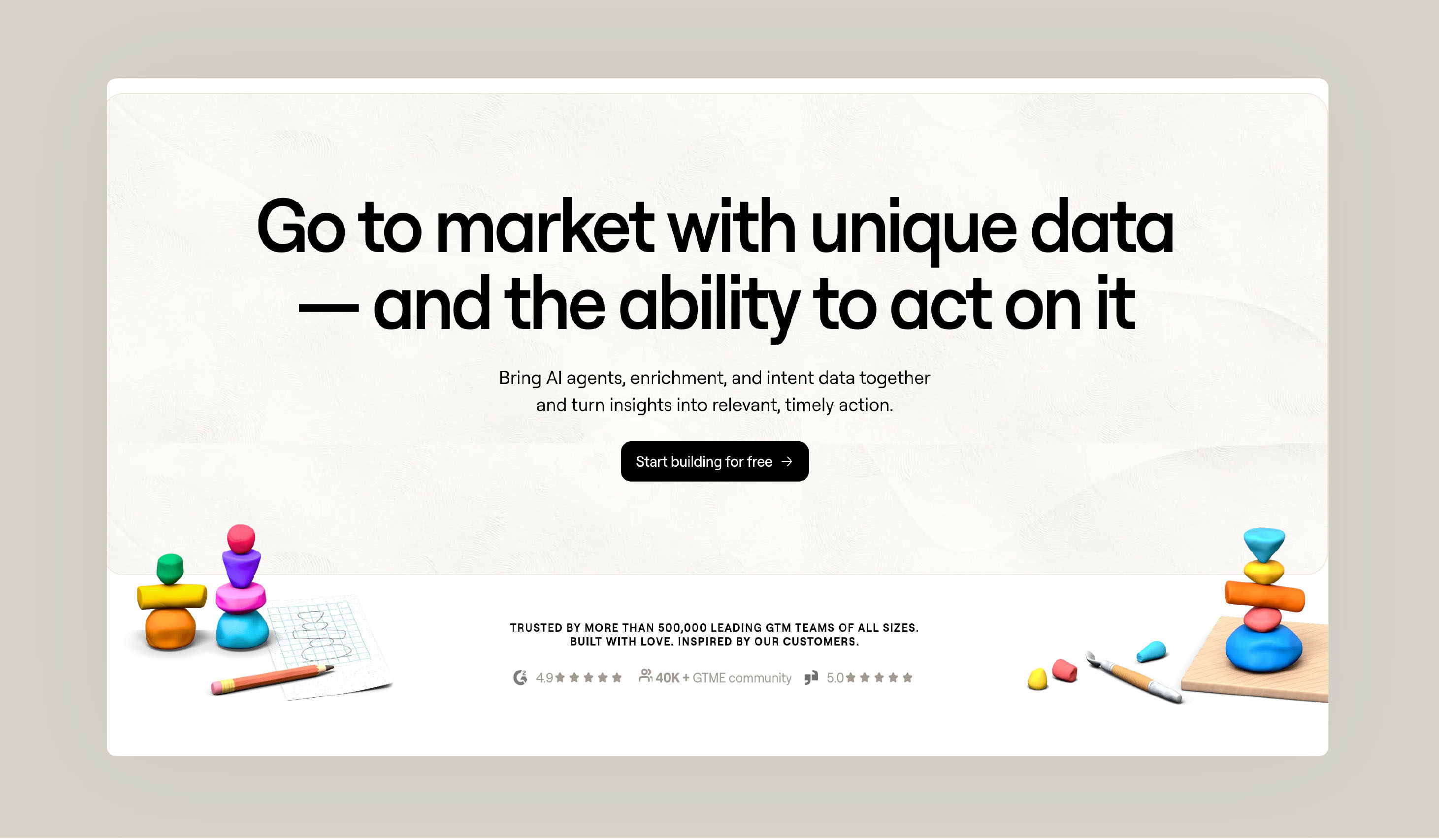
7. Clay
Clay is a data orchestration layer, not an outbound AI agent in the autonomous sense. It aggregates enrichment data from 100+ sources, runs Claygent AI research per prospect — pulling job changes, funding signals, tech stack data, and intent indicators — and pushes enriched output into a sequencing tool. Clay's waterfall enrichment approach means outreach arrives with more specific, timely context than single-source prospecting lists produce. The trade-off is build time: Clay requires RevOps capacity to configure workflows and a separate tool to send the emails it prepares.
Best for: RevOps teams and growth operators who want maximum personalised outreach at scale; teams with existing sequencers who want to improve data quality and relevance
Channels: feeds into any sequencing tool; does not send outreach independently
Autonomy: no — an operator builds and maintains the workflows; Clay executes them
Pricing: from $167/month (Launch tier); pricing scales with credit usage
Watch out for: credit-based pricing is hard to predict before running a full campaign; significant RevOps time investment before it produces output
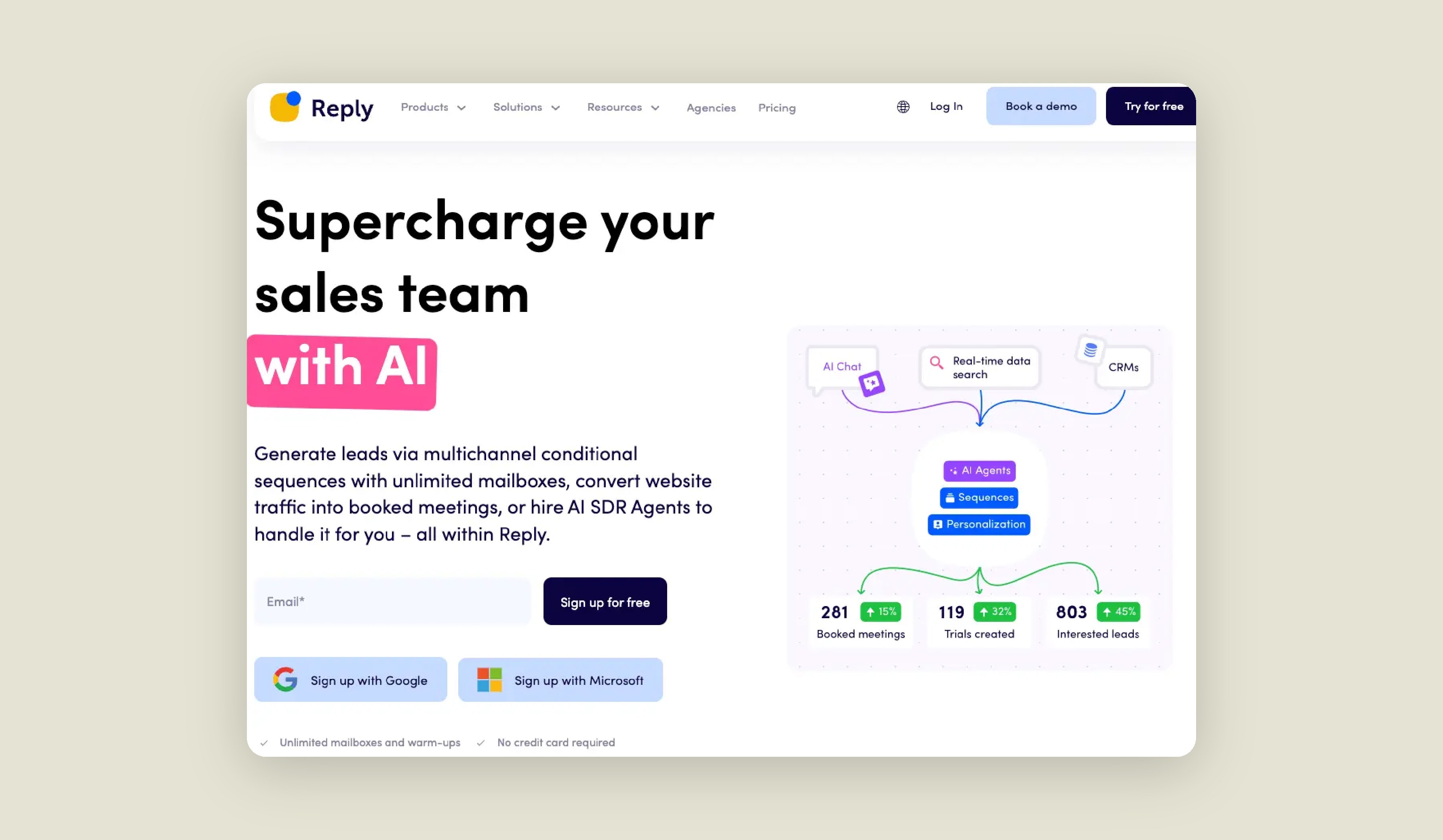
8. Reply.io
Reply.io is a mid-market multi-channel sequencing platform covering email, LinkedIn, phone calls, and SMS within a single workflow. It includes built-in inbox warm-up, A/B testing, and inbox rotation — more deliverability infrastructure than most platforms at this price point. At $49–$89/user/month, it sits between Apollo's all-in-one approach and Outreach's enterprise complexity. Sequences are human-operated; AI assists with message generation and reply handling.
Best for: 10–50 seat outbound sales teams that need multi-channel sequences without enterprise overhead or implementation timelines
Channels: email, LinkedIn, phone, SMS
Autonomy: partial — AI assists with message generation and reply detection; sequences are SDR-operated
Pricing: from $49/user/month (email); $89/user/month (multi-channel)
Watch out for: contact database is not native; LinkedIn step is not fully automated
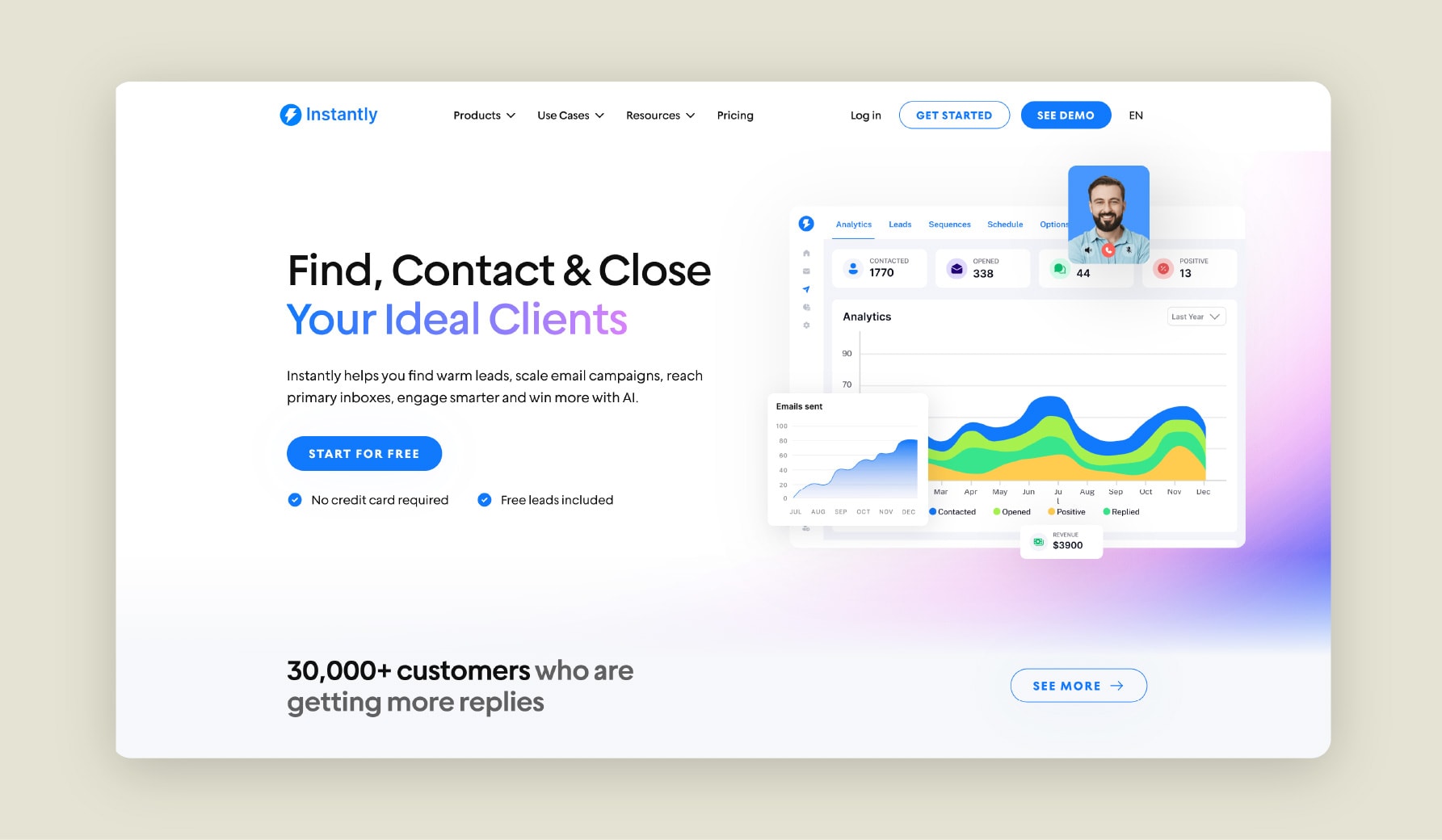
9. Instantly.ai
Instantly is built for high-volume cold email at the lowest total cost per inbox. Its defining feature is unlimited sending accounts across all plans, which allows teams to rotate dozens of warmed mailboxes and protect domain reputation without paying per-seat for each one. It includes built-in warm-up and a lead database billed separately as Instantly Credits. Email is the only channel — LinkedIn outreach requires a separate tool. The modular pricing structure means the advertised entry price rarely reflects the actual monthly spend once lead sourcing and CRM features are activated.
Best for: agencies and high-volume outbound teams running large campaign lists across multiple inboxes; email-only operations where cost per inbox matters more than channel breadth
Channels: email only
Autonomy: partial — AI Sales Agent feature assists with reply handling; campaigns are human-configured
Pricing: from $30/month (Growth); realistic total cost with lead sourcing and CRM is $77–$124/month
Watch out for: email-only; lead database and CRM are separate paid modules; credits expire on monthly plans
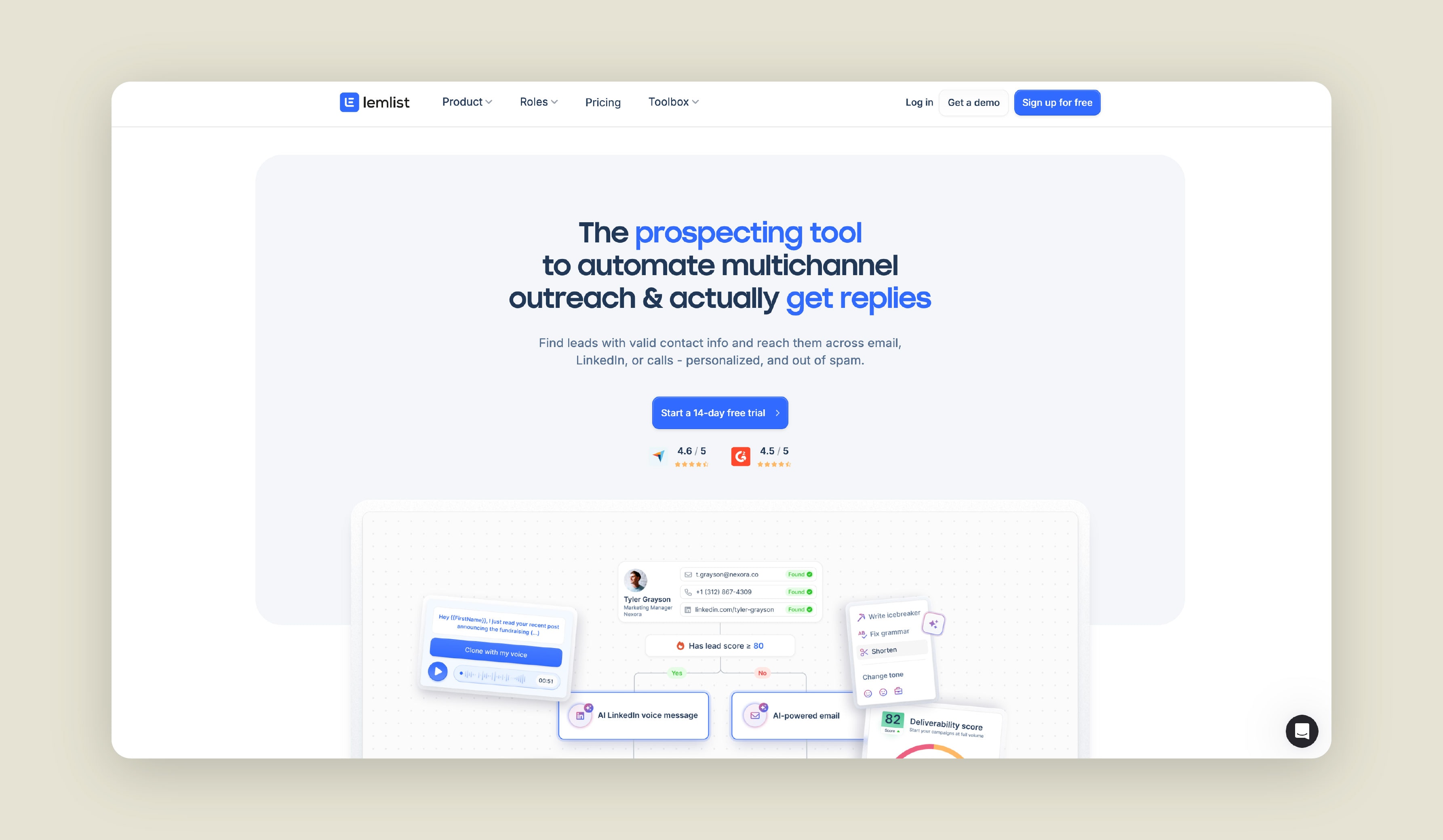
10. Lemlist
Lemlist is a cold email and LinkedIn sequencing platform with the strongest personalisation features in the engagement platform category. It allows teams to embed custom images, video GIFs, and dynamic text into email sequences: a meaningful inbox differentiator when every other team is sending plain-text variations of the same message. Its per-seat pricing model means costs scale with team size, making it significantly more expensive than Instantly for teams above three or four users.
Best for: teams that prioritise standing out in crowded inboxes; smaller outbound teams where per-seat costs don't compound
Channels: email, LinkedIn
Autonomy: no — human-operated sequences with AI-assisted copy suggestions
Pricing: from $79/user/month (Email Pro); $109/user/month (Multi-Channel Expert)
Watch out for: per-seat pricing makes it expensive for larger teams; AI is assistive, not autonomous; no native contact database
The right tool for the right pipeline problem
The outbound AI sales agent category works when the tool matches the problem. Autonomous agents solve the headcount problem: pipeline added without hiring, without ramp time, without attrition. Engagement platforms solve the rep-efficiency problem: existing SDRs producing more with the same hours. Enrichment layers solve the data-quality problem: outreach that arrives with relevant, timely context instead of generic copy.
Buying the wrong category is the most expensive mistake in outbound sales. It's also the most common. If adding pipeline without adding headcount is the decision your team is working through, book a demo to see what Lilian books in your specific market, with your ICP, in the first 30 days.
FAQ
What is an outbound AI sales agent?
An outbound AI sales agent is software that executes outbound prospecting autonomously — sourcing leads, writing personalised messages, sequencing follow-ups, and booking meetings without requiring an SDR to operate each step. The category also includes human-operated tools like sequencing platforms and enrichment layers, but these are not autonomous agents. The distinction matters when evaluating cost against SDR headcount.
How is an outbound AI agent different from a tool like Apollo or Outreach?
Apollo and Outreach are human-operated tools: an SDR loads the contacts, builds the sequences, and manages performance. An outbound AI agent like Lilian or Alice runs that workflow autonomously. The relevant comparison for an autonomous agent is against the cost of a human SDR hire. The relevant comparison for Apollo or Outreach is against the productivity of an existing SDR team.
How long does it take to get an outbound sales agent producing pipeline?
Autonomous agents like Lilian deploy immediately with no ramp period. Engagement platforms like Outreach and Salesloft typically require several months of implementation before operating at full capacity. Enrichment tools like Clay require RevOps time to build workflows before the first campaign runs. Setup speed is one of the sharpest practical differences between category types.
Do outbound AI sales agents work for smaller B2B teams?
Yes. Autonomous outbound agents are designed for 50–500 employee B2B companies where adding headcount ahead of pipeline is a budget constraint. Enterprise engagement platforms like Outreach are built for teams with 30+ reps and dedicated RevOps. A smaller team evaluating Outreach is paying for infrastructure they can't fully use.
What is the biggest reason outbound AI agents fail to deliver?
The two most common causes are category mismatch — buying an engagement platform to solve a headcount problem — and an underspecified ICP. Autonomous agents perform best when the target profile is precise: industry, company size, tech stack, and buying trigger defined before the first campaign runs. Vague targeting produces low-relevance outreach regardless of how capable the agent is.





.svg)


.svg)


.jpeg)