
Europe Expansion
Vector Agents Enters Europe. Announcing Our Regional Leadership.

Europe Expansion
Vector Agents Enters Europe. Announcing Our Regional Leadership.


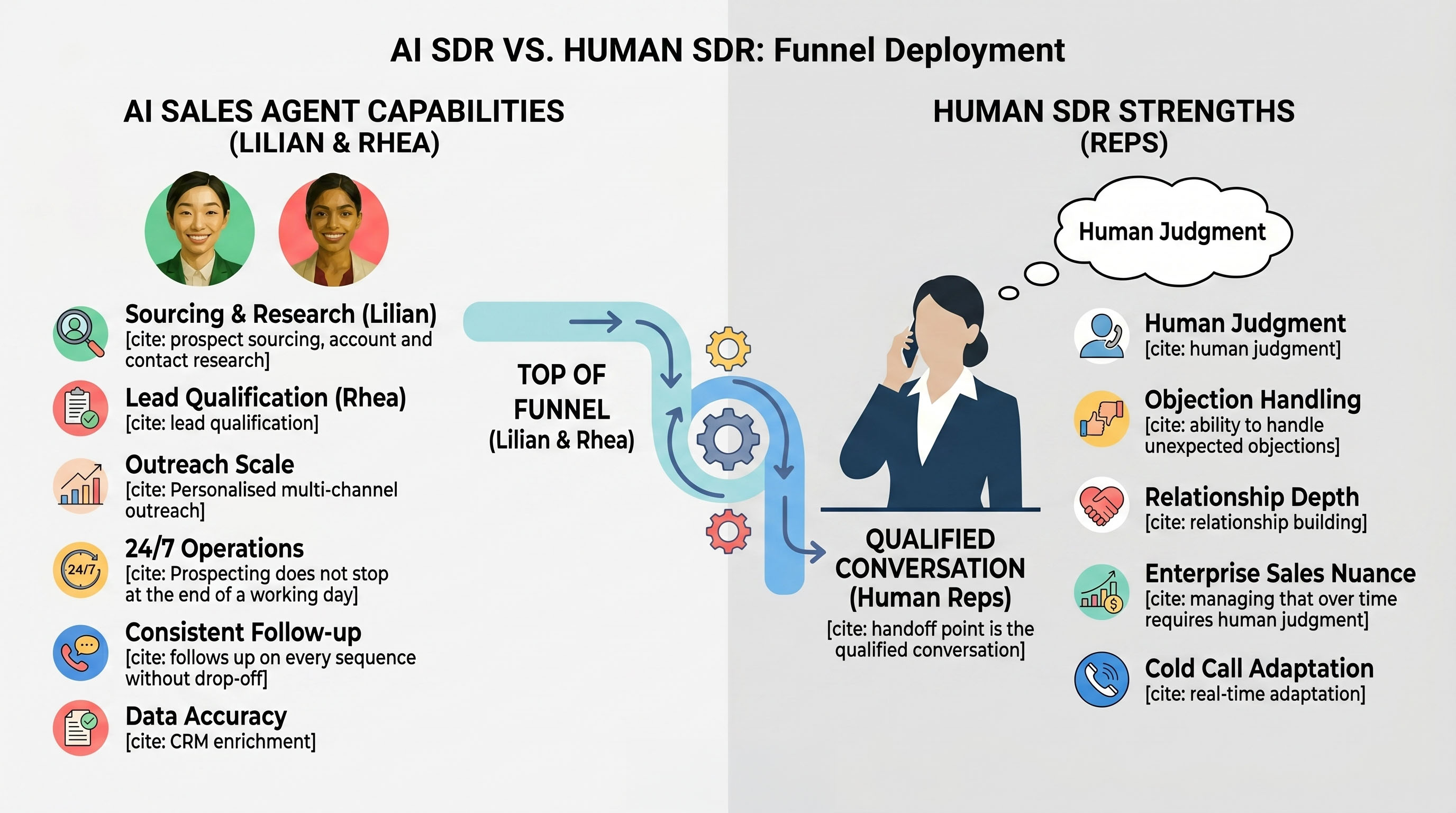
The question of AI sales agent capabilities versus human SDRs is no longer theoretical. It is a practical decision about how pipeline gets built.
AI sales agents and human SDRs solve different parts of the same problem. Each has clear strengths. Each has clear limitations.
The goal is not to choose one blindly. It is to understand what each delivers, where each breaks down, and how they fit together in a real sales process.
An AI sales agent handles top-of-funnel work autonomously. Earlier tools relied on fixed sequences and templates. Modern systems adapt. They adjust tone, timing, and messaging based on how prospects engage.
In practice, the capabilities cover the full top-of-funnel workflow:
The handoff point is the qualified conversation. From there, the responsibility shifts to the human team.
There are clear limitations to what AI can handle today. Ignoring these leads to poor deployment decisions.
These are not edge cases. They define where human SDRs remain essential.
Where the comparison shifts is in execution at scale.
AI operates with a level of consistency and throughput that human teams cannot match. It runs across thousands of prospects simultaneously, follows up on every sequence without drop-off, and responds to inbound signals quickly.
It also removes operational gaps that are common in human teams. Follow-ups do not get missed. Outreach does not slow down under pressure. CRM data stays current because it is maintained as part of execution.
For teams working across time zones, this matters even more. Prospecting does not stop at the end of a working day.
This is why most sales organisations now use AI in some part of the workflow. It has become part of the baseline for competitive outbound.
The difference between AI and human SDRs is not about replacing one with the other in all cases. It is about how each operates within the pipeline and what each costs to build, maintain, and scale.
A human SDR carries costs that begin before they make their first call:
Capacity is also finite. Output depends on experience, motivation, and time. Performance varies across individuals, and no amount of process documentation fully eliminates that variance.
An AI sales agent operates differently:
The compounding effect matters here. A human SDR team that doubles in size doubles cost, doubles management load, and doubles ramp time. An AI SDR scales output without scaling cost at the same rate.
The impact is not just on volume. It is on consistency, cost predictability, and the removal of the hiring dependency from pipeline planning altogether.
The most effective teams do not treat this as a binary decision. They structure each component of the system deliberately.
AI handles the top-of-funnel execution: sourcing, outreach, follow-up, qualification, and meeting booking.
Human SDRs and AEs focus on what requires judgment. They handle conversations, objections, and relationship development.
This changes how time is spent. Reps are no longer buried in repetitive tasks. They work on qualified opportunities with context already in place.
One requirement makes this work: setup quality.
AI needs a clearly defined ICP, tested messaging, and precise targeting rules. Without that, output becomes inconsistent. With it, the system performs reliably.
Ask yourself one question before deciding: is your outbound function broken because you do not have enough people, or because the people you have are spending their time on the wrong things?
No SDR function yet:
Existing SDR team:
Companies should hold off if the fundamentals are not in place. If positioning is unclear, messaging is untested, or the sales process depends entirely on complex enterprise relationships, AI will amplify those weaknesses rather than solve them.
Lilian is Vector Agents' AI sales agent. She runs the prospecting and outreach function as a continuous system rather than a headcount-dependent role.
Where a human SDR splits their week across research, sequencing, admin, and CRM hygiene, Lilian handles all of it at once. Lead sourcing across various data sources, deep prospect research, personalised outreach, qualification, meeting booking, and CRM enrichment all run in parallel, continuously.
The output is concrete. Lilian engages roughly 2,000 leads per month, produces 30% more meetings per AE, and reduces cost per lead by 50%.
For AEs, this means a consistent flow of qualified meetings that does not depend on rep availability, tenure, or ramp stage. For CROs and Heads of Sales, it means pipeline generation that runs without attrition risk or a recurring hiring cycle.
Lilian takes on the high-volume, repeatable work that defines the SDR role. Conversation and deal progression stay with your human sellers.
AI sales agents win on scale, speed, consistency, and cost. Human SDRs win on relationship depth, live conversation, and complex account management. Neither is universally better. Both are better in the right context.
The AI SDR vs. human SDR differences come down to where in the funnel each earns its place. Top-of-funnel volume, precision outreach, and pipeline consistency are where AI changes the math. Discovery, relationship development, and closing are where humans deliver what AI can't.
For most B2B sales teams, the most effective model is both: AI handling the work that doesn't need a human, humans handling the work that does. The result is more pipeline, lower cost per lead, and a team that spends its time on what actually moves deals forward.
If you want to see what that looks like in practice, book a demo with Vector Agents.
An AI sales agent handles top-of-funnel sales tasks autonomously, including prospect sourcing, personalized outreach, lead qualification, and meeting booking. A human SDR performs the same role but brings emotional intelligence, live conversation skills, and the ability to navigate complex, unscripted situations. AI scales output. Humans handle nuance.
It depends on the sales context. For early-stage companies running high-volume outbound with a clear ICP, an AI sales agent can replace the SDR function entirely and deliver stronger pipeline consistency. For complex enterprise sales where relationship quality drives outcomes, AI is better deployed as a complement alongside human SDRs.
A human SDR includes salary, benefits, ramp time, and ongoing management overhead. An AI SDR operates without ramp time, does not depend on individual performance, and runs continuously from deployment. The difference is less about headline cost and more about how output scales and how consistent pipeline generation becomes over time.
An AI sales agent can handle prospect sourcing, account and contact research, personalized outreach across email and LinkedIn, follow-up sequencing, inbound lead qualification, meeting booking, and CRM enrichment. This covers the full top-of-funnel workflow up to the point of a qualified conversation.
Human SDRs outperform AI in cold calling, complex multi-stakeholder account management, interpreting nuance in communication, and building relationships over long sales cycles. For deals where trust and context matter, human involvement remains essential.
An AI SDR needs a clearly defined ICP, tested messaging frameworks, and precise targeting rules before deployment. Output quality depends on setup quality. Teams that invest in a clean, structured setup see consistent results, while vague targeting leads to an inconsistent pipeline.
The ROI comes from a combination of increased pipeline coverage, faster response times, and consistent execution. AI removes gaps caused by capacity limits, missed follow-ups, and ramp periods. For teams where top-of-funnel consistency is the constraint, this leads to a more predictable pipeline and improved efficiency over time.

.svg)


.svg)
Vector AI All rights reserved. © 2025


.jpeg)