
Europe Expansion
Vector Agents Enters Europe. Announcing Our Regional Leadership.

Europe Expansion
Vector Agents Enters Europe. Announcing Our Regional Leadership.


B2B cold calling still produces meetings.
Most teams running it poorly have concluded the channel is broken when the actual problem is upstream: unverified contact data, no sequencing discipline, and reps spending the majority of their prospecting hours on research and list-building rather than on calls.
This article covers what separates teams that make cold calling work from those that don't, and where the approach needs to change when the ceiling becomes visible.
Phone conversations give a rep something no other outbound channel delivers at the same speed: an immediate reaction. Email produces silence for days. A call surfaces a response within 30 seconds, which makes it the fastest channel for testing whether a message is landing and qualifying whether a prospect is worth pursuing.
In B2B sales, the goal of a cold call is to book a meeting, not close a deal. Teams that treat the call as a closing mechanism damage the relationship before an Account Executive ever enters the picture. Teams that use it to earn a next step consistently convert more of their reachable pipeline into qualified conversations.
Cold calling remains active across most B2B outbound programs: 68% of sales professionals work for organizations that use it, and among teams running it as a primary channel, 63% have increased call volume year-over-year since 2024. The channel isn't shrinking. It's concentrating in the hands of teams that run it with structure.
That structure matters. Cold calling used as a standalone activity, dial, no follow-up, no surrounding sequence, consistently underperforms cold calling used as the phone leg of a multi-touch cadence alongside email and LinkedIn. The channel is the same; the system around it determines the output.
The average cold call success rate sits at 2–3%, and only 32% of daily cold callers hit a 6–10% call-to-appointment rate. The distance between average and top-performer results isn't a talent gap. It's a process gap, and it shows up in four specific places before the rep says a word:
These are infrastructure failures, not channel failures. A well-run cold calling motion with verified data, timed calls, and structured follow-through produces a materially different result than the same rep dialing from a stale list at random times with no cadence behind it.
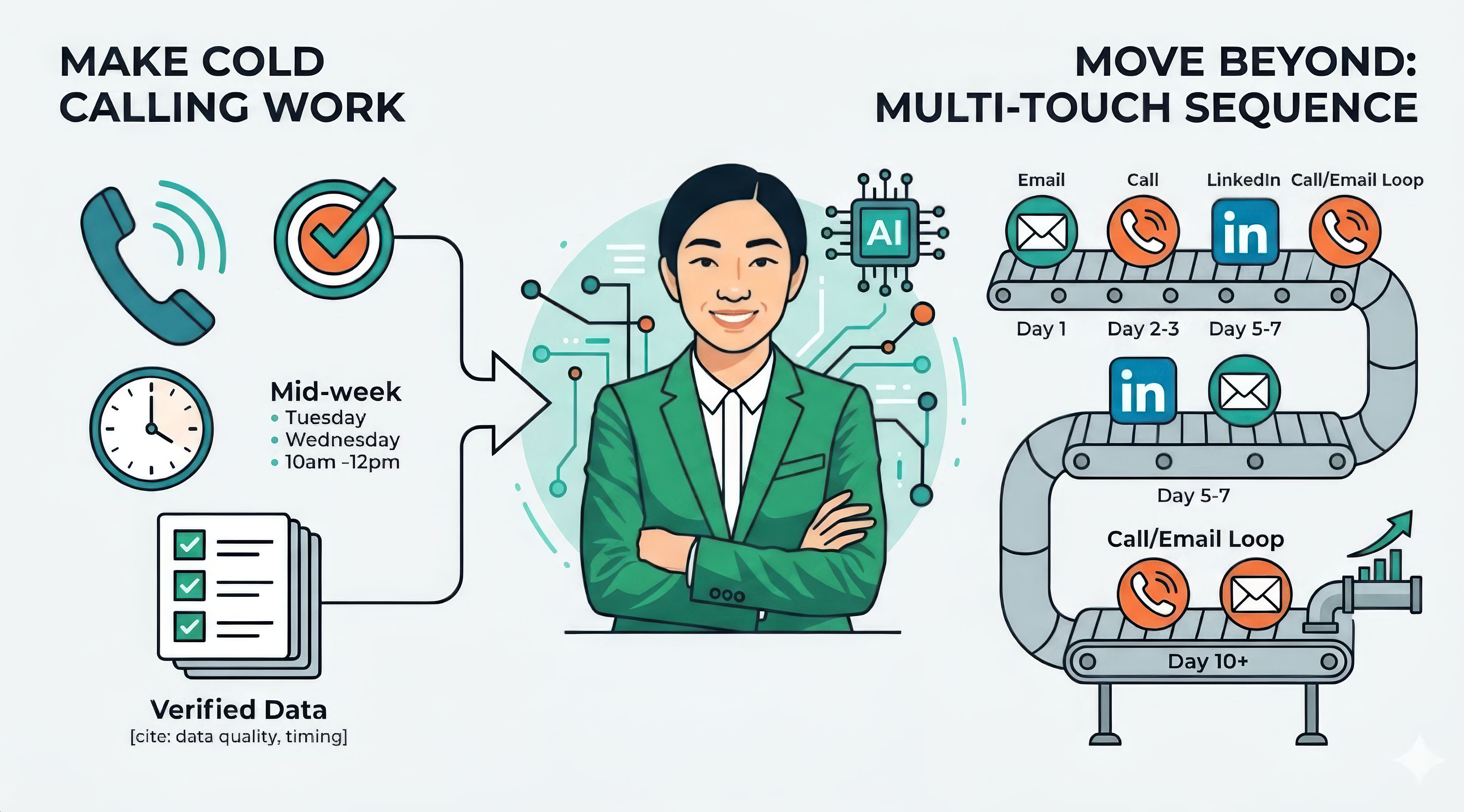
The structure that consistently books meetings isn't a cold call in isolation. It's a sequence, and the specific elements of that sequence determine whether the call lands or gets cut off in the first ten seconds. A strong cold calling sales motion runs over two to three weeks:
Tuesday and Wednesday are the highest-performing cold calling days, cited by 30% and 27% of sales professionals respectively, and late morning — 10am to 12pm — is the most productive window for 38% of salespeople. Shifting dial activity into these windows moves connect rates by several percentage points without changing the list, the script, or the rep.
Within the call itself, the opening 30 seconds determine most outcomes. Referencing something specific and recent about the prospect's company, a hiring move, a new market they're entering, a challenge visible from public information, signals that the call was prepared for this person rather than dialed from a queue. 55% of successful cold callers identify a research-driven approach as their most effective technique, which means the prep work before the call produces as much of the outcome as anything said during it.
Reps who exit a cadence at three to five touches hand back pipeline to competitors willing to persist. The volume of meetings booked by high-performing teams correlates directly with cadence length, not dial speed.
Even a well-executed cold calling motion has a ceiling. Most B2B sales teams hit it before they identify the cause. Nearly half of sales reps say they lack sufficient bandwidth for adequate cold outreach, despite spending close to a full day per week on prospecting. The time that should go toward conversations is consumed by list research, contact verification, pre-call preparation, and activity logging. The result is a team that's active but not productive at the thing that fills pipeline.
The symptoms of a capacity ceiling are specific:
When these symptoms appear together, the problem has shifted from execution to infrastructure. Better scripts and longer hours don't resolve a capacity constraint. The relevant question becomes whether the team is structured to find, research, and engage the right contacts at the right time, consistently, at a volume that matches the pipeline target.
The most significant change in B2B cold calling lead generation over the past two years isn't in how calls are run. It's in what gets done before them.
AI for sales prospecting now handles the research and targeting work that used to consume SDR hours: identifying companies showing buying signals, building prospect profiles, surfacing trigger events, and drafting personalized openers grounded in real account intelligence. Reps who previously spent two to three hours preparing to make calls now spend that time making them.
Top-performing sellers are 1.7x more likely to use AI agents for prospecting outreach than underperformers; a gap that reflects how much of the pipeline difference between teams comes from targeting quality rather than call volume.
Intent-led targeting compounds the effect further:
Calling into this subset produces materially higher connect and conversion rates because the targeting does the qualification work before the rep picks up the phone.
The capacity problem above, reps spending their prospecting hours on research instead of conversations, is what Lilian is built to absorb. Lilian is Vector Agents' AI sales development representative. She runs the full outbound prospecting motion autonomously:
What that frees the sales team to do is specific. Reps show up to conversations with pre-qualified, pre-researched prospects rather than dialing into a list they built themselves from four separate tabs. The calls become the primary activity, not the reward for clearing the prep work.
For teams evaluating B2B cold calling companies and outsourced services as a way to scale outbound, Lilian represents a different model. Rather than adding headcount or outsourcing calls, she automates the research and targeting infrastructure that determines whether those calls produce pipeline in the first place.
B2B cold calling works when the infrastructure behind it is sound: verified data, mid-week timing, structured multi-touch cadences, and enough follow-through to reach prospects who are genuinely reachable. It stalls when reps spend more time on the work that precedes the call than on the call itself, because the capacity to research, target, and reach the right people at the right volume runs out before the pipeline target is met.
The teams consistently booking meetings have separated the work of finding and preparing from the work of calling and closing, and structured their outbound motion so each function feeds the other rather than competing for the same rep hours.
If your team's prospecting hours are going toward research and list-building rather than conversations, book a demo to see how Lilian takes on that groundwork so your reps can focus on the calls that generate pipeline.
The average B2B cold calling success rate is 2–3% across most sales teams. Top-performing outbound teams reach 6–10% through better contact data, structured multi-touch sequences, and personalized openers grounded in account research. Increasing dial volume without improving data quality and sequencing does not improve the rate.
The best time to cold call B2B prospects is late morning, between 10am and 12pm, on a Tuesday or Wednesday. Mid-week avoids the catch-up mode of Monday and the wind-down of Friday. Late morning reaches decision-makers before lunch without competing with the heaviest part of their morning workload.
Most reps stop at three to five attempts. High-performing teams run structured cadences of eight to twelve touches spread across calls, emails, and LinkedIn over two to three weeks. Exiting the cadence early is one of the most consistent reasons reachable pipeline goes unworked and dial activity doesn't convert into meetings booked.
B2B cold calling services make sense when the internal team lacks bandwidth to prospect and call simultaneously, or when the bottleneck is in finding and targeting the right contacts rather than running the conversations themselves. Outsourcing the call without fixing the underlying targeting and data quality problem rarely produces sustained pipeline improvement.
Cold calling for B2B sales refers specifically to phone-initiated contact with no prior relationship. Cold outreach is broader; it includes email, LinkedIn messages, and direct mail. The most effective outbound programs use cold calling as one touchpoint inside a multi-channel sequence rather than as a standalone activity, because single-channel outreach consistently underperforms coordinated multi-touch cadences.
Cold calling B2B lead generation targets structured buying decisions evaluated by multiple stakeholders against measurable business outcomes. The measure of a successful B2B cold call is a booked meeting with the right decision-maker — a CRO, Head of Sales, or Founder — not a closed sale. The sales cycle, the persona, and the qualification criteria are all different from B2C, which means the scripts, the timing, and the follow-up motion need to reflect that.

.svg)


.svg)
Vector AI All rights reserved. © 2025


.jpeg)