
Europe Expansion
Vector Agents Enters Europe. Announcing Our Regional Leadership.

Europe Expansion
Vector Agents Enters Europe. Announcing Our Regional Leadership.


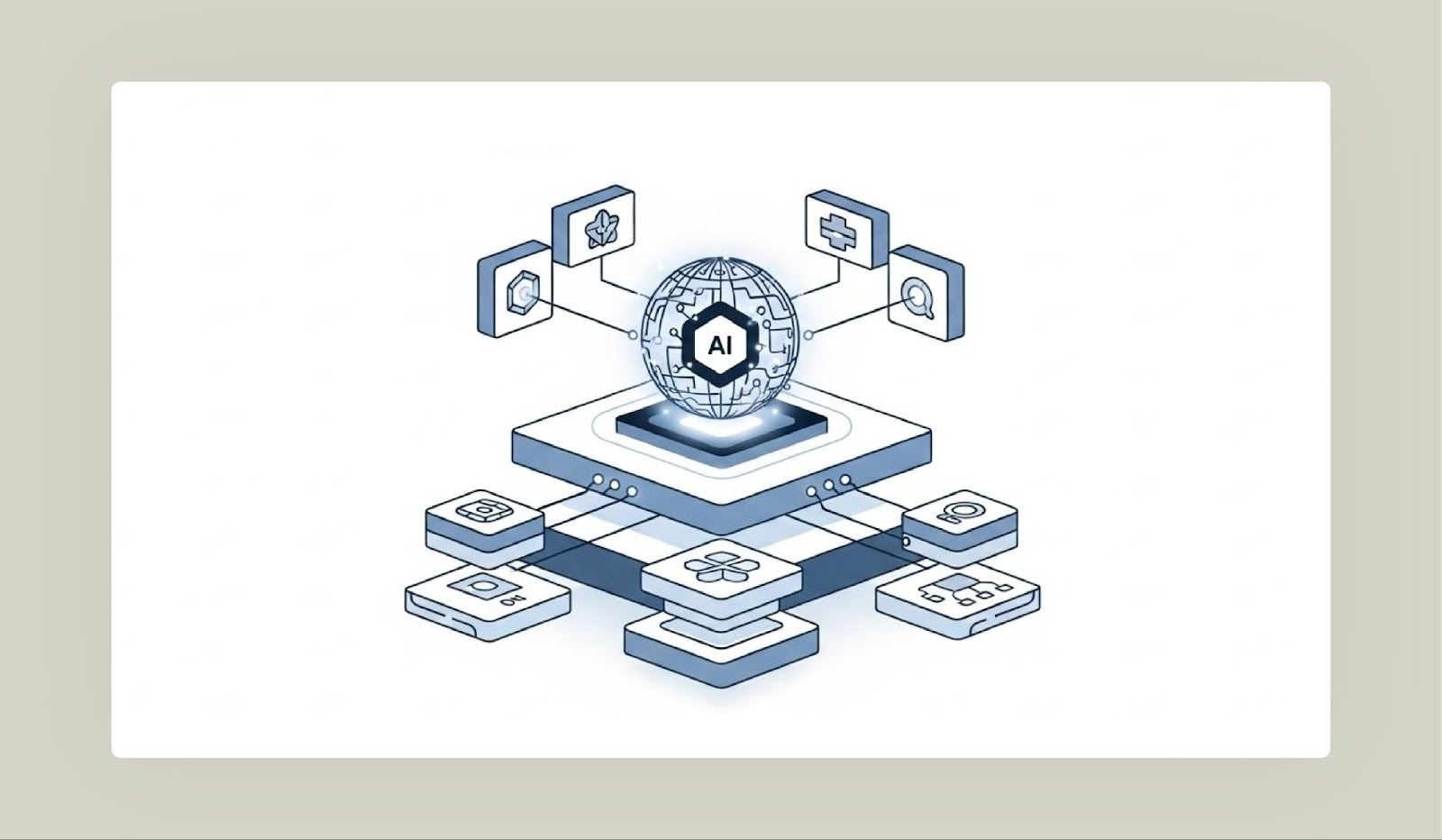
Sales reps spend just 28% of their time actually selling; the rest goes to deal management, data entry, and moving information between systems that don't talk to each other. Most roundups of best sales automation tools list the same eight or nine names and rank them by feature count. The question that actually changes an outcome is different: what does each tool automate, and what still lands back on a rep to move forward.
This list breaks down what the leading AI sales automation tools do, what they don't, and where a single system replaces the whole stack instead of adding one more piece to it. The quick-reference table below is followed by a fuller look at each tool, including database size, integrations, and reported results where the vendor publishes them.
Every tool in this category claims to save time. The criteria below decide whether it actually does, or just shifts the manual work somewhere else.
Sellers close deals using an average of 8 different tools, which is exactly why these four criteria matter more than any single feature. Every tool below gets evaluated against them.
The eight tools below cover the categories most B2B sales automation buyers compare: prospecting, sequencing, conversation intelligence, and forecasting, plus one system built to run all of it as a single motion.
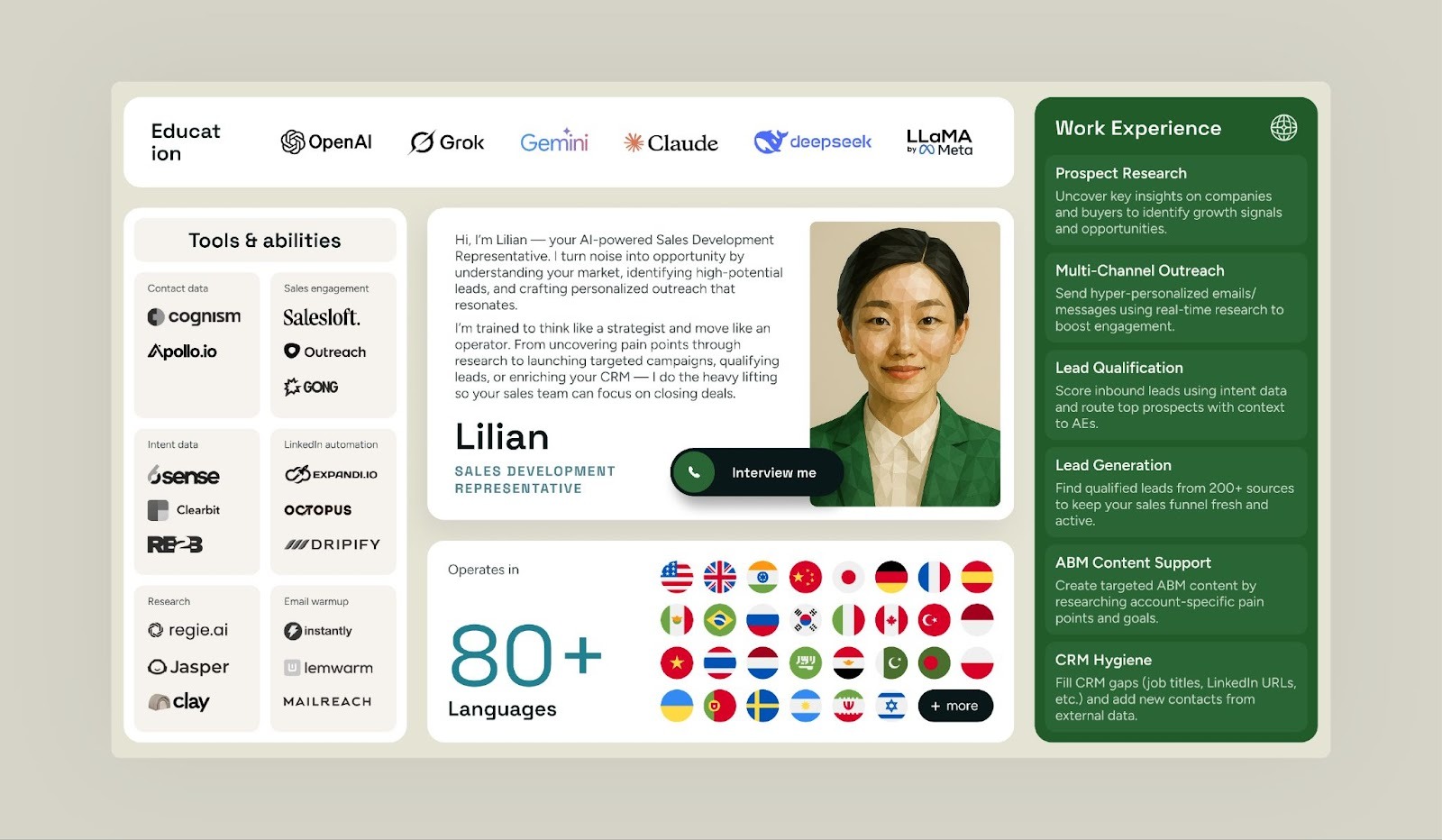
Lilian runs prospecting, enrichment, sequencing, personalized outreach, and meeting booking as one continuous process instead of four separate tools a rep has to operate in sequence. It draws leads from a multitude of sources, researches each prospect for pain points and growth signals before the first message goes out, and writes hyper-personalized outreach based on that research rather than a static template.
The system also revives dormant leads through reengagement campaigns, keeps CRM records clean by filling data gaps automatically, and supports account-based marketing with targeted content for named accounts.
Best for: teams trying to hit a higher pipeline target without adding an SDR for every stage of the motion.
What still needs a rep: strategy, ICP definition, and deal negotiation once a meeting is booked.
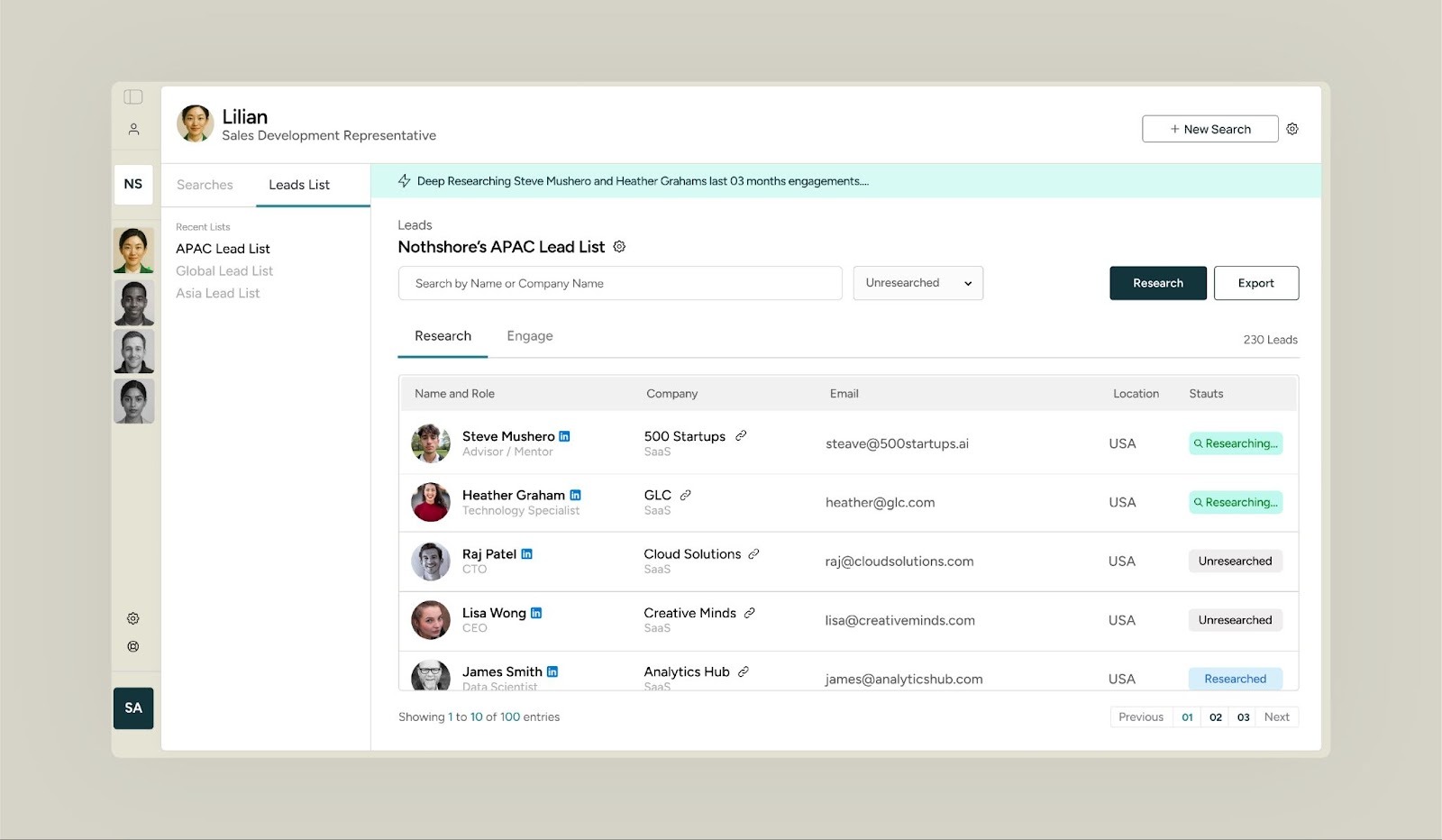
Apollo holds one of the largest B2B data networks on the market, with more than 240 million verified contacts and 30 million company profiles. Beyond the database, it runs AI-powered multichannel outbound campaigns, deliverability guardrails, and prioritized task lists, plus inbound tools for anonymous visitor identification and real-time form enrichment.
On the deal-execution side, Apollo generates pre-meeting prep notes and AI call summaries and maintains pipeline boards for coaching. It holds GDPR, SOC 2, CCPA, ISO/IEC 27001, and PCI DSS certifications.
Best for: teams that need a broad, searchable contact database as the first step in their motion.
What still needs a rep: moving the list into a sequencer, prioritizing outreach order, and running the actual outreach.
ZoomInfo covers similar ground to Apollo, contact data and intent signals, at greater depth: 420 million-plus global contacts, 145 million-plus companies, and 120 million-plus direct-dial numbers, searchable across more than 300 filterable attributes including technology stack and funding data. Its Chorus product adds conversation intelligence across calls, meetings, and email.
Best for: teams prioritizing data depth and account-level intent tracking over outreach execution.
What still needs a rep: sequencing, personalization, and conversation tracking once contacts are identified.
Saleshandy pairs a lead database of 852 million-plus contacts across 42 million-plus companies, filterable by more than 50 buying signals, with sequencing across email, calls, LinkedIn, WhatsApp, and custom tasks in a single campaign. Domain and mailbox setup, including SPF, DKIM, and DMARC records, is automated in under 10 minutes.
Its deliverability suite handles automatic warmup, domain health monitoring, and spam testing, reporting 99.4% inbox placement and a 0.02% spam rate across customer sends. A unified inbox centralizes replies across multiple sending accounts alongside basic pipeline tracking.
Best for: teams running high-volume email outreach who need sequence automation without a large platform commitment.
What still needs a rep: sourcing the leads that go into the sequence and handling calls or forecasting separately.
Outreach extends sequencing across email and calls with AI agents that handle sequencing and administrative work so reps can focus on live conversations. Its forecasting layer delivers real-time revenue projections, and its pipeline management tools flag stalled deals and risk indicators drawn from buyer sentiment signals.
The platform also provides live conversation guidance, including AI-generated battle cards and objection handling during calls.
Best for: teams running coordinated multichannel cadences across a larger rep team.
What still needs a rep: lead sourcing and conversation analysis, which sit outside the sequencing layer.
Gong records and analyzes sales calls for sentiment and deal-risk signals through a set of connected products: Gong Engage for personalized outreach, Gong Forecast for revenue projection, Gong Enable for rep coaching, and Gong Agents for automating follow-ups and pipeline updates. Its Revenue Graph connects customer interactions across the business, and its Collective ecosystem includes more than 400 integrations.
Best for: teams that want visibility into what's actually being said on calls across the team.
What still needs a rep: acting on the insight. The tool flags the risk; a person still has to follow up on it.
Fireflies transcribes and summarizes meetings automatically, reporting 95% transcription accuracy across more than 100 languages, captured via an AI bot, browser extension, mobile app, desktop app, or dialer integration. Its AskFred feature answers questions across a team's full meeting history, and more than 200 industry-specific AI skills extend the product into sales, recruiting, and other functions.
The platform carries SOC 2 Type II, GDPR, and HIPAA compliance, offers zero data retention for non-training use, and integrates with Salesforce, HubSpot, Slack, and Asana, alongside API access for custom workflows.
Best for: teams that want fast, low-effort meeting documentation without a full conversation-intelligence platform.
What still needs a rep: everything after the summary, follow-up execution and lead qualification included.
Einstein applies predictive scoring to pipeline data inside Sales Cloud, surfacing the factors and trends behind a forecast rather than just a number, and scoring open opportunities on the positives and negatives affecting their likelihood to close. One-click deal summaries remove manual prep work before pipeline reviews.
Salesforce cites a customer-reported 14% improvement in win rate from combining opportunity scoring with its forecasting tools, though results are drawn from individual case studies rather than an aggregate benchmark.
Best for: teams already on Salesforce that want predictive scoring layered onto existing pipeline data.
What still needs a rep: prospecting, outreach, and conversation handling, none of which the forecasting layer touches.
Inbound leads that hit a form or place a missed call outside business hours sit until someone follows up the next morning. Every hour that gap stays open, the odds of a response drop, because the prospect is often evaluating other options in the same window.
Lilian, functioning as an AI receptionist, answers inbound queries, qualifies the lead against a team's criteria, and books the meeting directly, including outside business hours. The gap between a prospect reaching out and a qualified response closes to minutes instead of the next business day, which is the difference between a lead that converts and one that's already talked to a competitor by the time someone calls back.

The question worth asking before adding another line item to a sales automation software budget isn't whether the tool does its job well. It's whether the team still has to do the job of connecting it to everything else. A stack that automates every stage individually can still leave a rep spending more time operating the stack than selling through it.
If the bottleneck is coordination between stages rather than any single stage itself, the fix isn't a ninth tool.
Book a demo to see how Lilian runs prospecting, outreach, and meeting booking as one motion instead of a stack a rep has to operate by hand, and evaluate it against the best sales automation tools listed above.
A sales automation tool automates one stage of the sales cycle, like sending emails or enriching contact data, and still requires a person to move the output into the next step. An AI sales agent runs multiple stages as one continuous process, from identifying a lead through booking a meeting, without manual handoffs between systems.
Point tools alone don't replace an SDR; they automate parts of what an SDR does while the SDR still connects the pieces. A system that runs prospecting, outreach, and meeting booking as one motion removes more of that connecting work, which changes how much SDR capacity a team needs to add as pipeline targets grow.
There's no fixed number that works for every team. The better question is whether each additional tool reduces manual handoffs or adds a new one. A smaller stack where tools pass work to each other automatically outperforms a larger stack where a rep manually bridges every gap.
Automation works best on a process that already exists and is repeatable. Teams still defining their ICP, messaging, or qualification criteria typically get more value from testing that process manually first, then automating the version that's already working.
Results depend on how much of the current motion runs through manual handoffs today. Teams with the most fragmented stacks, where a rep manually moves leads between four or more systems, tend to see the fastest change, because consolidation removes the largest share of coordination work first.

.svg)


.svg)
Vector AI All rights reserved. © 2025


.jpeg)