
Europe Expansion
Vector Agents Enters Europe. Announcing Our Regional Leadership.

Europe Expansion
Vector Agents Enters Europe. Announcing Our Regional Leadership.


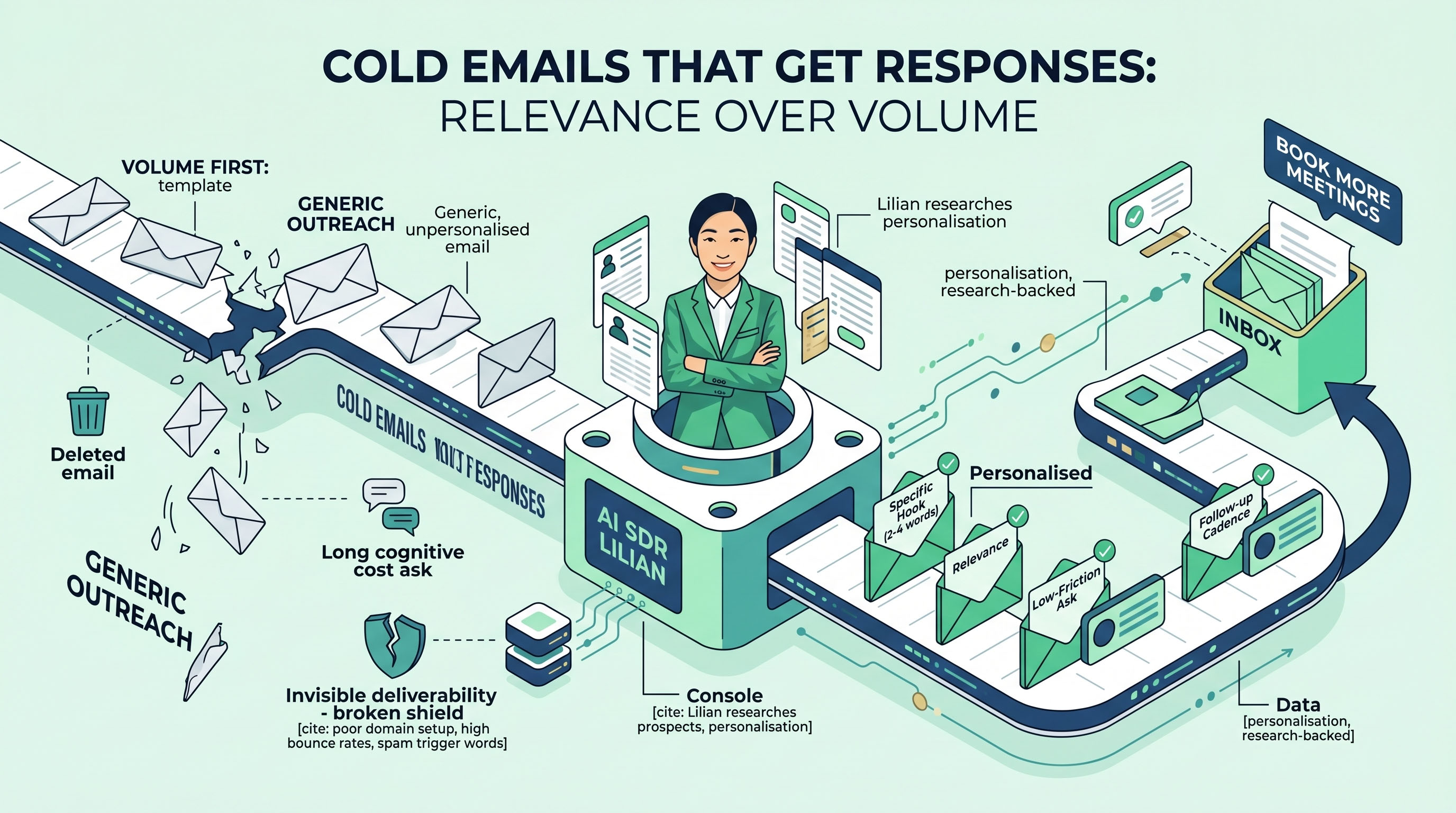
Inboxes are more crowded than they've ever been, spam filters are smarter, and prospects have become expert at identifying templated outreach in under two seconds. The volume-first playbook is dead. Cold emails that get responses are written by people who send better.
This guide covers the structural elements that determine whether a cold email gets a reply: targeting, subject lines, opening lines, body copy, CTAs, personalisation, deliverability, and follow-up cadence. Each one matters. Each one compounds. And each one can independently kill your reply rate if it's wrong.
Understanding why cold email fails is the fastest way to fix it. Low reply rates aren't random — they have specific, traceable causes.
The three root causes are poor targeting, generic messaging, and invisible deliverability failures.
Low reply rates are a symptom, not a cause. Each of the sections below addresses a specific piece of the problem.
The structure of a cold sales email is not arbitrary. Each element has one job, and when any element fails to do that job, the email dies at that point.
The subject line's only job is to get the email opened. It doesn't sell. It doesn't explain. It earns the open, nothing more.
Research across 5.5 million B2B emails found that personalised subject lines achieve a 46% open rate compared to 35% for generic ones, with reply rates more than doubling from 3% to 7%. Subject lines of 2–4 words hit the highest open rates. Lines of 9–10 words drop to 34–35%.
Questions outperform statements because they suggest the email contains an answer worth reading. Subject lines framed as questions create curiosity and signal genuine intent.
What kills subject line performance:
The goal is simple: look like a message from someone who has done their homework.
If the subject line gets the email opened, the opening line determines whether it gets read. Most cold emails lose the reader in the first sentence.
The opening line should be about the prospect, not the sender. A specific, researched observation — a recent company announcement, an active hiring push, a published piece of content, or a challenge relevant to their industry — creates an immediate moment of recognition. It tells the prospect this email was written for them, not for a segment they happen to belong to.
What kills the opening immediately: "I hope this finds you well," a self-introduction, or leading with the company name. These signal that the sender has nothing specific to say.
Once the email is open and the reader is engaged, the body and CTA determine whether a reply happens. These two elements are where cold contact email campaigns most commonly break down.
Short is better. Cold emails perform best at 50–125 words — one to two paragraphs is enough. The body makes one clear connection between something observable about the prospect's situation and the value on offer.
No feature lists. No company history. No lengthy explanations. Relevance does the work, not volume of information. The pitch should be implied by context, not stated directly. A prospect who understands why your email is relevant to their specific situation will reply. A prospect who has just read a product brochure will not.
The CTA is the most misunderstood element of a cold email. Most senders ask for too much.
A cold prospect doesn't know you. Asking for a 30-minute demo call in the first email creates a cognitive cost that most prospects aren't willing to pay. The CTA should feel like a natural next step, not a close.
Start a conversation (lowest friction)
Offer something without asking for anything
Suggest a next step without locking in a time
Soft close for later in the sequence
Passive CTAs — "Let me know if you're interested," "feel free to reach out" — require the prospect to do all the work. They consistently underperform. One question. One clear next step. That's the CTA.
Personalisation is the single biggest lever in cold emails that get responses, but most teams are doing it wrong. Dropping a first name into a template isn't personalisation; it's a merge tag, and prospects have learned to ignore it.
The data on subject line personalisation makes the difference clear: referencing the prospect's company name, a recent initiative, or a specific pain point is what drives the reply rate jump from 3% to 7%. Name tokens alone don't move the needle.
The practical framework: spend three to five minutes per prospect finding one genuine hook — one observable, specific detail that couldn't apply to anyone else in that role. Use it in the subject line and the opening line.
The test: if the email could be sent to anyone with the same job title without changing a word, it isn't personalised. Start over.
A well-written email that lands in spam achieves nothing. Deliverability is the infrastructure layer beneath every cold outreach campaign, and most people ignore it until something breaks.
The fundamentals aren't optional:
Domain reputation is cumulative. Damage from one poorly managed campaign affects every campaign that follows. Getting the infrastructure right before sending is not a technical detail — it's what makes everything else work.
Doing all of the above manually; the research, personalisation, sequencing, follow-ups, and deliverability management, is what consumes a sales rep's day and limits how much quality outreach actually gets sent.
Vector Agents' digital worker Lilian handles outbound prospecting end to end. She researches prospects across multiple sources, writes personalised outreach based on real-time data, manages follow-up sequencing, and qualifies leads, so the sales team picks up at the conversation, not the cold email.
Because Lilian's approach is precision-driven rather than volume-driven: fewer emails, better targeting, research-backed personalisation, it protects deliverability rather than burning it. That's the difference between an outbound function that compounds over time and one that burns its own domain.
Most of the replies that come from cold outreach don't come from the first email. The follow-up is where a significant share of the work gets done, and most people either skip it entirely or do it badly.
The practical cadence: two to three emails in total, spaced two to four days apart. Each follow-up must add a new angle or piece of value. Sending the same email twice with a different subject line isn't a follow-up; it's a repeat.
A structure that works:
After three emails, reply rates drop sharply and the risk of spam complaints starts to affect deliverability. "Just checking in" performs as badly as a generic subject line. Every email in the sequence needs to earn its place.
To have cold emails that get responses is a shift in mindset: from volume to relevance. Every element covered in this guide, compounds when done right.
The constraint most teams hit isn't knowledge. It's time. Doing this at the level of research and consistency that drives replies is what burns out salespeople and caps outbound pipeline.
If you want to see what it looks like when an AI digital worker handles your outbound end to end, book a demo with Vector Agents.
A good B2B cold email reply rate is 5–10%. Top-performing campaigns on tightly segmented lists with strong personalisation can reach 15% or higher. Anything consistently below 3% signals a problem with targeting, messaging, or deliverability. Fixing deliverability should be the first step before changing copy or templates.
Cold emails perform best at 50–125 words. One to two short paragraphs is enough. Longer emails reduce reply rates because they ask the prospect to invest time before any trust has been established. Get to the relevant point quickly, make one clear connection, and ask one low-friction question.
The best cold email templates follow a consistent structure: a short, personalised subject line (2–4 words), an opening line that references something specific to the prospect, a one to two paragraph body that connects their situation to your value, and a single low-friction CTA. Templates are starting points — they only work when personalised with real, researched details.
Send two to three emails in total, spaced two to four days apart. The first follow-up generates the highest return. After three emails, reply rates drop sharply and spam complaint risk rises. Each follow-up should introduce a new angle — never repeat the first email or write "just checking in."
Spend three to five minutes per prospect finding one specific, observable hook: a recent funding round, active SDR hiring, a piece of content they published, or a company expansion. That single relevant detail — used in the subject line and opening line — is enough to differentiate the email from generic outreach.
Yes, but not manually. AI-powered outbound tools can research prospects, generate personalised outreach, and manage follow-up sequences at scale — without the volume-over-relevance approach that burns domain reputation. The teams getting the best results are sending fewer, more targeted emails using AI to handle the research and execution layer.

.svg)


.svg)
Vector AI All rights reserved. © 2025


.jpeg)