
Europe Expansion
Vector Agents Enters Europe. Announcing Our Regional Leadership.

Europe Expansion
Vector Agents Enters Europe. Announcing Our Regional Leadership.


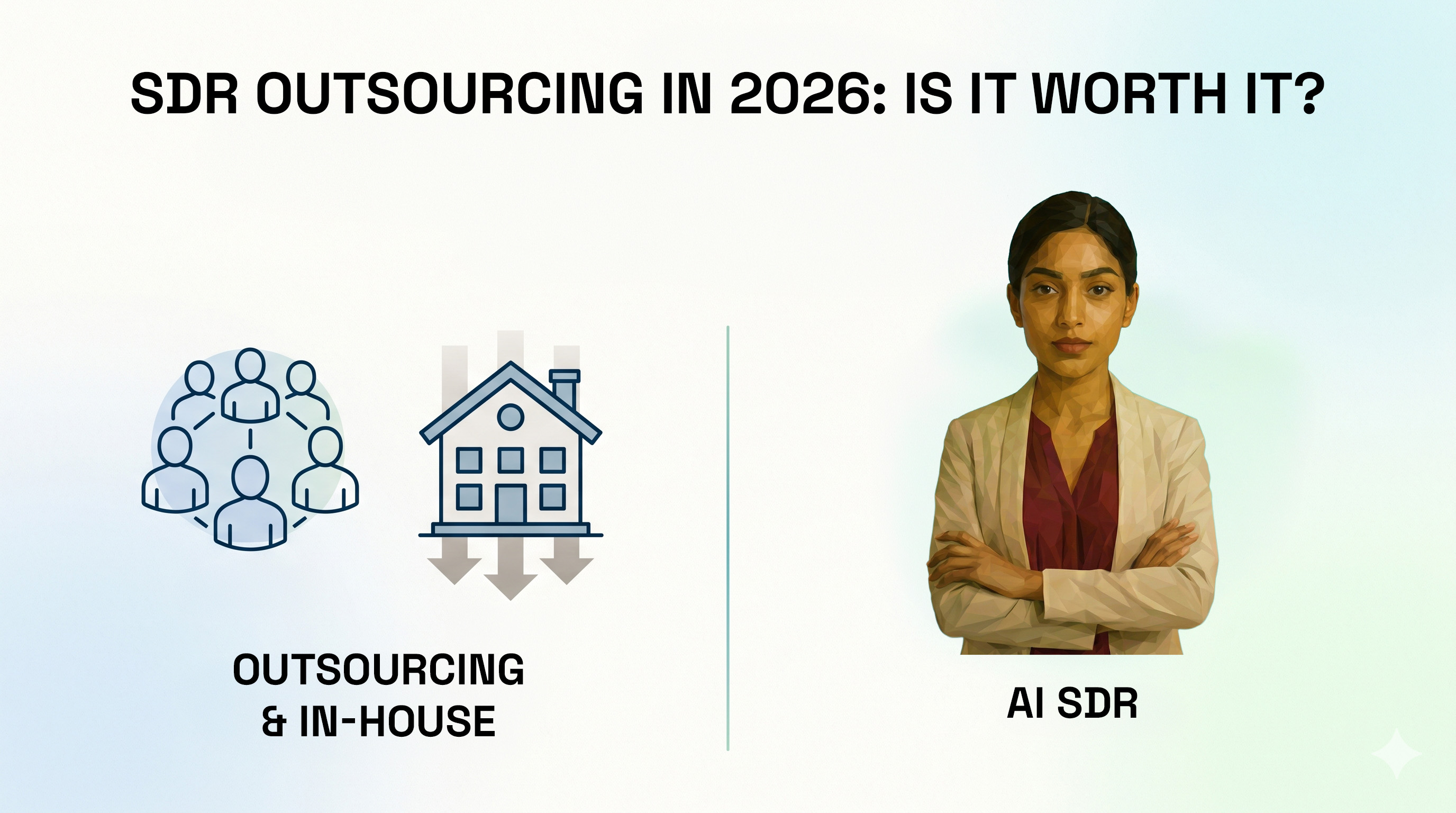
Building an in-house SDR team has always been expensive.
In 2026, it's also slow, structurally prone to churn, and harder to justify on a tight growth budget.
SDR outsourcing is the most commonly reached-for solution, but it's not a simple fix.
This article breaks down what outsourcing actually involves, what the pricing models look like, where programs fail, and why a third option, the AI SDR, has changed the economics of the decision entirely.
By the end, you'll have a clear framework for deciding which path makes sense for where your pipeline is right now.
SDR outsourcing means contracting an external provider to handle top-of-funnel sales development on behalf of your internal team. The provider manages prospecting, outreach, lead qualification, and meeting booking. Your Account Executives pick up at the conversation.
The key structural difference from an in-house SDR is that outsourced reps typically split their time across multiple client accounts. Some work within offshore agencies; others are part of specialist outbound firms operating in your target market.
Modern outsourced sales development is not telemarketing. It's multi-channel, outcome-driven, and measured on qualified meetings and pipeline created, not call volume. There are three structural models to know:
Understanding which model you're buying is the first filter. Each comes with a different cost structure, management requirement, and risk profile, and they're not interchangeable depending on your stage.
Before evaluating any external option, you need an accurate picture of what in-house actually costs. Most teams underestimate it significantly.
The median total pay for a Sales Development Representative in the United States is $102,000 per year. Base pay alone ranges from $53K to $72K, with commission and bonuses adding $30K to $57K on top. That's what the role costs before the employer adds benefits, tools, recruiting overhead, or management time.
According to the U.S. Bureau of Labor Statistics, benefits account for an additional 29.5% of total employer costs for private industry workers. Applied to an SDR's compensation, that adds roughly $30,000 or more per year before a single dollar of recruiting, tooling, or management time is counted.
Then there's the replacement cycle. Many employers estimate the total cost to hire a new employee at three to four times the position's salary, once recruiting, onboarding, and ramp time are included. For SDRs, where the role is entry-level, and churn is structurally high, that cycle doesn't happen once. It repeats.
Every departure triggers the same sequence: recruiting fees, onboarding time, tool provisioning, manager bandwidth, and a gap in the pipeline while the territory sits vacant. These costs reset with every replacement.
The comparison most teams make when evaluating outsourced sales staff is the outsourcing fee against the SDR's base salary. That's the wrong number. The right comparison is the outsourcing fee against the total employer cost: salary, benefits, tools, recruiting overhead, and the cost of churn. When you run that calculation, the gap between in-house and outsourced sales development narrows considerably, or disappears.
Knowing the cost case for outsourcing is one thing. Understanding what you're actually buying is another. A well-run outsourced sales development program follows a defined workflow. Each step builds on the last, and skipping any of them is where programs start to break down.
The quality of execution across all of these steps, not just the volume of emails sent, is what separates programs that build real pipeline from those that burn budget.
The model works in some scenarios and fails clearly in others. Knowing the difference before you commit saves a lot of expensive course correction. SDR outsourcing fits well in these situations:
It fits poorly in these situations:
The common thread in the failure scenarios is the same: the problem wasn't the outsourcing model, it was the absence of the inputs the model depends on.
Even with the right scenario fit, programs fail regularly. The failure modes are well-documented and almost entirely avoidable.
The fix for almost all of these is front-loaded: a precise ICP, clean data, a connected CRM, and a governance structure before the first email is sent.
The decision facing most B2B companies in 2026 isn't binary. There are now three structurally different options, each with its own cost profile, speed-to-pipeline, and operational requirements.
50% of executives are now using outsourced services for front-office functions including sales, and 83% are integrating AI into their outsourced services. The landscape has shifted. Here's how the three options compare:
Option 1: In-house SDR team
Option 2: Outsourced SDR agency
Option 3: AI SDR
For many B2B SaaS companies at the 50 to 500 employee stage, the practical answer is a combination: AI handling high-volume prospecting and CRM enrichment, and human resources focused on the conversations that require judgment and relationship-building. The decision isn't about which option is best in the abstract. It's about which fits the company's current stage, ICP clarity, and pipeline urgency.
For companies evaluating the AI SDR option, Vector Agents offers Lilian: an AI-powered sales agent built specifically for sales development.
Lilian handles outbound prospecting end-to-end. She researches prospects, crafts personalized outreach, qualifies inbound leads, enriches CRM records, and books meetings directly into AE calendars. Your sales team picks up at the conversation.
The benefits over traditional outsourced sales development are hard to argue with. No ramp period. No attrition. No management overhead. No retainer built on reps splitting attention across multiple client accounts. Just a dedicated, research-driven outbound function that runs continuously and gets sharper over time.
The clearest buying signal is a live job posting for an SDR or BDR. If you're hiring for pipeline generation, Lilian can be operational before a new hire clears their first week of onboarding, at a fraction of the fully loaded cost.
Vector Agents builds digital workers designed to work alongside your team, not replace it. Lilian absorbs the prospecting work that consumes SDR hours so your sales team can focus on what they're actually hired to do: have conversations, build relationships, and close deals.
The companies still cycling through in-house hires and agency engagements are solving a pipeline problem with the same tools that created it. The structural issues, ramp time, attrition, and cost, don't disappear by switching agencies or hiring faster. They're built into the model.
In 2026, the outsourced sales development decision has a third path that didn't exist at scale before. AI SDRs have eliminated the ramp-time and attrition arguments that made agency outsourcing the compromise choice for companies that couldn't justify full in-house headcount.
The right answer still depends on where the company is. Testing a new market, scaling after a funding round, and rebuilding an underperforming outbound motion each call for a different approach. But the economics have changed, and any honest evaluation of SDR outsourcing in 2026 needs to include the AI option in the comparison.
If you want to see how Lilian handles your outbound prospecting end to end, from research to booked meetings, try Lilian today!
What is SDR outsourcing?
SDR outsourcing means contracting an external provider to manage your sales development function, including prospect research, outbound outreach, lead qualification, and meeting booking, on behalf of your internal team. Instead of hiring and managing reps in-house, you work with a specialist partner that supplies the people, processes, and technology to generate pipeline consistently.
How much does outsourced SDR pricing typically cost?
Outsourcing pricing for SDR services typically runs on monthly retainers, ranging from a few thousand to over $10,000 per month depending on ICP complexity, channel mix, and whether the provider guarantees a meeting volume. The correct comparison is against the fully loaded annual in-house SDR cost, which ranges from $140,000 to $150,000 when salary, benefits, tools, recruiting, and management are included.
What's the difference between outsourced SDRs and an AI SDR?
Outsourced SDRs are human reps provided by an external agency who handle prospecting and outreach across multiple client accounts. An AI SDR is an autonomous platform that performs the same tasks without a human rep, with no ramp time, no attrition, and continuous operation. AI SDRs currently lack live cold calling capability but handle high-volume personalized email and LinkedIn outreach effectively.
When does it make sense to outsource your SDR function?
SDR outsourcing works best when a company needs pipeline quickly without the time or budget to build internally: after a funding round, when entering a new market, during a hiring freeze, or when scaling faster than internal hiring can keep pace. It performs poorly when the company lacks a clear ICP or hasn't yet validated its outbound message.
Why do outsourced SDR programs fail?
Most outsourced sales development programs fail because of a vague ICP, poor data hygiene that damages sending domains, no CRM integration, and absent feedback loops between AEs and the provider. Signing a large contract before proving a repeatable outbound message is also a common cause. These are setup failures, not inherent flaws in the outsourcing model itself.
What KPIs should I track for an outsourced SDR program?
The primary KPIs are accepted meetings, held meeting rate, SQL conversion rate, and pipeline created. Activity metrics like emails sent are secondary. Held meeting rate should target 70 to 85%, and SQL rate from held meetings should reach 35 to 60% when ICP alignment is strong. Track these weekly, not monthly.
Is an AI SDR a viable alternative to an outsourced SDR agency in 2026?
Yes. An AI SDR is a commercially viable alternative for companies whose outbound motion is primarily email and LinkedIn-based. It eliminates ramp time, attrition risk, and management overhead at a fraction of the cost of a human SDR or agency retainer. The trade-off is the absence of live cold calling, which human-led programs still handle more effectively.

.svg)


.svg)
Vector AI All rights reserved. © 2025


.jpeg)