
Europe Expansion
Vector Agents Enters Europe. Announcing Our Regional Leadership.

Europe Expansion
Vector Agents Enters Europe. Announcing Our Regional Leadership.



Most sales leaders set their hiring budget around a single number: the going SDR salary for their market. That number comes from a job board or a recruiter, and it becomes the basis for the entire headcount plan. Base salary is the smallest piece of what a Sales Development Representative seat actually costs. Benefits, ramp time, recruiting, and turnover all sit on top of it, and none of them show up in a salary lookup. Before deciding how many SDR seats to fund, it helps to see the full number, not the headline one.
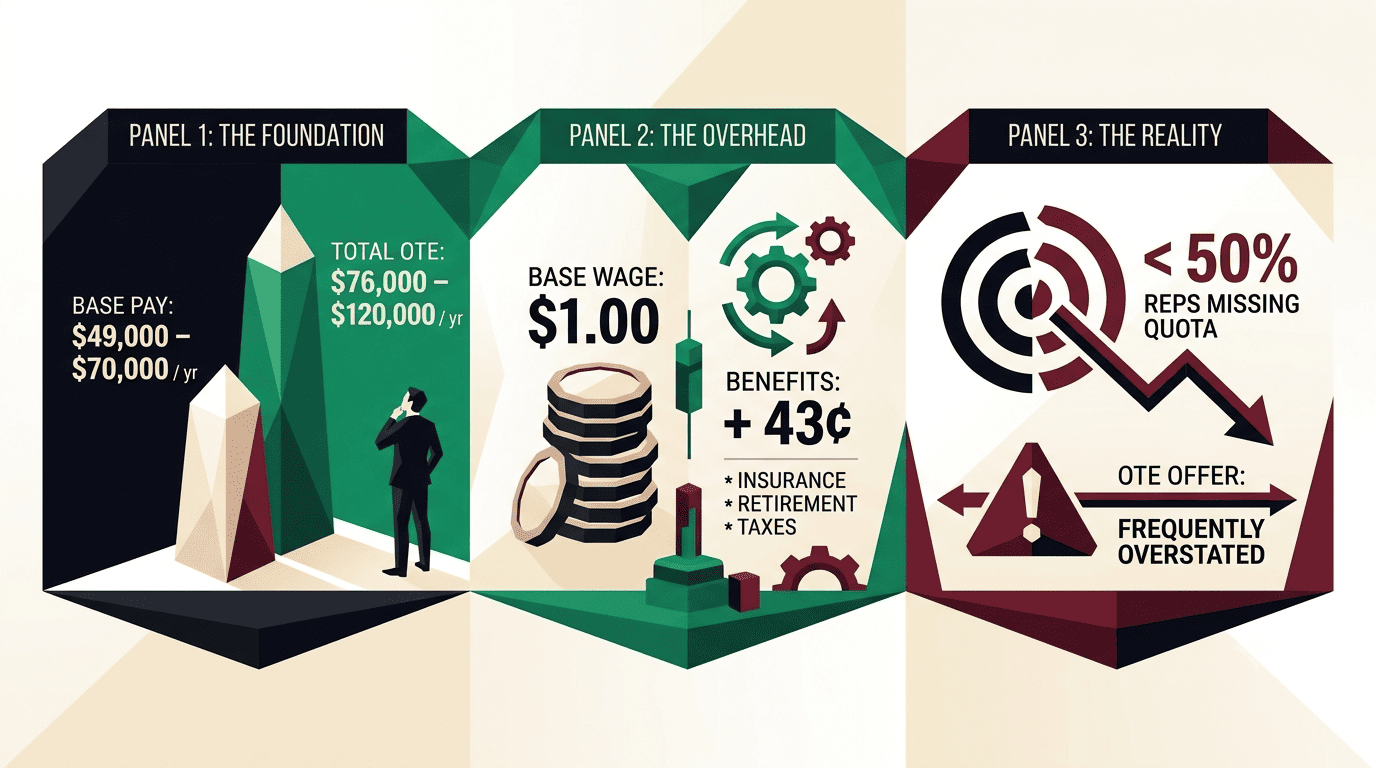
Three figures define what an SDR salary actually means for a hiring budget. Each one changes a different part of the calculation.
Additional considerations include:
These five numbers compound each other. The next section breaks down why.
The SDR salary quoted in a job posting was never built to include any of this. The true cost of an SDR stacks recruiting, ramp time, tooling, and turnover on top of the base figure above, and none of those costs show up in a salary range.
What looked like a single line item in a hiring plan is five cost drivers stacked on top of each other, and only one of them was visible in the original salary range. That stacking is what a different kind of capacity is built to avoid.
Recruiting, ramp, tooling, management time, and turnover all exist because a human seat needs to be filled, trained, and eventually replaced. An AI SDR removes the conditions that create most of that cost, without changing the work itself. None of this changes the SDR salary itself; it changes which costs stack on top of it.
The quota-attainment gap doesn't disappear under this model; it changes who's affected by it. The work that benefits most from this shift is also the work that drives most of the cost: prospecting, research, and outreach at volume. That's the category Lilian operates in.
Lilian is Vector Agents' digital worker for sales prospecting. She takes on the research, outreach, and qualification work that a human SDR seat is hired to do, and she runs it without the ramp period or turnover cycle covered in the sections above.
This isn't a claim that prospecting and outreach make up the entire SDR function. Complex account research, multi-stakeholder deals, and judgment calls about which leads deserve a human conversation still need a person making that call. Lilian is built for the volume-driven, repeatable part of the function, which is also the part most exposed to the ramp and turnover costs described earlier.
The human SDR vs AI SDR decision comes down to which part of the function carries the cost drivers covered above, and which part depends on judgment an AI SDR doesn't replicate.
The right split depends on how much of the current function is repeatable versus relationship-driven, which is worth answering before the next hiring cycle starts.
A single salary figure was never going to capture what a seat costs once benefits, ramp time, recruiting, and turnover are added on top of it. The real SDR salary conversation isn't about what the role pays; it's about what the function costs once every one of those pieces is counted, and how much of that cost repeats every time a seat turns over.
If prospecting and outreach are the part of that cost stacking hardest against your hiring plan, it's worth seeing what changes when that work runs without a ramp period or a turnover cycle. You can book a demo to see how Lilian handles that part of the function directly.
The true cost includes base salary, benefits, recruiting costs to fill the seat, the ramp period where output sits below target, tooling and software tied to the role, and management time spent coaching and reviewing pipeline. Turnover restarts each of these costs, which is why the fully loaded number runs consistently higher than the salary range alone.
No. SDR OTE is base salary plus variable pay calculated at full quota attainment, which represents a target outcome rather than a guaranteed one. Many reps earn less than their OTE figure in a given year, because the variable portion only pays out at the attainment level they actually reach, not the level the offer assumed.
An AI SDR does not fully replace a human SDR for most teams. It handles repeatable, volume-driven work like prospect research, outreach, and follow-up sequencing well, but it doesn't replace the judgment needed for complex, multi-stakeholder accounts or relationship-driven conversations. The repeatable share of the function runs through the AI SDR, while the relationship-driven share stays with a human SDR or AE.
Start with the work that's most repeatable and least dependent on account-specific judgment, typically prospect research, first-touch outreach, and follow-up sequencing. These tasks follow consistent patterns across accounts and are also where new human hires spend much of their ramp period, making them the highest-cost, most automatable share of the function.
Yes. Every additional SDR seat repeats the same recruiting cost, ramp period, and turnover risk as the first one. A team adding several seats multiplies that stacked cost across each hire rather than just adding salary lines, which is why the gap between budgeted salary and actual spend tends to widen as headcount grows.

.svg)


.svg)
Vector AI All rights reserved. © 2025


.jpeg)