
Europe Expansion
Vector Agents Enters Europe. Announcing Our Regional Leadership.

Europe Expansion
Vector Agents Enters Europe. Announcing Our Regional Leadership.


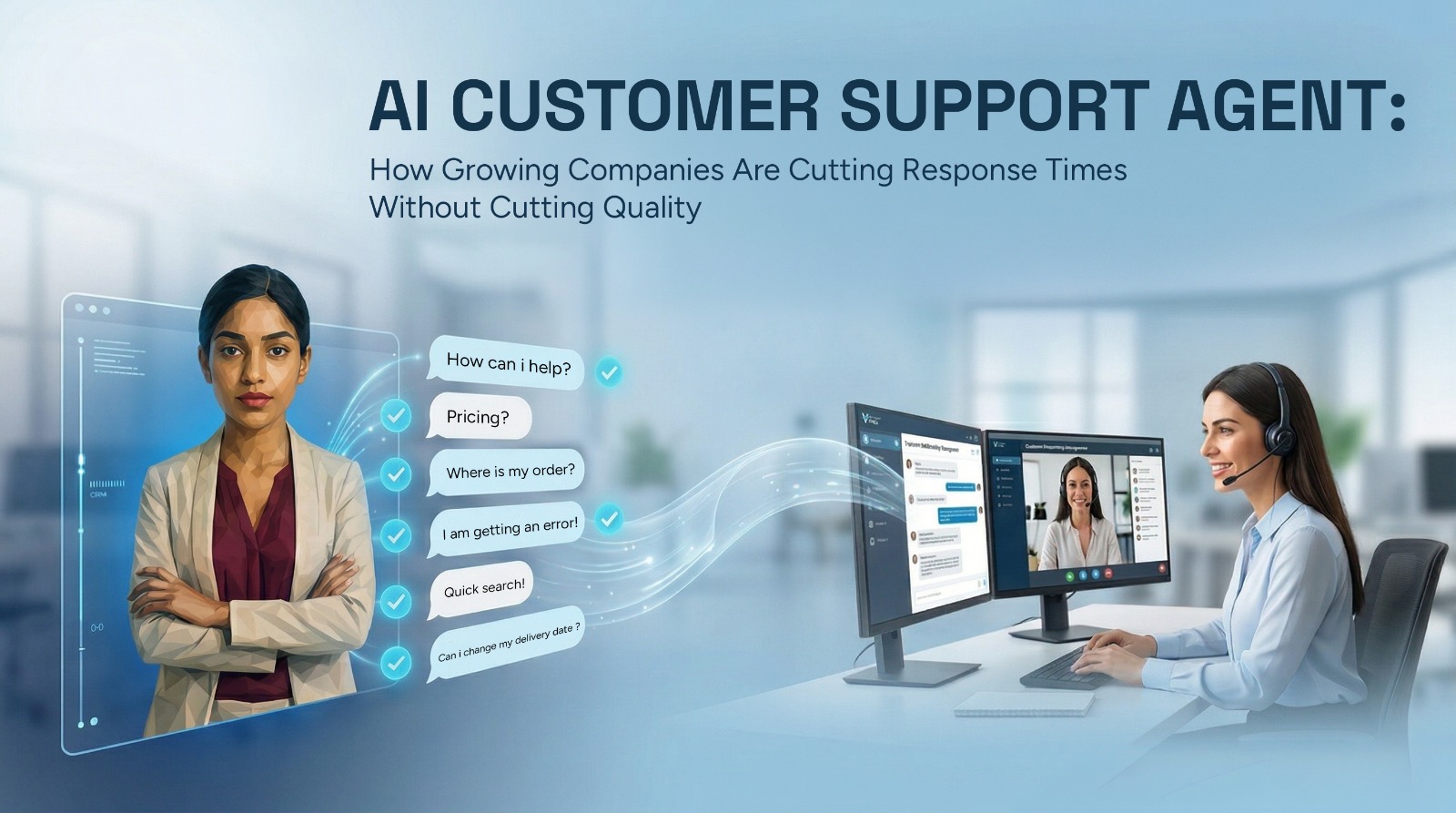
Here’s a problem every scaling company recognizes.
When you’re small, support is personal. Your team knows every customer. Response times are fast because the queue is short. Quality is high because the people answering know the product cold.
Then you grow. Query volume doubles. Then triples. Your support team starts losing the battle with the inbox. Response times creep up. Customer satisfaction scores drift down. You hire more support staff, which works, until it doesn’t, because volume keeps growing faster than headcount.
This is the support scaling problem. And an AI agent for customer support is how the best companies are solving it in 2026.
An AI customer support agent is a digital worker that handles customer queries independently, intelligently, and around the clock.
It’s not a FAQ page dressed up as a chat window. It’s not a decision-tree chatbot that falls over the moment a customer goes off-script. It’s a digital worker that understands what your customer is asking, knows your product and policies inside out, and gives accurate, helpful, human-feeling responses.
When something genuinely needs a human, a complex complaint, an unusual situation, an upset customer who needs empathy, not efficiency, it escalates intelligently. The human team gets the full context and can step in without asking the customer to start over.
The rest, the routine queries, the repetitive questions, the predictable requests — the agent handles. And that’s typically 60–80% of total support volume for most businesses.
Proof that this works at scale: Klarna’s AI assistant handled two-thirds of all customer service chats in its first month, equating to the workload of 700 full-time agents. Customers resolved issues in under two minutes, compared to 11 minutes previously, with satisfaction scores remaining on par with human agents.
Let’s be concrete. Here are the query types a customer support AI agent handles without breaking a sweat.
“Does your product do X?” “How does Y feature work?” “What’s included in the Pro plan?” These are often the highest-volume queries and the lowest-value use of a human’s time. The agent answers instantly, accurately, every time.
Password resets, subscription changes, invoice requests, payment issues. Structured, predictable, easily automatable, and a consistent drain on support resources when handled manually.
“Where’s my order?” “Can I change my delivery date?” “My shipment hasn’t arrived.” If the system has the data, the agent can answer. No human needed.
New customers asking how to get started, how to set something up, what they need to do next. A well-deployed agent can guide them through onboarding step by step, with follow-up messages built in.
“This isn’t working.” “I’m getting an error.” “The app keeps crashing.” For known, documented issues, the agent walks customers through solutions without queueing for a human.
Refund policies, terms of service, cancellation procedures. Clear, consistent answers that don’t vary based on who’s working that day.
If you’re evaluating whether an AI agent for customer support makes sense for your business, these are the metrics to track.
The financial case is significant, too. Gartner projects that conversational AI deployments in contact centers will reduce agent labor costs by $80 billion in 2026, driven by the fact that labor can account for up to 95% of contact center operating costs.
Poor AI support experiences are real and common. Most of them share the same root cause: the agent was under-configured, under-trained, or deployed as a cost-cutting exercise rather than a quality improvement.
Here’s what separates a good AI agent for customer support from a frustrating one.
High-volume enquiries about listings, pricing, availability, and viewing bookings. Most of it predictable, repetitive, and perfectly suited for automation. Agents handle initial enquiries around the clock; critical in markets where buyers and renters are researching outside business hours.
Enrollment questions, course information, payment queries, and student support. Often a small admin team managing a large student base. AI agents handle the volume; the human team focuses on the experience.
Law firms, accounting practices, consultancies. Query triage, appointment scheduling, document requests. The agent handles the intake; the professional handles the work.
Order status, delivery queries, exception handling. High volume, often time-sensitive. An agent that can answer “where’s my shipment” at 10pm without a human standing by is a genuine competitive advantage in customer experience.
Onboarding, troubleshooting, billing, and feature questions. Often the highest volume of any support type. The 2024 Customer Service Trends Report found that 70% of C-level support executives planned to invest in AI for customer service in 2024, with SaaS companies leading adoption. AI agents handle the long tail of product questions while human support focuses on strategic customer relationships and complex technical issues.
A realistic deployment timeline for an AI agent for customer support looks like this.
Week 1–2: Knowledge build. Compile your existing FAQs, product documentation, policies, and past support tickets. This becomes the foundation of your agent’s knowledge base.
Week 2–3: Configuration and integration. Connect the agent to your support channels (WhatsApp, live chat, email), your CRM, and your order management or booking system as relevant. Define escalation rules.
Week 3–4: Internal testing. Run the agent against real queries from your history. Identify gaps and edge cases. Refine responses.
Week 4–6: Live with monitoring. Go live with human supervision. Track resolution rate, CSAT, and escalation triggers. Refine the knowledge base based on real performance.
Month 2 onwards: Optimize. As the agent processes real volume, you’ll identify patterns — common questions it’s not answering well, escalation triggers that fire too early or too late, response tones that need adjustment. This is ongoing, not a one-time exercise.
Rhea is Vector Agents’ AI customer support agent, built for companies that need always-on, high-quality customer support without the overhead of a large human team.
She is one of the leading AI agent solutions for customer support who handles inbound queries across WhatsApp, live chat, and email. She integrates with your existing systems. She speaks multiple languages. She escalates to humans when she should, and handles everything she can — which is most of it.
Rhea is already deployed across businesses in the US, Singapore, Australia, the Middle East, and Europe, in industries from property and logistics to education and professional services.
She doesn’t replace your support team’s judgment. She removes the work that doesn’t need it.
Customer expectations for response times have moved in one direction: faster.
Businesses still relying on a human-only support model are already at a disadvantage compared to those that have deployed AI intelligently. Not because AI is always better, but because 24/7, instant first response is now a baseline expectation that’s hard to meet with humans alone.
The good news: it’s not too late. The businesses deploying now are still early.
Want to see what Rhea would look like for your support workflow?
Book a demo with Vector Agents.
An AI customer support agent is a digital worker that handles customer queries autonomously across chat, email, and messaging platforms. It understands natural language, retrieves answers from a connected knowledge base, and resolves the majority of queries without human involvement, escalating complex or sensitive cases to your team with full context intact.
Most businesses see an AI agent autonomously resolve 60–80% of inbound support queries. The exact figure depends on how structured your query types are, the quality of your knowledge base, and how clearly you’ve defined escalation rules. High-volume, predictable query types — order status, billing, onboarding — see the highest automation rates.
When deployed well, AI agents typically improve customer satisfaction, not reduce it. Instant, accurate, 24/7 responses outperform delayed human replies for routine queries. The key factors are knowledge base quality, escalation logic, and brand voice alignment. Businesses that treat AI deployment as a quality investment, not just a cost-cutting exercise, consistently see CSAT hold or improve.
The best AI agents for customer support combine deep knowledge base integration, multichannel coverage (WhatsApp, email, live chat), intelligent escalation, and the ability to operate in multiple languages. They should be trained on your specific product documentation and policies rather than generic data, and improve in accuracy over time. Vector Agents’ Rhea is built to these specifications for growing businesses.
A realistic deployment runs four to six weeks from knowledge base build to live monitoring. Week one and two cover documentation and knowledge compilation; weeks three and four cover configuration, system integration, and internal testing; weeks four to six go live with human supervision. Ongoing optimization continues from month two, as real query volume reveals refinement opportunities.
A well-configured AI customer support agent escalates to a human when it lacks confidence in its answer, when a customer’s frustration exceeds a defined threshold, or when the query involves legal, compliance, or sensitive dimensions. The escalation passes full conversation context to the human agent, so the customer doesn’t need to repeat themselves.

.svg)


.svg)
Vector AI All rights reserved. © 2025


.jpeg)