
Europe Expansion
Vector Agents Enters Europe. Announcing Our Regional Leadership.

Europe Expansion
Vector Agents Enters Europe. Announcing Our Regional Leadership.


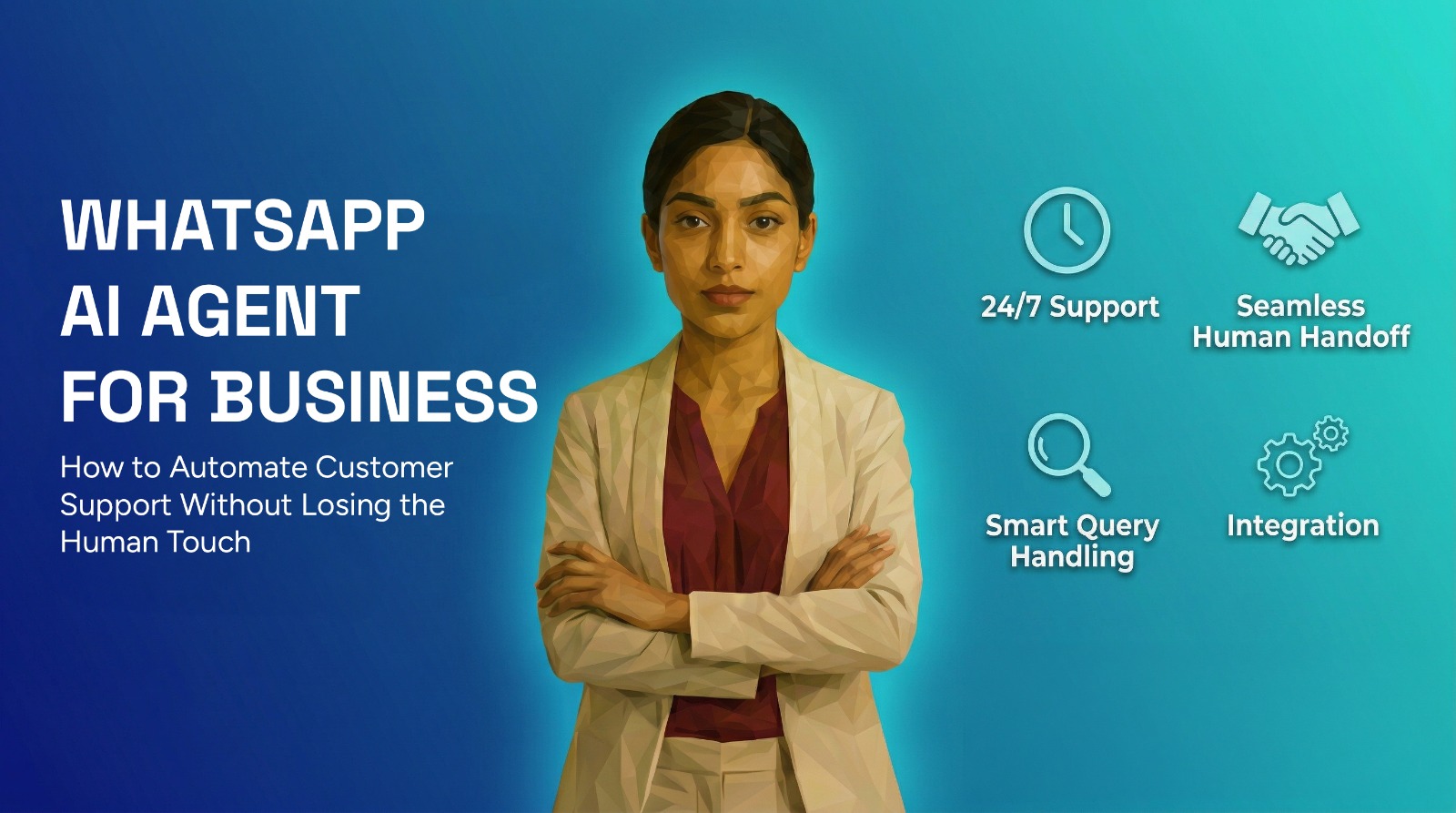
If your business relies on messaging to connect with customers, there's a good chance they're not emailing you. They're WhatsApp-ing you.
And if you're handling that volume with a small team, or worse, routing every message through one person's phone, you already know the problem. Response times slip. Queries go unanswered overnight. Your best people spend half their day copying and pasting the same answers to the same questions.
A WhatsApp AI agent doesn't just solve this. It changes what customer support looks like for your business entirely.
Here's how.
Whatsapp had an estimated 2.9 billion active users in 2025. With more than 760 million active Whatsapp Business users.
For a growing number of businesses, it's become the primary channel for customer communication; not email, not live chat, not phone calls.
And yet most businesses treat it like a direct messaging app with a team inbox.
That creates a structural problem. WhatsApp is synchronous by expectation. Customers message you because they expect a fast response.
Scaling a human team to keep up isn't the answer. You'd need someone available every evening, every weekend, across every time zone your customers are in. The smarter move is to deploy a WhatsApp AI agent — one that responds instantly, answers intelligently, and escalates to a human only when it genuinely needs to.
A chatbot operates on a decision tree. You map out possible questions, write scripted answers, and the bot follows the flow. It works fine for FAQs with predictable inputs. It fails immediately when a customer asks something unexpected, or asks the same question in ten different ways.
AI agents for WhatsApp are different. They understand natural language. They handle varied, unpredictable inputs. They draw on your company's knowledge base to give accurate, contextual answers. And they get better as they learn from real conversations.
In practice, this means:
The difference isn't just technical. It's the experience your customer has, and whether they come back.
You don't need a six-month implementation. A well-built AI agent can be operational in days. Here's what it can take off your team's plate from the start.
1. Answering inbound enquiries. Product questions, pricing, availability, opening hours, service details; anything your team currently answers by hand, repeatedly. The agent handles it instantly, accurately, 24/7.
2. Onboarding new customers. Guide new users through setup, account activation, document submission, or onboarding steps, with follow-up reminders built in. No human needed unless something goes wrong.
3. Handling appointment and booking requests. Capture requests, check availability, confirm bookings, and send reminders. The entire booking loop, without a human in the middle.
4. Post-purchase and after-sales support. Order status, returns, complaints, and feedback collection. The agent keeps the conversation professional and resolves what it can, escalating only when necessary.
5. Reactivating dormant customers. Use WhatsApp proactively, not just reactively. A WhatsApp AI sales agent can reach out to customers who haven't engaged in a while, share updates, or ask for feedback. Outbound WhatsApp, done intelligently.
Customer support automation doesn't mean there is an absence of human interaction.
The biggest mistake businesses make when deploying WhatsApp AI agents is treating them as a replacement for human judgment, rather than a layer that handles the repetitive so humans can focus on the meaningful.
A well-configured agent knows its limits. When a complaint is complex. When a customer is upset. When the answer requires judgment that goes beyond your knowledge base. In those moments, it hands off to a human, seamlessly, with the full conversation context already loaded.
The businesses that deploy this well don't just have lower support costs. They have better customer satisfaction scores. Because their team is spending time on conversations that actually matter, not copying and pasting answers to "what are your hours?"
The same principle applies across every AI-powered function, from support to prospecting. The businesses getting the most from these tools are the ones treating them as tools for business that complement their team, not replace it.
Not all AI support tools are built for WhatsApp-first businesses. Before you commit, ask these questions.
Rhea is Vector Agents' AI customer support specialist, built for WhatsApp-first businesses that need intelligent, always-on support at scale.
She handles inbound queries, manages onboarding flows, books appointments, and escalates to humans when needed. She's multilingual, she integrates with your existing systems, and she doesn't need a weekend.
Rhea is already working for businesses across the US, Singapore and the Middle East, in industries from property and logistics to education and professional services.
She doesn't replace your support team. She makes them dramatically more effective.
Customer expectations on WhatsApp aren't going to slow down. Message volumes grow, response time expectations shorten, and the businesses that rely on manual support to keep up will keep falling behind.
A WhatsApp AI agent changes that equation. Your team stops spending their day on repetitive queries and starts focusing on the conversations that actually move the business forward. Support gets faster, costs stay predictable, and customers get a better experience, without you needing to hire for every spike in volume.
That's what Rhea does for the businesses she works with. Not a chatbot that frustrates customers with dead ends, but a digital worker that handles the load intelligently and knows exactly when to bring a human in.
The best way to understand what a WhatsApp AI agent can do is to meet one.
Get in touch for a live demo tailored to your industry.
What is a WhatsApp AI agent?
A WhatsApp AI agent is a digital worker that uses natural language processing to handle customer conversations on WhatsApp automatically. Unlike rule-based chatbots, it understands varied inputs, draws on your company's knowledge base, and responds accurately 24/7, only escalating to a human agent when a query requires it.
How is a WhatsApp AI agent different from a chatbot?
A chatbot follows a fixed decision tree and fails when customers ask unexpected questions. A WhatsApp AI agent understands natural language, handles unpredictable inputs, and learns from real conversations over time. The result is a significantly better customer experience, with far fewer dead-end responses.
What can a WhatsApp AI agent do for my business?
It can handle inbound enquiries, guide customers through onboarding, manage appointment bookings, resolve post-purchase queries, and proactively re-engage dormant customers. Most businesses see meaningful time savings from day one, with agents autonomously resolving 55–70% of queries without any human involvement.
Is a WhatsApp AI agent right for businesses in Southeast Asia and the Middle East?
Yes, these are the markets where WhatsApp-first customer communication is most entrenched. Businesses in Singapore, Malaysia, Indonesia, the UAE, and the Gulf depend on WhatsApp as a primary support channel, making AI automation on the platform especially high-value. Multilingual support is essential in these regions.
How does the AI agent know when to escalate to a human?
You configure escalation rules based on your business needs. When a query is too complex, a customer is distressed, or the situation falls outside the agent's knowledge base, it transfers the conversation to the right human, with full context included so the customer doesn't have to repeat themselves.
How long does it take to deploy a WhatsApp AI agent?
A well-built WhatsApp AI agent can be operational within days, not months. Deployment time depends on the complexity of your knowledge base and system integrations, but most businesses are live and handling real queries within the first week.

.svg)


.svg)
Vector AI All rights reserved. © 2025


.jpeg)