
Europe Expansion
Vector Agents Enters Europe. Announcing Our Regional Leadership.

Europe Expansion
Vector Agents Enters Europe. Announcing Our Regional Leadership.


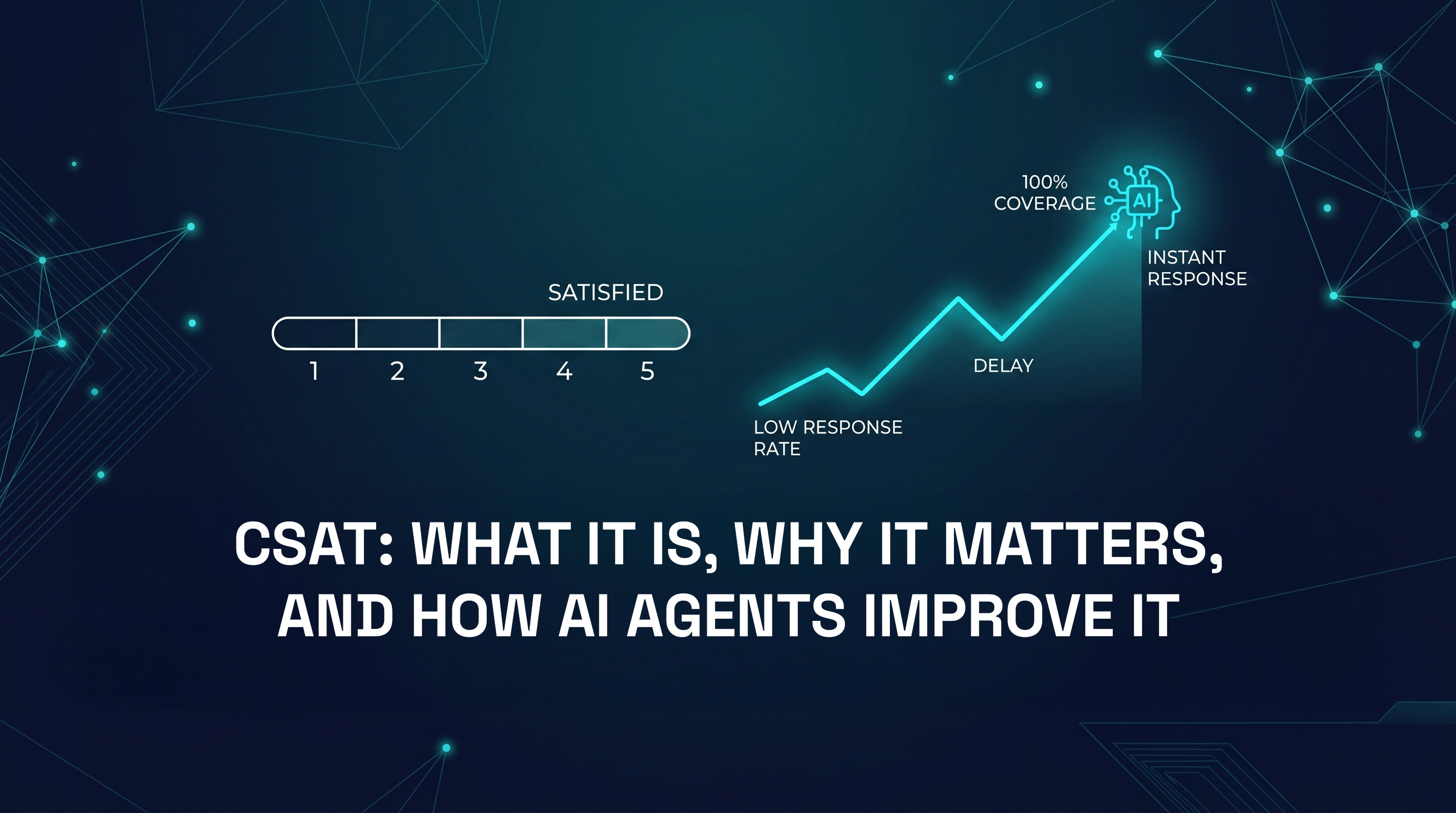
Customer satisfaction score, CSAT, is one of the most widely used metrics in customer support. It's also one of the most misunderstood. Most businesses track it. Fewer understand what's actually driving the number. Even fewer use it systematically to improve performance, or take advantage of AI to help measure satisfaction across every single interaction automatically.
This article covers what CSAT actually measures, what good looks like across industries, the levers that move it, and how AI CSAT agents are consistently improving customer satisfaction scores for businesses that deploy them well.
CSAT measures how satisfied a customer is with a specific interaction, usually a support conversation, a purchase, or an onboarding experience.
The standard format is simple: after the interaction closes, the customer receives a question like "How satisfied were you with your support experience today?" They rate it on a 1–5 scale (or sometimes 1–10).
The CSAT score is calculated as:
CSAT = (Number of satisfied responses / Total responses) × 100
"Satisfied" typically means a 4 or 5 on a 5-point scale.
A business where 80 out of 100 respondents give a 4 or 5 has a CSAT of 80%. Simple to calculate. Harder to move consistently.
Knowing your CSAT score is useful. Knowing whether it's good or bad requires context.
Benchmarks vary significantly by industry. According to the American Customer Satisfaction Index (ACSI), the only national cross-industry measure of customer satisfaction in the US, the national satisfaction score across industries measured 77.3 out of 100 in Q4 2024. Industry-level scores sit either side of that figure depending on sector. E-commerce, consumer electronics, and personal care products consistently score among the highest, while cable television, airlines, and telecommunications tend to sit below the national average.
If your CSAT is significantly below your industry average, you have a clear performance gap. If you're at or above average, the opportunity is to extend the lead and use CSAT as a competitive differentiator. The ACSI is the most rigorous benchmark available for US businesses; if you operate in a sector it covers, it's the right place to set your target.
One important caveat: CSAT response rate matters enormously. A 75% CSAT from a 60% response rate is a very different signal than a 75% CSAT from a 15% response rate. Low response rates mean you're only hearing from the customers most motivated to respond, which tends to skew towards the extremes. This is one of the core problems that AI CSAT measurement solves, by generating a score for every conversation rather than relying on customers to voluntarily complete a survey.
CSAT isn't one thing. It's the combined effect of several factors, and improving it requires understanding which ones you're underperforming on.
Speed of first response
This is consistently the single biggest driver of CSAT in support interactions. Customers rate faster interactions higher, even when the quality of the eventual response is identical. 31% of US consumers say that not responding quickly enough is the most likely factor to make them feel negatively about a brand, followed by customer service not being available 24/7, cited by 26%. Every minute of delay beyond an ideal first response correlates with lower CSAT. Hours-long waits produce predictably low satisfaction scores.
Accuracy and completeness of the answer
An answer that arrives fast but is wrong or incomplete drives low CSAT, even if the speed was good. Customers want their questions fully resolved, not partially answered and then forced to follow up.
Number of interactions to resolution
First contact resolution, the rate at which queries are fully resolved in a single interaction, is strongly correlated with CSAT. Every additional message required to resolve a query reduces satisfaction. Customers who have to follow up three times to get a complete answer consistently give low scores.
Channel availability
Customers who can only get support during business hours and contact you at 9 pm tend to give lower satisfaction scores, not just because of wait time, but because the experience of being unable to get help when you need it is fundamentally frustrating.
How escalation is handled
When a query needs to go to a human, the transition matters. A customer who is smoothly handed over, who doesn't have to repeat their problem, and whose context is already visible to the agent they're transferred to, rates the experience higher than one who starts from scratch each time.
The stakes for getting CSAT right are rising. Customer-obsessed organizations report 41% faster revenue growth, 49% faster profit growth, and 51% better customer retention than non-customer-obsessed organizations.
AI-powered customer experience tools for improving CSAT scores are not a nice-to-have but a practical competitive advantage.
AI agents for customer support have a direct, measurable impact on each of the drivers above. Businesses searching for AI support agent software with the highest CSAT scores in 2026 consistently find that the mechanics are the same: speed, accuracy, availability, and clean escalation.
Instant first response
An AI agent responds to every inbound query in seconds, regardless of volume, time of day, or day of week. The CSAT improvement from eliminating multi-hour first response times is immediate and substantial. Businesses that deploy AI agents typically see first response time go from hours to seconds for the majority of their query volume.
Accurate, knowledge-base-grounded answers
A well-configured AI agent, one built on a comprehensive, accurate knowledge base, gives consistent, correct answers. There's no variation based on which agent is working, what time of day it is, or how tired the support team is. This consistency drives first contact resolution rates up, which drives CSAT up.
Clean escalation
Well-designed AI agents hand off to human agents with full conversation context already visible. The human agent can see exactly what was discussed, what the customer's issue is, and what has already been tried. No asking the customer to start over. CSAT for escalated queries, which tend to be complex and higher-stakes, improves when the handoff is seamless.
Consistent CSAT collection through AI CSAT tools
This is where AI CSAT measurement makes a material difference. Rather than relying on customers to complete post-interaction surveys, which typically achieve response rates of 15–30%, AI can analyze the language and sentiment of every conversation and assign a satisfaction score automatically. That means 100% coverage, no survey bias, and pattern recognition at a scale no manual process can match.
Businesses using AI-powered customer experience tools for improving CSAT scores get a far more accurate picture of where satisfaction is breaking down and why.
CSAT data is most valuable when you use it to identify patterns, not just track a number. Here are the four cuts that turn a satisfaction score into something actionable.
It's worth being direct about three things that feel like CSAT improvements but aren't.
Rhea is Vector Agents' AI customer support digital worker. She integrates directly into your existing support stack, handles inbound queries across email, chat, and social channels, and resolves the majority of ticket volume autonomously, so your human agents can focus on the interactions that actually need them.
The CSAT impact is direct and measurable. Rhea addresses each of the core drivers: she responds to every inbound query in seconds, regardless of volume or time of day, draws on your knowledge base to give accurate and consistent answers, operates around the clock so after-hours queries never go unanswered, and hands off to human agents with full conversation context already in view.
None of those are marginal improvements. They change the fundamental structure of the support experience in ways that customers notice and rate higher. Businesses that deploy Rhea typically see CSAT improvement within the first 90 days, driven by the same mechanisms: faster first response, higher first contact resolution, and no availability gaps.
AI CSAT improvement comes down to a small number of well-understood levers: faster first response, more accurate answers, round-the-clock availability, and seamless escalation. The businesses that close those gaps systematically, rather than reactively, end up with satisfaction scores that compound into retention and revenue.
Measuring where you stand is the starting point, and that's where AI CSAT tools earn their keep. By scoring every conversation automatically, rather than waiting on survey responses from the 20% of customers who bother to reply, you get a complete and accurate picture of what's working and what isn't.
AI-powered customer experience tools for improving CSAT scores don't require a full team overhaul. Rhea works alongside your existing people, handling the high-volume, repetitive queries so your human agents can focus on the interactions that actually need them.
If you want to see what that looks like for your specific support operation, book a demo today!
An AI CSAT tool measures customer satisfaction by analyzing the language and sentiment of support conversations automatically, without relying on customers to complete a survey. Instead of capturing satisfaction from 15–30% of interactions, AI CSAT tools generate a score for every conversation, giving support teams complete coverage and far more reliable data to act on.
What counts as "good" depends heavily on your industry. According to the American Customer Satisfaction Index, the US national average sat at 77.3 out of 100 in Q4 2024, with sectors like e-commerce and consumer electronics scoring above that and telecommunications and cable television sitting below it. Use your industry benchmark as the baseline, then set targets above it rather than chasing a universal number.
AI improves CSAT primarily by addressing the factors customers care most about: speed of first response, accuracy of answers, and around-the-clock availability. An AI support agent responds in seconds, gives consistent knowledge-base-grounded answers, and never goes offline. Each of these directly raises satisfaction scores by removing the friction that drives customers to rate interactions poorly.
The fastest CSAT improvement typically comes from reducing first response time. Customers consistently rate faster interactions higher, even when the quality of the eventual answer is identical. Deploying an AI agent to handle first response across all channels, including outside business hours, produces one of the most immediate and measurable lifts in CSAT scores.
Break your CSAT data down by query type, channel, and time of day rather than looking at a single overall number. This tells you which categories of issues are driving dissatisfaction, whether certain channels are underperforming, and whether after-hours coverage is a gap. Cross-referencing low CSAT scores with churn data confirms whether those dissatisfied customers are actually leaving.
CSAT measures satisfaction with a specific interaction, captured immediately after it happens. NPS (Net Promoter Score) measures overall loyalty and likelihood to recommend, captured at a relationship level. Both are useful, but they measure different things. CSAT is the better signal for diagnosing support performance issues; NPS is better for understanding long-term brand sentiment and retention risk.

.svg)


.svg)
Vector AI All rights reserved. © 2025


.jpeg)