
Europe Expansion
Vector Agents Enters Europe. Announcing Our Regional Leadership.

Europe Expansion
Vector Agents Enters Europe. Announcing Our Regional Leadership.


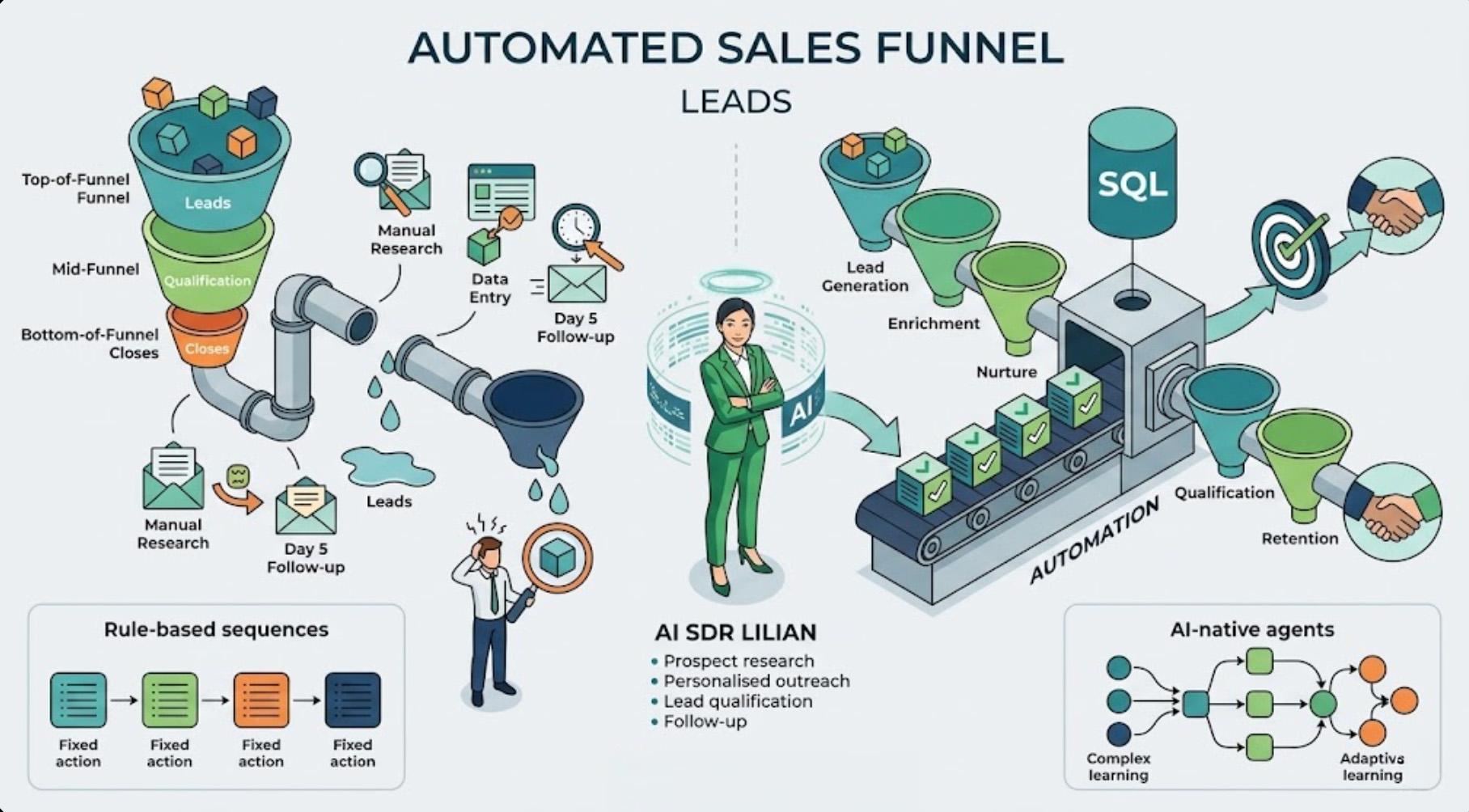
Most sales teams already have some form of automation in place. There is usually a CRM with sequences running, a few Zapier workflows, and an email tool sending follow ups on a schedule. But the pipeline still leaks.
Leads go cold between stages. Reps spend hours on research that never converts into conversations. Follow-ups arrive too late or feel too generic to move prospects forward.
The problem is usually not the idea of automation itself. The problem is that most setups are only partially automated. The repetitive work still depends heavily on manual effort, which creates delays, inconsistency, and missed opportunities across the funnel.
A real automated sales funnel works differently. It handles repetitive tasks systematically while keeping human reps focused on the conversations that actually close deals.
This article breaks down what an automated sales funnel actually looks like, which stages benefit most from automation, how AI changes what is possible, and how to build a system that works from the top of the funnel all the way through to close.
An automated sales funnel is a system that moves prospects from first contact to purchase without requiring manual effort at every stage. Software handles the repetitive work, while the sales team focuses on the conversations that close deals.
In a manual funnel, reps handle the tasks that connect each stage. That includes prospect research, outreach, follow up, qualification, and CRM updates. In an automated funnel, those tasks are handled by software using triggers, rules, or AI driven decisions.
The work being automated is usually the work that does not require human judgment. That includes sending follow ups at the right time, enriching lead profiles before outreach, scoring leads against the ICP, and filtering out poor fit prospects before they ever reach a rep.
The result is not a funnel with fewer people involved. It is a funnel where the people involved spend their time on the right work.
Each stage has its own automation opportunities, and the work being automated at each one is different.
Not every stage needs to be automated at once. Most teams start at the top of the funnel, where the volume is highest, and the manual tasks are most repetitive, then layer in automation further down as the system matures.
Most sales teams already have some form of rule-based automation, and it is important to understand why that differs from what is now possible with AI. Rule-based tools such as CRM sequences, Zapier workflows, and trigger-based email platforms follow fixed logic. If one action happens, the system responds with another. These systems are reliable when the rules are correct, but they cannot adapt when a prospect behaves unexpectedly or when the ICP changes.
AI-native automation works differently. Instead of following fixed rules, AI agents learn from data, adapt to behaviour, and make decisions based on patterns rather than preset triggers. The decision about which message to send, when to send it, or whether a lead is worth pursuing is made dynamically based on what the system has learned, not simply what someone configured months earlier.
A practical example is an AI sales funnel operating at the top of the funnel. A rule-based sequence sends the same emails on the same schedule to every lead on the list. An AI agent researches each prospect before outreach, writes personalised messages based on what it finds, adjusts timing based on engagement signals, and qualifies leads in real time. The system improves over time because it learns from outcomes rather than simply executing instructions.
Most organisations now use AI in at least one business function, but many are still in the experimenting or piloting phase. Revenue gains from AI are reported most often in marketing and sales. As a result, the gap between teams running rule-based sequences and those running AI native funnels is continuing to widen. Teams that make the shift now are not just saving time. They are building a compounding advantage over teams that do not.
Building an automated sales funnel that actually works isn't primarily a technology decision. It's a process decision first, and a technology decision second.
Choosing the right AI sales funnel builder matters more than the specific features on any vendor's list. The right criteria depend on your team's stack, your ops capability, and how much you're willing to invest in setup. These are the ones that consistently determine whether a platform delivers.
Stack compatibility is the practical filter that narrows the list fastest. A platform that integrates cleanly with your existing CRM has a materially lower adoption barrier than one requiring a rip-and-replace, regardless of its feature set.
The gap between a described system and a working one is where most teams get stuck, so it helps to ground the concept in a practical example.
Vector Agents’ Lilian is an AI SDR that handles the full top of funnel operation. That includes prospect research, personalised outreach, lead qualification, and follow-up. The sales team joins once a real conversation is ready to happen. Lilian handles the work before that point.
She plugs into the existing stack instead of forcing teams to rebuild their systems around a new platform. Research is completed, and outreach is written for every prospect before engagement begins. Meetings are booked, and the pipeline keeps moving, while the sales team spends its time on the parts of the process that actually require human involvement.
For teams evaluating what lead funnel automation looks like when it is fully operational inside a live pipeline, Lilian is a strong example.
The difference between a team managing a manual funnel and one running an AI-native automated sales funnel is not effort. It is architecture. Most teams have already taken the first step, with some form of CRM automation or email sequencing already in place. The next shift is moving from rule-based sequences to AI agents that learn, adapt, and run the top of the funnel from end to end.
The late funnel still remains human. The goal of sales funnel automation is to concentrate rep time at the stages that require human judgment, not remove people from the process entirely. Teams that get this right are not working harder than everyone else. They are simply focusing their time on the right stages of the funnel while AI handles the repetitive operational work.
If you want to see what an AI native automated sales funnel looks like in practice, book a demo with Vector Agents.
An automated sales funnel is a system that moves prospects from first contact to purchase without requiring manual effort at every stage. Software handles repetitive tasks such as follow ups, lead scoring, CRM updates, and qualification using triggers, rules, or AI driven decisions. The sales team focuses on conversations that require human judgment, primarily at the bottom of the funnel.
A CRM with sequences is a form of rule based automation that sends pre set messages on a fixed schedule. Sales funnel automation, especially AI native automation, is adaptive. It responds to prospect behaviour, adjusts timing and messaging dynamically, and can handle research, enrichment, and qualification in addition to email delivery.
Lead capture, enrichment, scoring, nurture sequences, qualification, and follow-up can all be automated. Top-of-funnel tasks such as prospect research, personalised outreach, and initial qualification usually deliver the highest return from automation. The later stages of the funnel, including complex objection handling and negotiation, are generally most effective when handled by humans.
Zapier and HubSpot workflows follow fixed if this, then that rules. AI native automation learns from data and adapts over time. An AI agent can research a prospect before outreach, personalise the message based on what it finds, adjust send timing based on engagement signals, and improve its own performance through outcomes. Rule-based tools cannot do that.
AI native outreach that is personalised for each prospect generally performs better for deliverability than high-volume generic sequences. The real risk to sender reputation comes from untargeted mass outreach, not from personalised outreach aligned to the ICP. The right AI sales funnel builder enriches prospect data before engagement so the messages are relevant enough to generate replies rather than spam complaints.
A basic automated funnel with lead capture, enrichment, and outreach sequences can often be operational within days using the right platform. A fully mapped multistage funnel with qualification logic and buying signal triggers usually takes between two and four weeks to build and test properly. The largest time investment is normally mapping the existing process before automation begins.
Organisations using AI in sales most commonly report revenue gains in marketing and sales functions. At the team level, the most consistent outcomes are higher pipeline volume without proportional headcount increases, faster follow-up response times, and sales reps spending more time in late funnel conversations and less time on research and administrative work.

.svg)


.svg)
Vector AI All rights reserved. © 2025


.jpeg)