
Europe Expansion
Vector Agents Enters Europe. Announcing Our Regional Leadership.

Europe Expansion
Vector Agents Enters Europe. Announcing Our Regional Leadership.


Turning a lead list into real pipeline, without burning rep hours a growing quota can't spare, is what separates teams that scale from teams that just add headcount. Quota keeps climbing, reps are already busy, and adding headcount isn't always the answer finance signs off on. The methods that hold up against a growing target aren't necessarily the newest channel, they're the ones that produce qualified pipeline without adding hours nobody has. This article works through eight methods for finding B2B leads, what each one actually costs in rep time, and how to decide which mix fits a team scaling past the size where manual prospecting used to be enough.
The problem with most prospecting advice is that it treats effort as the constraint, when the real constraint is usually precision. A rep building a list from scratch, cross-referencing job titles and company size by hand, produces a list that's already stale by the time outreach starts. Manual research takes real hours per account, and by the time a rep works through fifty accounts, the first ten have often already changed roles or priorities.
The bigger issue shows up on the other side of that outreach. Buyers have gotten better at filtering out anything that doesn't feel specific to them, and 73% actively avoid suppliers who send irrelevant outreach. A generic, high-volume list wastes the hours spent building it and closes the door on accounts that might have converted with a targeted approach.
This is why precision, not volume, determines whether a method for finding B2B leads is worth the hours it costs.
A systematic approach to finding B2B leads doesn't mean stacking more tools on top of the same manual process. It means defining criteria once, keeping the underlying B2B lead data current, and matching each method to how the buyer actually wants to be reached.
Buyer preference is part of why this shift matters. 61% of B2B buyers now prefer completing their early research without direct contact from a rep. Finding a lead isn't only about reaching out first, it's about being visible and credible where a buyer already looks before they're ready to talk to anyone.
The eight methods below split into two groups: methods that actively go find a buyer, and methods that make a team findable before a buyer starts looking elsewhere.
Sales Navigator lets a rep filter by industry, headcount, job title, and seniority to build a list scoped tightly enough that most contacts on it are worth contacting. That precision means fewer wasted touches than a broad export pulled from a generic database.
The tradeoff shows up in time. Building and refreshing a list by hand still takes a rep real hours every week, and that cost doesn't shrink as the target account list grows. It suits a defined, narrow ideal customer profile well. It suits a team needing volume beyond what one or two reps can manually filter far less.
A referral program works because it removes the trust problem every other method here has to solve some other way. When an existing customer vouches for a company, the prospect arrives already believing the product works for companies like theirs.
The limitation is volume. A referral program is capped by the size of the current customer base and how consistently the ask gets made, usually through onboarding or renewal conversations. It produces business to business sales leads that arrive with a level of trust no other method here creates on its own, since the introduction comes from someone the prospect already trusts rather than a company they've never heard of, but it was never going to carry a pipeline target alone.
Firmographic filters, industry, headcount, and other company-level traits, answer who matches the profile. Intent data answers who's actually in-market right now, based on signals like technology changes, funding events, hiring surges, or spikes in research activity on relevant topics.
That shift changes the math on outreach without changing list size. An account showing active buying signals responds differently than the same account contacted at random because it matched a filter. Intent tools don't replace the list-building step, they reorder it, so reps spend outreach hours on accounts already showing signs of movement.
Relying on a single channel for cold outreach means missing buyers who simply don't respond there, regardless of how well the message is written. Combining email, phone, and social spreads that risk across the channels where different buyers actually engage.
Response rates vary sharply by channel, and most outbound sequences are still weighted toward where outreach has always been sent, not toward where a given buyer actually responds. Rebalancing that mix is often a faster fix than rewriting the message itself.
Social selling is not cold outreach on a different channel. It's consistent, platform-appropriate content and engagement that builds visibility and credibility before a rep ever sends a direct message.
A prospect who's already seen a rep show up credibly in their feed responds differently to a direct message than a stranger would, which is the mechanism social selling depends on. It compounds over months, not days, making it a poor fit for a team needing pipeline this quarter but a strong complement to the faster methods above it.
Content built around the terms a buyer actually searches, comparison pages, and gated resources attracts interest without requiring a rep to reach out first. That matters directly for the buyer preference named earlier: content does the early-stage research work a cold call used to have to do.
The mechanism differs from every method above it. Instead of a rep finding the buyer, the content makes the company findable the moment a buyer starts researching a problem. It takes longer to build momentum than outreach does, but because the buyer already spent time researching the problem before a rep was involved, the lead arrives further along in the decision and takes less time to qualify.
Every method above depends on accurate B2B lead data underneath it. A Sales Navigator list, a referral, an intent signal, and an inbound lead are all worth less if the contact record behind them is outdated, since a lead with the wrong title, email, or company size doesn't turn into a meeting no matter which channel finds it first.
Enrichment and verification tools update firmographic and contact details before a lead reaches a rep, rather than relying on a list built months earlier. This isn't a standalone lead-sourcing channel. It's the layer that determines whether the other seven methods actually convert or only look productive on a report.
Automating the repetitive parts of prospecting, list-building, enrichment, and outreach sequencing frees up hours spent on tasks that don't require judgment, leaving qualifying and closing to the rep.
Sales reps currently spend 60% of their time on non-selling tasks like manual data entry and account research rather than actual selling conversations. That gap is exactly what automation targets: not the judgment calls, but the hours spent building lists and updating records by hand. The point isn't replacing the seven methods above, it's removing the manual labor underneath them so a smaller team can run all seven at a pipeline target that used to require more headcount.
Most searches for how to get B2B leads return the same list of channel names without weighing what each one costs. Not every one of these B2B lead sources fits every team, and picking one because it worked for another company usually means picking based on the wrong variable.
A few questions cut through the noise faster than a feature comparison would:
Sourcing methods fill the top of the list, reaching methods convert what sourcing finds, and sustaining methods determine whether the first six keep working as volume grows instead of degrading the way manual processes usually do:
Answering how to find B2B leads at a pace matching a growing pipeline target comes down to this mix question more than any single new tactic.
The constraint most teams hit isn't a shortage of methods, it's that Sales Navigator research, intent monitoring, multi-channel outreach, and data enrichment all draw from the same limited pool of rep hours. Adding a ninth method doesn't fix that, it adds another task competing for the same hours.
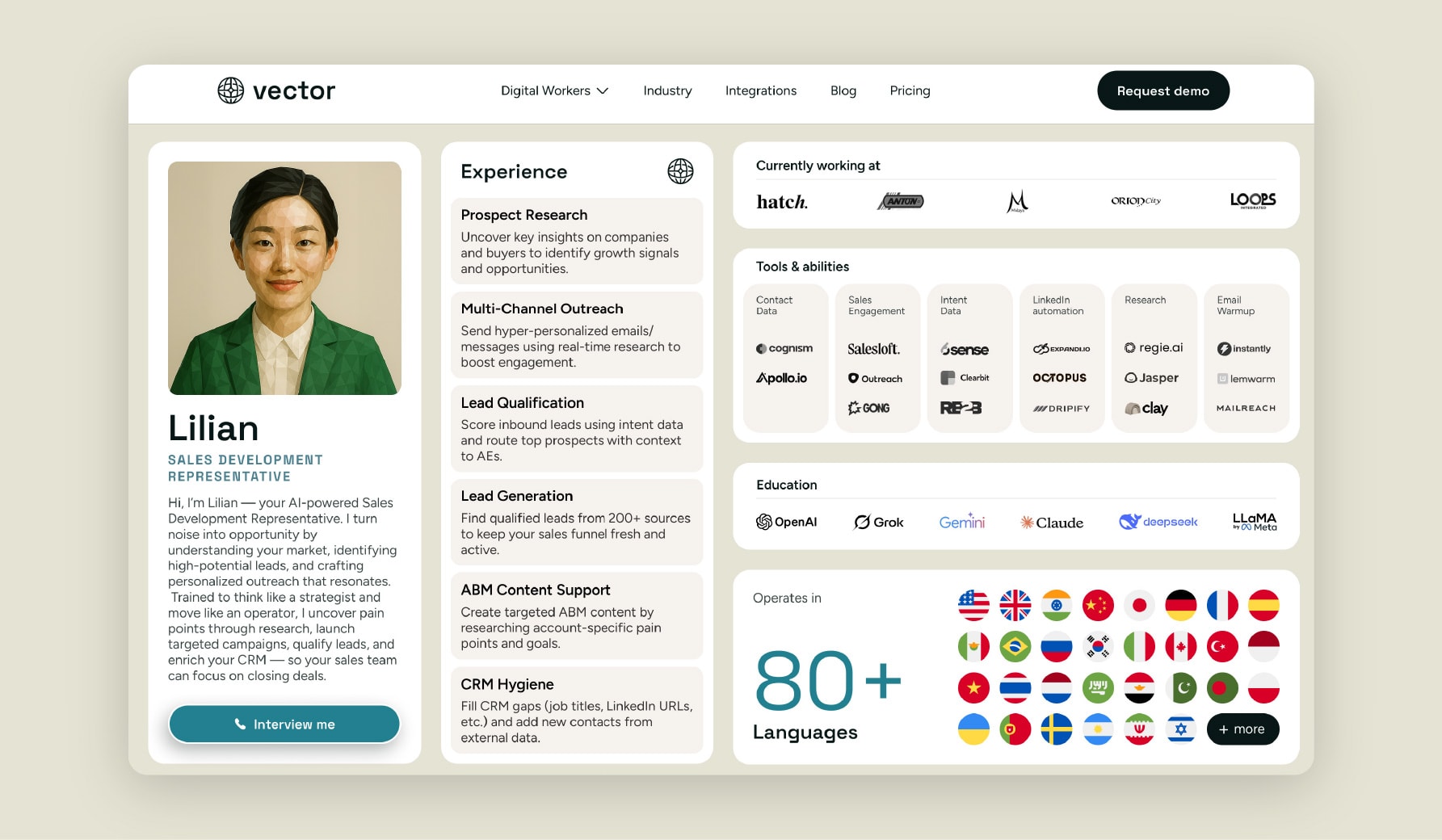
Lilian, Vector Agents' digital worker for sales, runs prospect research, list-building, enrichment, and outreach sequencing continuously in the background rather than as tasks a rep picks up between calls. What used to take a rep several hours a week to build and maintain manually happens on an ongoing basis, without a corresponding headcount increase.
This doesn't replace referral programs or social selling, both of which depend on real relationships only a person can build. It replaces the manual mechanics behind Sales Navigator research, intent monitoring, outreach sequencing, and data upkeep, the methods here that consume rep hours without requiring rep judgment.
None of the eight methods for how to find B2B leads above are competing with each other. They're layers of one system: some source leads, some reach them, and some keep the rest from degrading as volume grows. The bottleneck almost never turns out to be a shortage of ideas, it's the rep hours available to run all of them at once.
Book a demo with Vector Agents to see how Lilian removes the manual research and outreach work sitting underneath a pipeline target that's grown faster than the team built to hit it.
A B2B lead is any contact or company that matches a target profile, whether or not they've shown interest yet. A qualified B2B lead has been checked against fit, role, need, and authority, meaning the company matches the target market, the contact holds real decision-making influence, and the product actually solves a problem they have.
Two or three complementary channels keep volume high enough to matter while still leaving room to personalize each touch, which is harder to sustain across five channels at once. A common combination pairs a sourcing method like Sales Navigator with a reaching method like multi-channel outreach, then adds a sustaining layer like data enrichment as volume increases.
Cold outreach still works, but only when it's targeted and personalized rather than sent at volume to a generic list. Buyers respond differently depending on channel and relevance, which is why pairing outreach with accurate B2B lead data and a defined ideal customer profile matters more than the total number of contacts reached.
B2B contact data degrades continuously as people change roles, companies restructure, and job titles shift, so verification should happen close to the point of outreach rather than on a fixed quarterly schedule. Enrichment tools that update records in real time catch these changes faster than a list refreshed manually every few months.
Sourcing, enrichment, and outreach sequencing can be automated, but qualifying and closing depend on reading context and building trust in real time, which is why automated teams still keep a person responsible for the conversation itself. The most effective setups automate the repetitive research and list-building work so reps spend their time on decisions that require a person.

.svg)


.svg)
Vector AI All rights reserved. © 2025


.jpeg)