
Europe Expansion
Vector Agents Enters Europe. Announcing Our Regional Leadership.

Europe Expansion
Vector Agents Enters Europe. Announcing Our Regional Leadership.


Outbound is not dying, but generic outbound is being filtered out faster than ever. 73% of B2B buyers actively avoid suppliers that send irrelevant outreach. That means a poorly built outreach sequence does not just underperform. It actively closes doors.
Most sales teams do not have a pipeline problem. They have a sequence problem.
This guide breaks down what separates outreach sequences that build pipeline from the ones that burn it. It covers sequence structure, timing, and personalisation rules. It also includes three real examples you can use as templates, along with how AI is changing what outbound sequences can do at scale.
An outreach sequence is a pre-planned, multi-step communication flow that moves a prospect through email, LinkedIn, and phone over a defined period. It's not a one-off cold email, and it's not a bulk blast sent to a list. It's a structured campaign where every step has a job.
That job changes at each stage. The first touch builds awareness. The second frames a problem the prospect recognises. The third shares proof. The fourth asks for a decision. Each step is mapped to a channel, a timing window, and a specific message angle.
It's also worth separating sequences from cadences, since the two terms get used interchangeably. A cadence is the timing framework: how many touches, how far apart. A sales sequencing strategy is the full picture: the cadence, plus the channels, the content, and the messaging at each step. A cadence tells you when to reach out. A sequence tells you what to do and say.
The practical value of sequences is that they make outbound measurable and repeatable. Without them, reps follow up when they remember, stop when they feel like they've tried enough, and can't identify which step is producing replies.
Structure is the part most teams skip. They write a good first email, send it, and improvise from there. The sequence falls apart not because the message was wrong but because there was no system behind it.
A high-performing outreach sequence runs five to seven touches over two to three weeks. Fewer than five touches, and the prospect hasn't built enough familiarity to respond. More than eight, and each additional step returns less than the one before.
The channel mix matters as much as the step count. Each channel plays a different role:
On timing, the goal is persistent without being aggressive.
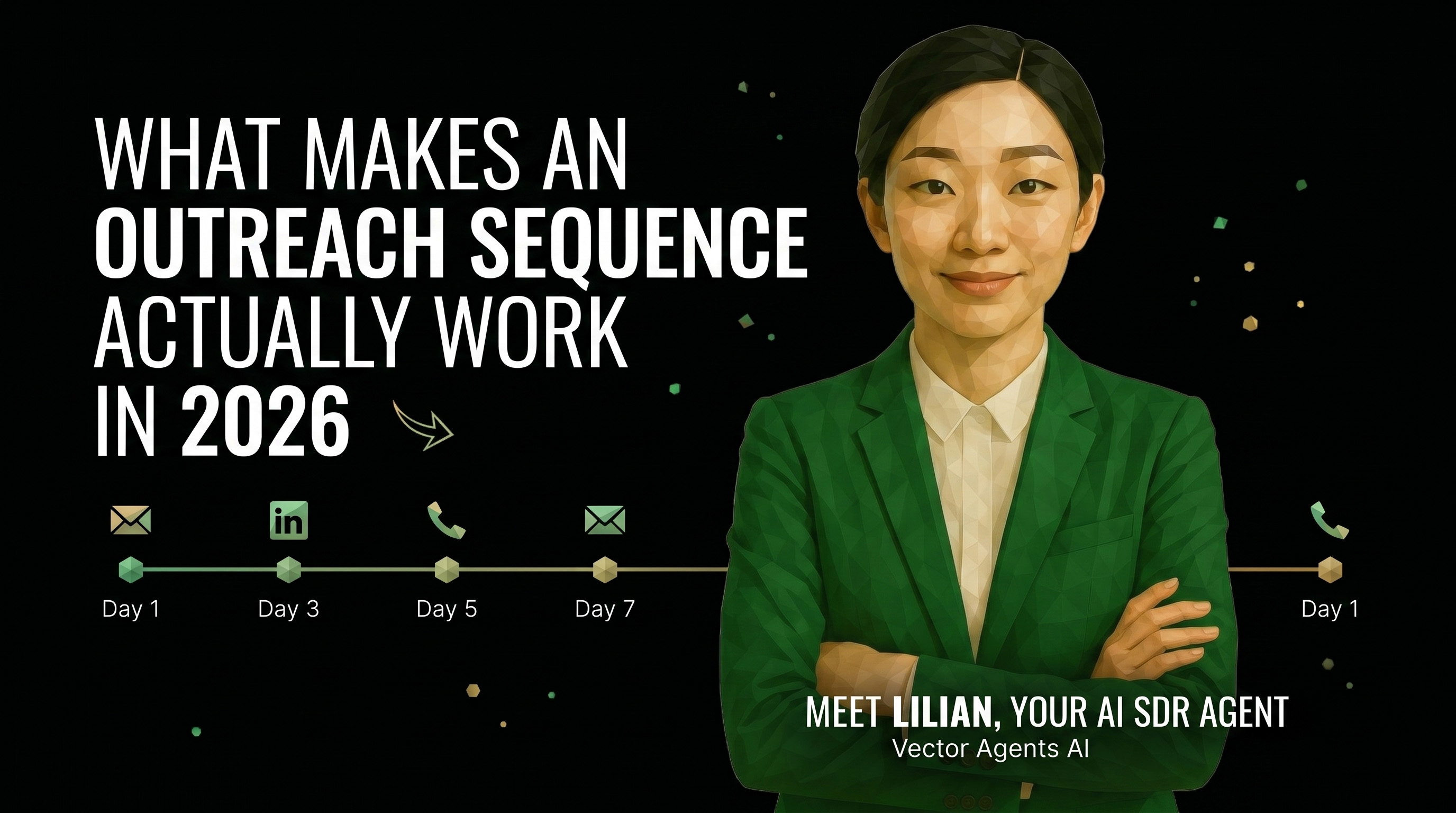
A practical baseline: day one email, day three LinkedIn, day five call, day seven follow-up email, day fifteen breakup email. Each gap gives the prospect enough space to respond without giving them enough space to forget you.
The best teams also segment their sequences by persona and seniority. A sequence targeting a CRO gets more manual steps, more personalisation, and a longer runway because the meeting is worth the extra effort. A sequence targeting a mid-level manager runs tighter and leans more heavily on automation. One template applied to every contact in a CRM is not a sales sequencing strategy.
Finally, every step in the sequence must add something new. A different angle, a piece of proof, a specific reference to the prospect's company or situation. Repeating the same pitch in different words isn't persistence; it's noise.
The fastest way to understand what a well-built sequence looks like is to see one in practice. The seller in each example is a B2B cybersecurity platform. The prospect is an IT Manager or Head of IT at a mid-sized company. Here are three sequences, each built for a different scenario.
The prospect works at a 150-person logistics company. They just posted a "Head of Information Security" job listing. That signal means one thing: they don't have a dedicated security function yet, and someone senior has decided that needs to change.
What makes it work: the hiring signal tells you exactly where they are in the buying journey. Every touch reflects that context instead of ignoring it.
The prospect downloaded a report on ransomware exposure in mid-market companies. They work in financial services, a sector named specifically in the report. They already know the brand and have self-identified with the problem.
What makes it work: the content download is a declared interest signal. The sequence treats it as one rather than ignoring it and starting from scratch.
They replied once, said the timing wasn't right, and went quiet. Since then, a major ransomware attack hit two companies in their industry and made national news. The original objection was about timing, not fit. The context has changed.
What makes it work: the re-engagement isn't built around following up on the pitch. It's built around a changed circumstance that makes the original problem more urgent. That's a reason to reach back out, not just persistence.
Most sequence problems are structural. The reply rate doesn't improve when you rewrite the email if the underlying system is broken.
One more failure mode worth naming: rigid automation that ignores engagement signals. When a prospect opens three emails in two days or revisits a piece of content, the next automated step should respond to that. A static sequence that fires its next pre-written message regardless of behaviour misses the window when the prospect is most receptive.
There's a constraint built into manual sequencing that most teams don't talk about directly. An SDR can only research and personalise so many accounts per day. At some point, teams have to choose between volume and quality. More contacts in the sequence means less time per contact, which means less personalisation, which means lower reply rates. The math doesn't work.
AI SDR agents remove that constraint. Research, personalisation, and sequence execution are handled autonomously. The rep picks up at the conversation.
In practice, an AI SDR agent researches each prospect before outreach: firmographic signals, recent funding, hiring activity, LinkedIn data, and website content. That research feeds directly into a personalised first touch written to reflect the prospect's specific context. The agent then executes the sequence across email and LinkedIn, tracks engagement, and routes warm replies to a human rep with context already established.
The deliverability benefit is direct. AI-native outreach targets more precisely and produces lower bounce rates than volume-based blasting. The sending domain stays clean. The reply rates reflect quality rather than volume.
The operating model that's emerging is hybrid: AI runs the outreach sequence, human reps manage live conversations and close. This is how teams scale pipeline without proportionally scaling headcount.
This is where the model described above becomes a specific and deployable product.
Lilian is Vector Agents’ AI SDR. She handles the full outreach workflow, including prospect research, personalised multi-channel outreach sequences across email and LinkedIn, lead qualification, and CRM enrichment. The sales team picks up at the conversation stage with context already established.
The results are grounded in what the workflow actually produces. Lilian delivers more meetings per AE and improves conversion rates through better lead targeting, while operating continuously without attrition risk.
The personalisation is not cosmetic. Lilian’s outreach is built on deep prospect research rather than list blasting. Every touch reflects real signals such as funding events, hiring activity, market triggers, and company-specific context. That is what protects deliverability and drives reply rates. It is also what makes the sequence feel relevant instead of intrusive.
The cost context is still important to understand. A human SDR can cost between $75,000 and $110,000 per year in salary alone before benefits, onboarding time, and management overhead are considered. The best sales sequences do not require a large SDR team to execute. They require the right system behind them.
The difference between outreach sequences that book meetings and ones that get ignored comes down to two things: structure and relevance. Volume without either produces noise. Structure without relevance produces polite avoidance. Both together, executed consistently, produce pipeline.
The shift toward AI-native sequence execution isn't about removing reps from the process. It's about removing the manual constraint that forces a trade-off between personalisation and scale. When research and outreach run autonomously, reps spend their time on the work that actually moves deals: conversations, qualification, and closing.
If you want to see what a fully researched, personalised outreach sequence looks like in practice, book a demo with Vector Agents today.
A high-performing outreach sequence typically runs five to seven steps over two to three weeks. Fewer than five steps risk the prospect not building enough familiarity to respond. More than eight produces diminishing returns, with each additional touch yielding less incremental response than the one before it.
A cadence is the timing framework: how many touches and how far apart. A sequence is the complete campaign, including the cadence, the channels, the messaging, and the content at each step. A cadence tells you when to reach out. A sequence tells you what to do and say at each point.
The most effective outreach sequences combine email, LinkedIn, and phone. Email carries detail and context. LinkedIn builds low-friction visibility between touches. Phone calls enable real-time qualification. Single-channel sequences, especially email-only, miss the segments of your prospect list that don't prioritise their inbox.
The most common causes are quitting too early, using a single channel, sending generic messages with no prospect-specific context, or poor list hygiene, burning your sending domain. Each of these is structural. Fixing them improves reply rates regardless of message quality.
AI SDR agents research each prospect autonomously, generate personalised outreach based on real signals like funding and hiring activity, and execute the full sequence across email and LinkedIn without manual input. Warm replies are routed to human reps. This removes the volume-versus-quality trade-off that limits manual SDR sequencing.
Yes. AI SDR agents like Lilian handle the full workflow: prospect identification, account research, personalised outreach, sequence execution, and routing of warm replies to your team. Your reps enter the process at the conversation stage, with context already established.

.svg)


.svg)
Vector AI All rights reserved. © 2025


.jpeg)