
Europe Expansion
Vector Agents Enters Europe. Announcing Our Regional Leadership.

Europe Expansion
Vector Agents Enters Europe. Announcing Our Regional Leadership.


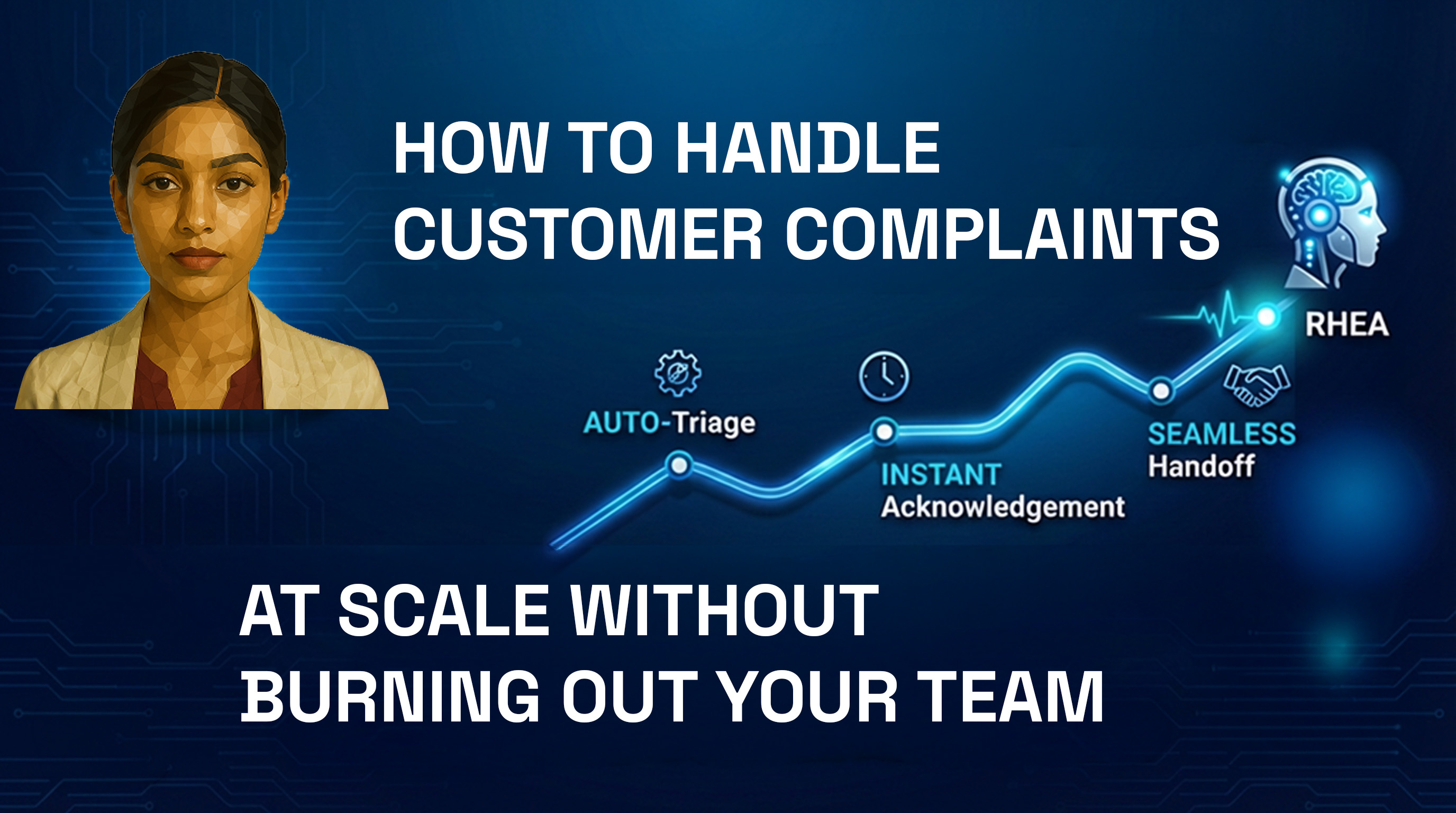
Complaints are the most important conversations your business has.
Not because they're pleasant. But because a customer who complains is still talking to you. They haven't left silently. They're giving you information and, implicitly, a chance to recover.
Organizations globally put $3.7 trillion in annual sales at risk due to bad customer experiences, with over half of consumers reducing or stopping their spending after a single poor interaction.
The businesses that handle complaints well don't just retain those customers; they often convert them into the most loyal advocates in their base.
The challenge isn't handling one complaint well. Any business can do that. The real challenge is scaling customer support consistently, without burning out the team responsible for it, and without letting volume create delays that make the problem worse.
Complaints aren't increasing because companies are getting worse. They're increasing because the environment around customer service has fundamentally shifted.
Customers have more channels to complain on. WhatsApp, email, live chat, social media, review platforms. Each new channel adds to the incoming volume.
Response expectations have risen sharply. A customer who complained via email in 2015 might wait 24 hours for a reply without concern. The same customer in 2026 expects a response within minutes.
Social amplification means one complaint can spread. A frustrated customer who doesn't get a response quickly doesn't just stay frustrated; they go to X, Google Reviews, or Facebook, and now one complaint has become public reputational damage.
Growth compounds the problem further. More customers means more complaints in absolute terms, even if the complaints-per-customer rate is steady. A business that doubles its customer base doubles its complaint volume with the same team. That's precisely where scaling customer support becomes a structural, not just an operational, challenge.
Before addressing scale, it's worth establishing what a well-handled complaint actually looks like. The mechanics apply whether you're handling five complaints a day or 500.
Every step above becomes harder as volume increases:
Acknowledging fast becomes impossible when there are 200 complaints in the queue. Validating the experience requires reading each complaint carefully, which is time a busy agent doesn't have. Investigating properly requires pulling account data that may live across multiple systems. Following up after resolution requires someone to track which cases need a 48-hour check-in, and tracking hundreds of cases manually is unworkable.
The burnout risk is real and measurable. State of Service research found that 77% of customer service agents report increased and more complex workloads compared to just one year ago, and over half have experienced burnout. According to the same report, 69% of service decision makers identify attrition as a major or moderate challenge.
The typical response to rising volume is to triage: senior agents handle the serious complaints, junior agents handle the minor ones, and the team works through the queue as fast as they can. The problems are inconsistency, delays, and a team that's constantly firefighting until it burns out.
And the fix isn't hiring faster either. It's changing what your team is responsible for. AI handles the work that breaks at volume — first responses, triage, routing, and follow-up — so your agents stop absorbing every complaint that lands and start focusing on the ones that actually need them.
AI doesn't handle complaints the same way a human does. But it plays several critical roles that change the economics of how to scale customer service entirely.
Instant acknowledgement, always
The first response problem is the easiest one for AI to solve. An AI agent can acknowledge every incoming complaint immediately, in a way that feels human and appropriate: "Thanks for reaching out. I can see this has been a frustrating experience and I want to make sure we sort this out. I'm reviewing your account now."
That response arriving in seconds, rather than hours, changes the customer's emotional state before anyone on your team has even seen the complaint. Given that 96.5% of consumers say a fast response is important or very important to them, this step alone has a measurable impact on CSAT.
Triage and classification
Not all complaints are equal. A complaint about a delayed delivery is different from a complaint about a billing error, which is different from a complaint about a product defect, which is different again from a complaint with legal implications.
AI can classify incoming complaints by type, severity, and urgency, then route them accordingly. Minor complaints that can be resolved with a standard process go to a defined workflow. High-severity complaints with legal or reputational risk get flagged and escalated to senior staff immediately.
This triage happens automatically, based on criteria you define. Your team sees a prioritized queue, not a flat inbox of 200 unclassified complaints. This is one of the most practical steps in learning how to scale customer support without adding headcount.
Resolving the resolvable
Some complaints can be resolved entirely by the AI digital worker: order issues where a refund or replacement can be issued automatically, account issues that can be fixed via an integrated system, queries where the answer and the fix are both defined.
For these, which represent a meaningful portion of complaint volume for most businesses, the AI resolves the issue end-to-end. The customer gets a fast, complete resolution. No human needed.
Preparing context for complex resolutions
For complaints that need a human, the AI prepares the handoff. The agent receiving the escalation sees what the customer complained about, their full account history, what the AI already did or tried, and the classification of the issue. They don't start from zero. They start from context.
This cuts the time to resolution significantly and eliminates the frustration customers feel when they have to repeat their entire situation to each person they speak to.
Follow-up automation
That post-resolution follow-up that almost never happens at scale? It's straightforward to automate. 48 hours after a complaint is marked resolved, the AI digital worker sends a check-in: "Hi [name], we wanted to make sure everything has been resolved to your satisfaction following [issue]. Is there anything else we can help with?"
Most customers never reply. Some do, and those replies surface unresolved issues before they become repeat complaints or public reviews.
If you're designing a scalable complaint process from scratch, here's the architecture to follow when thinking about how to scale customer service operations.
Rhea is Vector Agents' AI customer support digital worker. She provides instant acknowledgement across WhatsApp, live chat, and other channels. She classifies and routes complaints based on severity. She resolves the resolvable completely. And she prepares full context for the human agents handling complex escalations.
The result: complaint response times drop from hours to seconds. CSAT for complaint interactions improves. Your support team stops firefighting and starts doing the high-judgment work that only they can do. That's what scaling customer support with AI actually looks like in practice.
Customer complaints are inevitable. What isn't inevitable is the damage they cause. When businesses build the right systems around complaints, scaling customer support stops being a headcount problem and starts being a process one.
The architecture isn't complicated. It's channel consolidation, automated acknowledgement, smart triage, defined resolution pathways, automated follow-up, and closed-loop CSAT. What it does require is the right digital worker to run it.
Rhea handles complaint management across channels, at scale, from acknowledgement through resolution.
Talk to us at Vector Agents to see how she'd work for your business.
What does scaling customer support actually mean?
Scaling customer support means maintaining consistent response quality and speed as complaint volume grows, without proportionally increasing headcount or burning out existing staff. It typically involves AI triage, automated acknowledgement, defined resolution pathways, and structured escalation so that volume growth doesn't create delays or inconsistent experiences.
How do you handle customer complaints at scale without losing quality?
The key is process, not just people. AI handles instant acknowledgement and routes complaints by severity; human agents focus on complex escalations with full context prepared for them. This combination keeps response times low, ensures no complaint is missed, and protects quality without requiring every interaction to be handled manually.
Why do customer service teams burn out when complaint volume increases?
Higher volumes without better systems mean agents spend more time on repetitive, low-complexity tasks, leaving less capacity for the work that actually requires judgment. According to Salesforce's State of Service report, 77% of agents already report increased workloads and over half have experienced burnout. Without automation handling first responses and triage, teams end up firefighting indefinitely.
What role does AI play in how to scale customer service?
AI handles the parts of customer service that scale poorly with humans: instant acknowledgement, complaint classification, routing by severity, resolution of standard issue types, and follow-up automation. This frees human agents to focus on complex complaints that require empathy, judgment, and account knowledge, which is where their time is most valuable.
What is the cost of not addressing customer complaints quickly?
Qualtrics XM Institute research found that $3.7 trillion in global sales is at risk annually due to poor customer experiences, with more than half of consumers reducing or stopping their spending after a bad interaction. Slow complaint resolution is a direct driver of churn, negative reviews, and lost revenue at scale.

.svg)


.svg)
Vector AI All rights reserved. © 2025


.jpeg)