
Europe Expansion
Vector Agents Enters Europe. Announcing Our Regional Leadership.

Europe Expansion
Vector Agents Enters Europe. Announcing Our Regional Leadership.


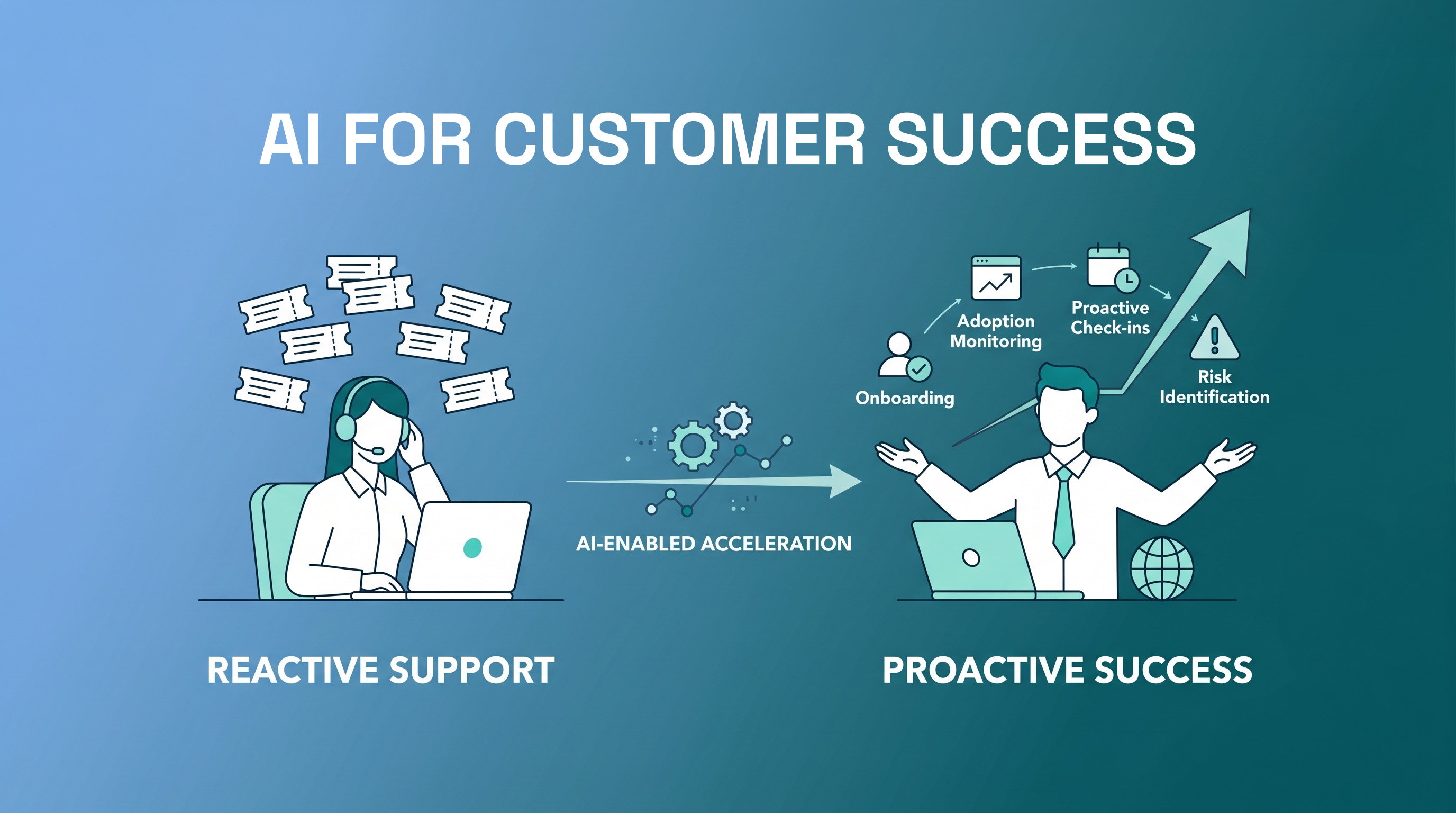
Most companies draw a clear line between support and success.
Support is reactive. It waits for problems. A customer raises a ticket, the team resolves it, the ticket closes.
Customer success is proactive. It spots problems before they happen. It tracks engagement, flags churn risk, ensures customers are getting value, and steps in at exactly the right moment.
The problem: the line between them is getting expensive to maintain. Running a proactive customer success function requires headcount, people who are constantly monitoring, reaching out, and managing dozens or hundreds of customer relationships simultaneously. For most businesses, that's a resource they either can't afford or can't scale fast enough.
AI for customer success is changing the equation. In 2026, the best customer success operations aren't bigger. They're smarter. And AI agents are the reason why.
At its core, customer success is about ensuring customers achieve the outcome they paid for. Not just "can they use the product" but "are they getting the value they expected?"
In practice, that involves:
AI tools for customer success can play a meaningful role across all of these, but not in the same way in each.
Not every part of customer success needs a human. The highest-value CS work, renewing accounts, expanding relationships, handling complex escalations, genuinely requires judgment and rapport. But a significant portion of what CS teams do every day is predictable, repeatable, and time-consuming in a way that doesn't need to be.
Onboarding is the most automatable part of customer success. The steps are largely the same for every new customer. The questions are predictable. The sequence is fixed.
An AI agent can guide new customers through onboarding proactively, sending the right message at the right step, answering questions as they arise, and escalating to a human CSM when something genuinely needs judgment.
The result: onboarding moves faster, customers reach value sooner, and the CS team isn't manually managing 50 simultaneous onboarding conversations.
Customer success starts to fall apart when support volume overwhelms the team. When CSMs spend half their day answering the same questions, they can't do proactive work.
AI tools for customer success as the first line of response handle the high-volume, repetitive queries, freeing up CSMs for the relationship work that only humans can do. "How do I export my data?" gets answered instantly. "We're thinking about expanding our contract" gets a CSM call.
Most CS teams can only proactively reach out to their highest-value accounts. There simply isn't enough time for everyone. AI customer success changes this.
An AI agent can monitor engagement signals, identify accounts that haven't logged in recently, and send personalised check-in messages automatically. Not a generic blast, but a targeted message based on that customer's usage pattern and tenure.
When the customer responds, the agent handles the conversation if it's straightforward. If it's a serious concern, it flags the account for the CSM.
One of the hardest things to scale in CS is consistency. High-touch accounts get personal attention. Mid-market and SMB accounts often get very little. AI closes the gap, giving every customer a consistent experience regardless of account size.
This matters especially at renewal. A customer who has had regular, helpful touchpoints throughout the year is far more likely to renew than one who hasn't heard from you since onboarding.
It's worth being honest about the limits.
The ideal model is AI as augmentation: handling the volume, surfacing the signals, delivering the consistent touchpoints, so your human CS team can focus on the high-stakes, high-value work that genuinely moves the needle.
You don't need to overhaul your entire CS function. Start with the highest-leverage entry point.
Pick one. Deploy it well. Measure the result. Then expand.
Rhea is Vector Agents' AI customer support digital worker, and for many businesses, she's the first layer of a modern AI for customer success operation.
She handles inbound queries from existing customers 24/7. She answers product and account questions instantly. She escalates to your human team when something needs judgment. And because she handles the volume, your CS team can focus on the proactive, strategic work that drives retention and expansion.
For businesses that are serious about growing Net Revenue Retention without doubling their CS headcount, Rhea is the starting point.
AI for customer success is the operating model that separates teams who scale from teams who stall. More than half of CS teams are already integrating AI into their core workflows. The ones pulling ahead are using it to catch churn earlier, onboard customers faster, deliver consistent touchpoints at every tier, and free their people to focus on the strategic relationships that actually move revenue.
With the right AI customer success tools in place, the same headcount can cover more ground, catch more risk, and drive more expansion, without the manual overhead that bogs most teams down.
That's exactly what Rhea is built for. She handles inbound queries from existing customers around the clock, answers product and account questions instantly, and escalates to your human team only when genuine judgment is needed. The volume gets covered. Your CS team gets their time back. And your Net Revenue Retention reflects it.
If you're ready to see what that looks like for your customer base, talk to us at Vector Agents.
AI for customer success refers to the use of AI-powered tools and agents to automate and scale key customer success activities, including onboarding, adoption monitoring, proactive outreach, and churn risk detection. Rather than replacing customer success managers, these tools handle high-volume, repeatable tasks so CS teams can focus on strategic, high-value relationships that drive retention and expansion.
AI improves customer retention by identifying at-risk accounts earlier than manual monitoring allows. By analyzing product usage data, engagement signals, and behavioral patterns, AI customer success tools flag churn risk in real time and trigger automated outreach before a customer disengages. AI saves CS teams more than ten hours per week, allowing them to intervene at the right moment with the right accounts.
AI tools for customer success can automate onboarding sequences, first-line support responses, proactive check-in messages, engagement monitoring, and renewal reminders. They can also surface health scores and flag accounts for human review. The tasks best suited to automation are those that are high-volume, repeatable, and time-sensitive, precisely the tasks that prevent CSMs from doing higher-value strategic work.
No. AI customer success tools are designed to augment CSMs, not replace them. AI handles volume and consistency; people handle judgment, empathy, and strategic relationships. Tasks like executive relationship management, complex contract negotiations, and sensitive account recovery still require a human. The most effective CS operations use AI to handle the load so their team can focus on the work that moves the needle.
Net Revenue Retention (NRR) measures how much recurring revenue you retain from existing customers over a given period, factoring in expansion, downgrades, and churn. An NRR above 100% means your existing customer base is growing without any new customer acquisition. It's the clearest measure of whether your customer success strategy is working.
Start with the highest-leverage problem your team faces. If support volume is the issue, deploy an AI agent for first-line query handling. If onboarding is slow, automate the sequence. If churn is catching you off guard, set up engagement-triggered outreach. Pick one use case, implement it well, measure the result, then expand. AI customer success works best when it's introduced systematically rather than all at once.

.svg)


.svg)
Vector AI All rights reserved. © 2025


.jpeg)