
Europe Expansion
Vector Agents Enters Europe. Announcing Our Regional Leadership.

Europe Expansion
Vector Agents Enters Europe. Announcing Our Regional Leadership.


Most AI chatbot pricing pages show a starting number. It usually tells you very little about what you’ll actually pay.
In reality, the total cost is made up of several components. These include a base subscription, resolution fees that increase with volume, and add-ons that are often locked behind higher tiers.
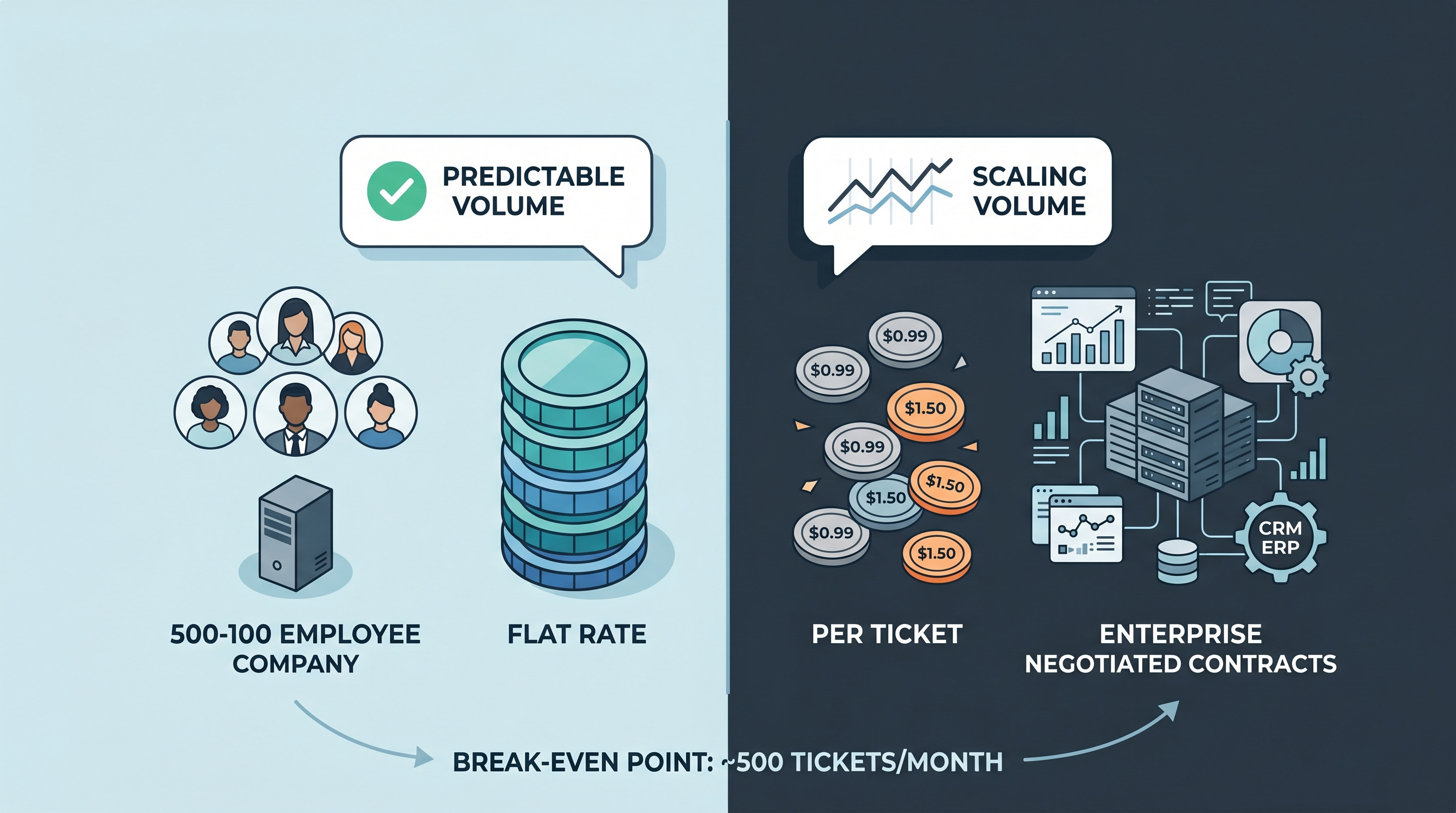
An AI chatbot cost breakdown for SMB vs enterprise typically comes down to two pricing models: flat rate and per resolution.
Which model is more cost-effective depends almost entirely on how many tickets your team handles each month.
This article maps both pricing structures against real volume scenarios. It helps you run the numbers for your own situation before speaking to any vendor.
The advertised seat price is the entry fee. The costs that grow unpredictably sit in the layers below it. Platforms using a per-resolution pricing model charge a fee for every ticket the AI closes. This is billed on top of the base subscription.
The per-resolution rate and what qualifies as a resolved ticket vary by vendor. As a result, the monthly bill depends on both the rate and how the platform defines success. Always confirm both figures directly with the vendor before forecasting costs.
Usually, the bigger issue is how platforms count a resolution. Many vendors mark a conversation as resolved in two cases. The first is when the customer confirms the issue is fixed. The second is when the customer simply stops replying after the AI’s last message.
That second case creates risk. A customer who leaves out of frustration can still be counted as a successful resolution.
This means you can be charged for outcomes that are not actually successful. It also introduces cost variance that cannot be controlled through AI configuration alone.
Understanding this structure is the prerequisite for comparing pricing models honestly. The next step is establishing the baseline that the comparison should be measured against.
Before comparing software, the baseline decision is AI versus human. This means the correct denominator is the fully loaded cost of a support hire, not a seat subscription fee.
The median hourly wage for US customer service representatives was $20.59 in May 2024, placing the median full-time annual salary at approximately $42,800. That figure understates the actual cost of a hire in three consistent ways.
When the AI chatbot cost breakdown for SMB or enterprise is framed against the fully loaded cost of a human hire rather than a seat subscription, the economics look materially different. That is the comparison that makes the pricing model decision consequential.
For a support team at a 100 to 500 employee company, per-resolution pricing introduces a specific planning problem. The monthly AI bill scales with the same events that are hardest to budget for.
Take a team handling 1,000 support conversations a month.
At different per resolution rates, the cost looks like this:
These figures are manageable in isolation. The problem surfaces when volume spikes.
A service incident or product release that doubles ticket volume changes the picture quickly:
The base subscription stays fixed. The AI bill doubles because the AI did its job.
For a team that budgeted for an average month, this shift turns into a finance issue rather than an operational one.
Every ticket the AI resolves is a billable event. As adoption improves and more volume is routed through the AI, costs increase alongside that success.
For small teams without a dedicated budget buffer, this creates two problems:
Flat rate pricing addresses this directly, though it introduces a different set of tradeoffs.
Flat-rate AI chatbot pricing models charge a fixed monthly fee covering a defined conversation volume. The cost is known before the month starts, and a spike in ticket volume does not automatically produce a corresponding spike in the bill.
To put numbers to the comparison, take a team handling 2,000 conversations per month.
At a per-resolution rate of $0.99, that results in $1,980 in resolution fees alone. At $1.50, the same volume costs $3,000.
Now compare that to a flat rate plan. A plan covering 2,000 conversations at $500 per month produces a saving of $1,480 against the lower per resolution rate, before any difference in base subscription is factored in.
The break-even point sits at around 500 conversations per month. Below that threshold, per-resolution pricing can cost less. Above it, the flat rate model becomes cheaper with each additional ticket.
The tradeoff is volume forecasting. Flat-rate plans require a reasonable estimate of monthly ticket volume:
For teams with predictable volumes, the forecasting exercise is straightforward. For teams with high variance, tracking against the cap monthly keeps the cost model honest.
The structural advantage is containment. A product incident that doubles ticket volume for two weeks does not produce a doubling of the AI bill; the cost ceiling holds while the AI absorbs the additional load up to the cap. For an SMB support team working inside a fixed budget, that predictability is worth more than the marginal per-unit savings per-resolution pricing offers at low volumes.
The AI chatbot cost breakdown differs significantly between SMBs and enterprises. At the enterprise tier, public pricing pages are no longer the relevant reference point, as the most important costs are negotiated per contract rather than listed.
Enterprise contracts include guaranteed uptime commitments, dedicated support contacts, and compliance certifications for regulated industries. What enterprise buyers get for that additional cost and complexity is capability that SMB-tier products don't offer: multi-region redundancy, deep system integration, advanced analytics, and the compliance posture that regulated industries require. The gap between SMB and enterprise pricing reflects a genuinely different set of requirements, not just a different margin.
Before any vendor conversation, four questions produce the numbers that determine which pricing model holds up at your scale.
Teams deploying AI support workers typically see about 20 percent reductions in both service costs and resolution times. When compared to the fully loaded cost of a human hire, including salary, overhead, attrition, and ramp time, an AI worker handling repeatable queries does not just cut costs. It removes the need to hire in the first place.
Rhea is Vector Agents’ AI support digital worker, built for teams managing growing support volume without increasing headcount. It operates on a flat rate pricing model, so cost remains predictable as ticket volume increases and monthly spend becomes easier to plan and justify.
Rhea resolves support tickets using your existing knowledge base, which means responses are grounded in your own documentation, policies, and product information. This ensures customers receive accurate, consistent answers rather than generic responses. As the knowledge base evolves, Rhea’s output improves alongside it.
For queries that require human judgment, Rhea handles escalation cleanly. Conversations are passed to agents with full context, including prior messages, customer intent, and relevant details already captured. This allows agents to step in without restarting the interaction, reducing resolution time and improving customer experience.
Rhea operates continuously across chat, email, and social channels, supporting over 100 languages. It handles high volume, repeatable queries that would otherwise consume agent time, allowing your team to focus on complex, high value interactions where human input matters most.
At typical support volumes, the AI chatbot cost breakdown for SMBs and enterprises is primarily a cost structure question, with flat rate models becoming more cost-effective as volume increases.
Enterprise buyers face a different set of considerations, including custom deployment, compliance, system integration, and procurement cycles, which make the cost model secondary to capability fit. For these buyers, pricing is determined through negotiation rather than listed on a pricing page.
For SMB and mid-market support teams, the decision is simpler. It comes down to whether the predictability of flat rate pricing outweighs the lower per-unit cost of per resolution pricing at low volumes. For most teams handling more than 500 conversations per month, it does.
If your per-ticket costs are increasing faster than your team can justify to finance, book a demo to see how Rhea’s flat rate model compares to your current support spend.
Flat-rate pricing charges a fixed monthly fee regardless of how many tickets the AI resolves. Per-resolution pricing charges a fee for every ticket closed, making costs variable and tied directly to support volume. At higher volumes, flat-rate is almost always cheaper because the cost ceiling holds while per-resolution fees compound with every additional conversation the AI handles.
The crossover point depends on the per-resolution rate and the flat-rate plan cost. Using a $0.99 per-resolution rate against a $500 flat-rate plan, the break-even sits at roughly 500 conversations per month. Above that volume, the flat-rate plan costs less. Below it, per-resolution pricing can produce a lower monthly bill, but offers no cost ceiling if volume spikes.
Yes. Enterprise plans typically add private cloud deployment, compliance configurations, dedicated SLA tiers, CRM and ERP integrations, and professional services for implementation. These are rarely listed on public pricing pages and are negotiated per contract. SMB-tier flat-rate plans cover conversation volume and standard channel integrations without the custom infrastructure layer.
Look beyond the base subscription for per-resolution fees, AI copilot add-ons, channel-specific fees for WhatsApp or SMS, onboarding and implementation costs, and overage charges for exceeding conversation caps. The definition of a "resolved" conversation also varies by platform and directly affects what gets billed, confirm it before signing.

.svg)


.svg)
Vector AI All rights reserved. © 2025


.jpeg)