
Europe Expansion
Vector Agents Enters Europe. Announcing Our Regional Leadership.

Europe Expansion
Vector Agents Enters Europe. Announcing Our Regional Leadership.


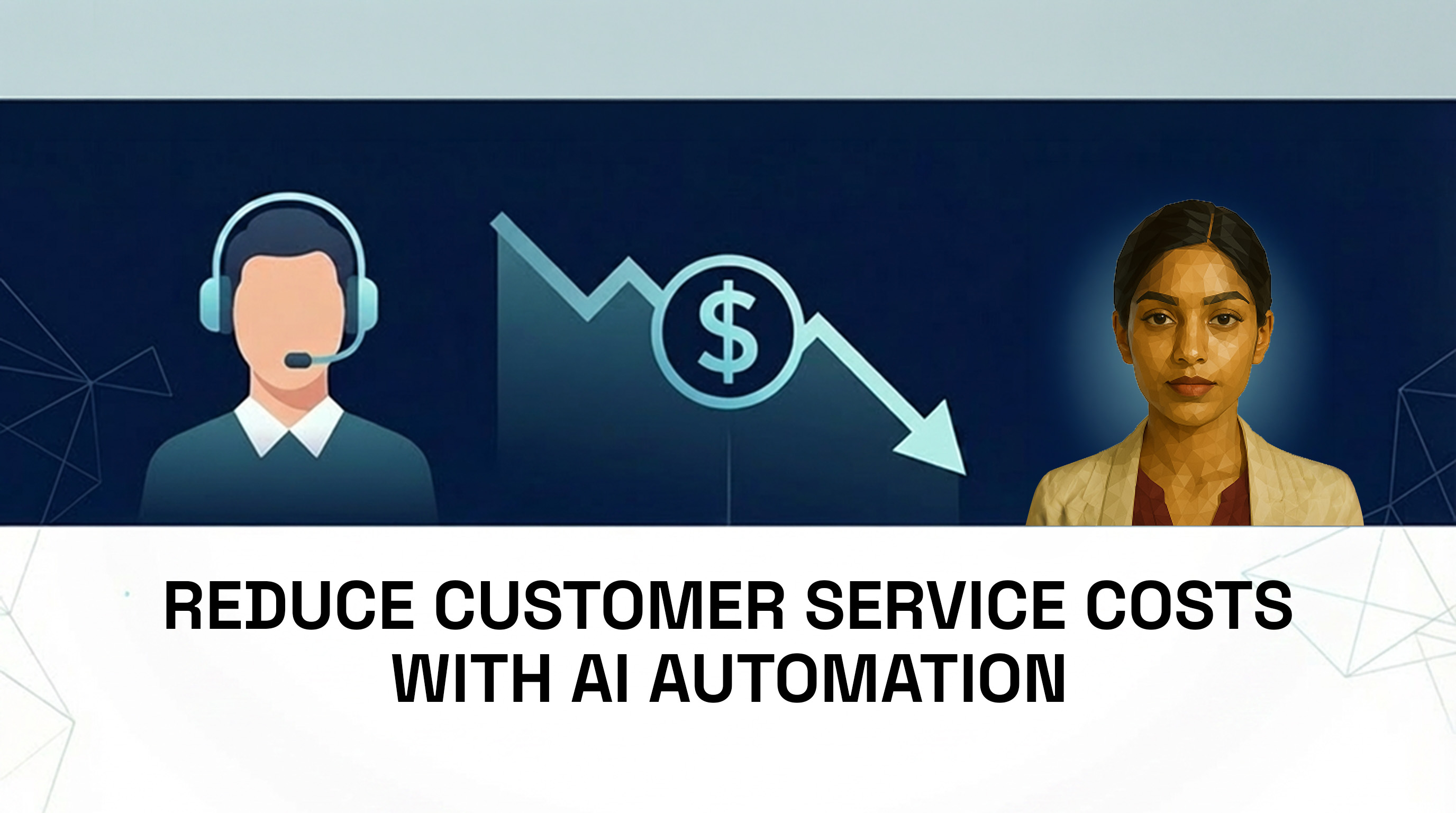
There's a belief embedded in most customer support discussions that quality and cost are in direct tension. To improve quality, you hire more people. To reduce customer service expenses, you cut. That was true before AI. It's not true anymore.
The best support operations in 2026 are reducing customer service expenses and improving quality simultaneously, because they've deployed AI in the right places. Teams using AI are seeing resolution times fall from 30 hours to 30 minutes, while early movers report 35% ticket-volume reductions and 20% improvements in response times.
This article explains exactly how, with the data and the mechanics behind why it works.
Before you can reduce customer service expenses, you need to know what they are. Most businesses dramatically underestimate the true cost of their support function.
Direct costs include salaries and benefits for support staff, management overhead for the support team, tools such as helpdesk software, CRM, and communication platforms, and training and onboarding for new support hires.
Indirect costs include time spent by non-support staff handling escalations, the cost of errors, mishandled complaints, and repeat contacts, churn attributable to poor support experiences (often the biggest hidden cost), and lost revenue from prospects who couldn't get quick answers during the sales process.
That's the number you're managing. And it's the number AI can meaningfully move.
The traditional response to growing support volume is to hire. More tickets coming in? More people to handle them.
This approach has three fundamental problems.
It scales linearly. Each doubling of support volume roughly requires a doubling of headcount. There's no leverage. Revenue can grow exponentially; support costs keep pace.
Hiring takes time. By the time you've recruited, onboarded, and trained a new support hire, you've probably been short-staffed for two to four months. During that period, response times suffer, and customers feel it.
Quality is inconsistent. Different agents give different answers. New hires make more mistakes. High-performing workers handle complex issues while newer staff struggle. Consistency at scale is genuinely difficult with a human-only model.
The key insight is that cost reduction comes from handling volume more efficiently, not from delivering a worse experience. In many cases, the automated experience is better than what customers were getting from an understaffed human team. This is where the best AI tools for support cost reduction make the clearest case for themselves.
The single biggest driver of support costs is volume of repetitive queries:
For most businesses, these queries represent 60–80% of total support volume. They're also the easiest to automate, because the answers are defined and consistent.
On average, AI agents cab deflect, with retail companies seeing the highest deflection rates above 50%. A digital worker handling these queries at scale costs a fraction of what a human team costs per interaction.
Slow resolution doesn't just frustrate customers, it costs money. Every query that requires a follow-up, a callback, or an escalation costs more to resolve than a query handled correctly the first time.
Gen AI has the potential to deliver a 25–30% increase in agent efficiency and a 5–10% improvement in customer satisfaction. Digital workers with access to a comprehensive knowledge base resolve a high percentage of queries completely in a single interaction. No follow-up needed. The cost per resolution goes down; customer satisfaction goes up.
Running 24/7 human support is expensive. Night shifts, weekend coverage, public holiday staffing: these cost significantly more than standard business hours. A digital worker that handles after-hours queries at the same cost as business-hours queries eliminates this premium entirely.
Every query that requires escalation to a senior or specialised agent costs more than one handled at the first point of contact. AI customer support agents reduce support costs by handling more queries end-to-end, with better access to information than a junior agent reading from a script. The queries that do escalate are genuinely complex, which means your senior team's time is spent on work that actually requires their expertise.
Assume a business receiving 2,000 support queries per month with a four-person support team.
Rhea is Vector Agents' AI customer support digital worker. She handles inbound queries across WhatsApp, live chat, and other channels 24/7, resolving the majority of tickets autonomously so your human team doesn't have to. With Rhea managing the high-volume, repetitive work, one full-time support agent can focus on complex queries rather than four agents fielding everything.
The reduction is significant, and the quality metrics go in the right direction.
How to calculate cost savings from AI support comes down to three inputs: your current cost per ticket, your monthly ticket volume, and your expected AI deflection rate. The formula is:
Monthly savings = (cost per human ticket × monthly volume × deflection rate) − monthly cost of AI digital worker
To get your cost per human ticket, take your fully-loaded agent cost (salary, benefits, tools, management overhead) and divide it by the number of tickets that agent resolves per month. Then apply your projected deflection rate.
Using the example above: four agents at $4,500/month resolving 2,000 tickets gives a cost per ticket of $9.00. At a 50% deflection rate, Rhea removes 1,000 tickets from the human queue each month, saving $9,000 in direct monthly costs before accounting for the cost of the digital worker.
Most businesses also undercount the indirect savings: fewer escalations, better first-contact resolution, and reduced repeat contacts all compress further costs that don't appear on the initial spreadsheet.
To successfully reduce support costs with AI, the deployment needs to be done properly. Shortcuts produce the results you'd expect.
The goal isn't to replace your support team with an AI agent. It's to change what they spend their time on.
A support team spending 70% of its time on repetitive queries is expensive and under-utilised. The same team, freed from that work by Rhea, can move into higher-value roles: managing complex escalations, building customer relationships, identifying churn risks before they materialise, and feeding product insights back into the business. These are the activities that retain customers, grow accounts, and compound over time.
That's not cost-cutting. That's leverage. The businesses that get this right don't just reduce their support costs. They convert their support function from a cost centre into a retention and growth engine, with the same headcount doing work that actually moves the needle.
Reducing customer service expenses doesn't require a trade-off between cost and quality. The mechanism is straightforward. Rhea handles the high-volume, predictable work. Your human team handles everything that genuinely needs them. The result is a support operation that scales without linear cost growth.
The businesses seeing the strongest results aren't the ones that cut the deepest. They're the ones that deployed AI thoughtfully, invested in their knowledge base, and let their teams focus on the work that actually moves the needle.
That's exactly what Rhea is built to do. For most businesses, the impact is visible within the first 30 days: less time spent on repetitive queries, faster response times, and after-hours coverage that didn't exist before.
See what that looks like for your team at Vector Agents.
The fastest way to reduce customer service expenses is to deploy an AI digital worker to handle your highest-volume, most repetitive queries. These typically represent 60–80% of total ticket volume. Deflecting even 40–50% of inbound queries with AI can cut monthly support costs significantly within the first 30 days, with no reduction in service quality.
Businesses using AI for customer support report cost reductions of 25–30% on average. The savings come from a combination of lower cost per interaction (as little as $0.50 for AI versus $6.00 for a human agent), reduced escalation volume, faster first-contact resolution, and the elimination of after-hours staffing premiums. McKinsey's research puts agent efficiency gains at 25–30% for well-deployed gen AI.
The best AI tools for support cost reduction are purpose-built digital workers that integrate directly with your existing channels and knowledge base. Key criteria include the ability to handle multi-channel inbound queries (WhatsApp, email, live chat), a reliable escalation workflow to human agents, and a knowledge base structure that can be updated as your products and policies change. Rhea by Vector Agents is built specifically for this use case.
To calculate cost savings from AI support, divide your fully-loaded agent cost by monthly tickets resolved to get your cost per human-handled ticket. Multiply your monthly ticket volume by your expected AI deflection rate and the difference in cost per interaction. Subtract the monthly cost of the digital worker to get your net monthly saving.
No. When deployed correctly, AI customer support typically improves quality metrics. The key is a well-maintained knowledge base, a clear escalation design, and ongoing refinement of the digital worker's responses.

.svg)


.svg)
Vector AI All rights reserved. © 2025


.jpeg)