
Europe Expansion
Vector Agents Enters Europe. Announcing Our Regional Leadership.

Europe Expansion
Vector Agents Enters Europe. Announcing Our Regional Leadership.


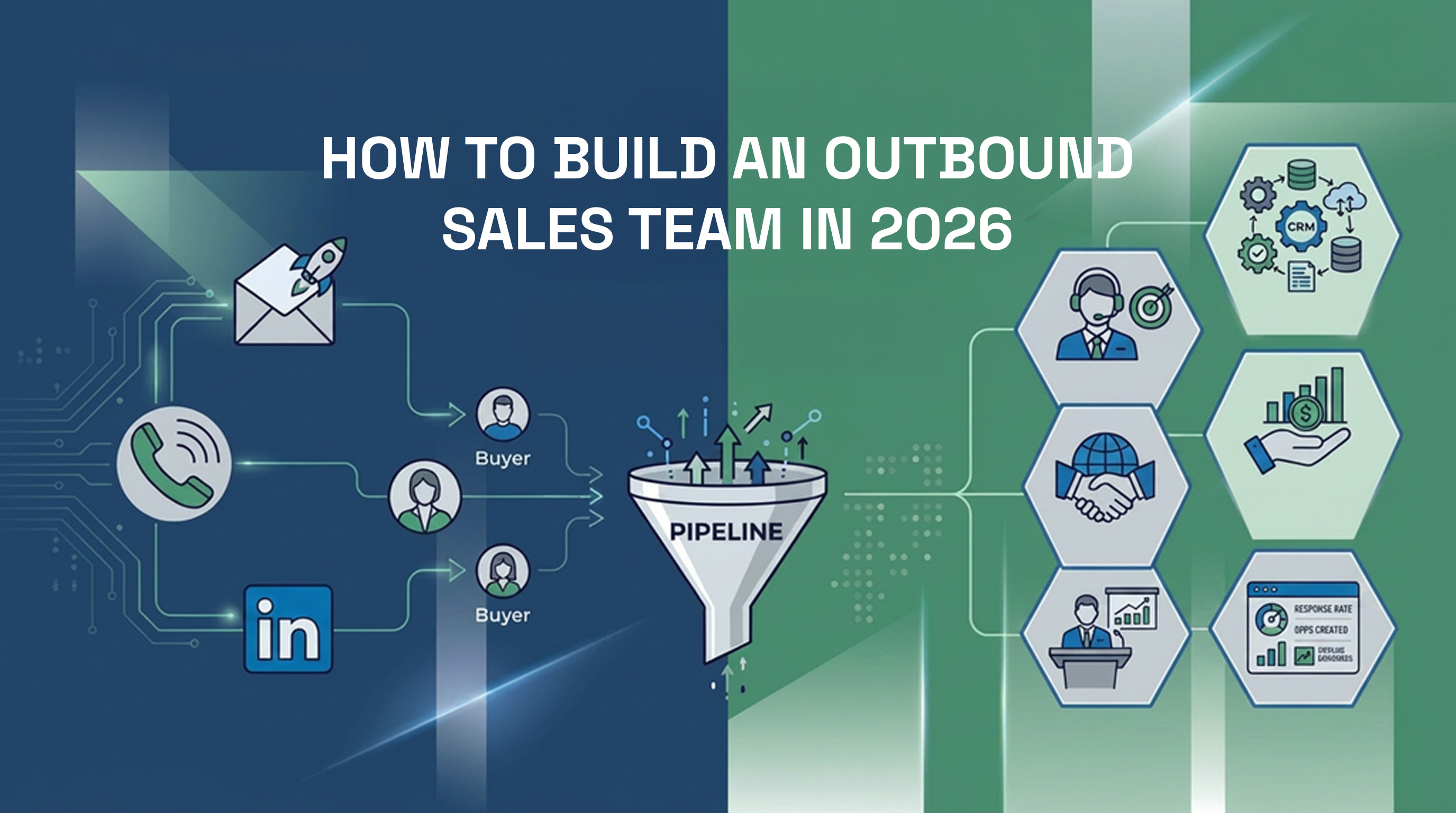
How to build an outbound sales team is one of those questions that sounds straightforward until you are the one doing it. On paper, the process looks simple. Hire SDRs, give them a list, and start outreach. In practice, most outbound teams fail because the structure underneath the outreach is weak.
Outbound sales is the practice of proactively reaching out to potential customers who have not expressed prior interest. This usually happens through cold email, cold calling, LinkedIn outreach, or a combination of all three. The seller makes the first move rather than waiting for inbound demand.
For B2B companies at the growth stage, outbound is often the fastest way to generate pipeline after a funding round, enter new markets, and reach buyers that inbound will never surface in time. But building an outbound function that consistently produces qualified pipeline requires far more than hiring a few reps and sending emails.
This guide breaks down what the build actually requires, including team structure, roles, tech stack, compensation, onboarding, and performance metrics, so you can make an informed decision on how to proceed.
Outbound has changed. The mechanics are the same. You identify a prospect, you reach out, and you try to start a conversation. But the standards for what works have moved significantly.
Outbound and inbound serve different purposes. Inbound attracts buyers who are already searching for a solution. Outbound reaches buyers before they start looking. That distinction matters at the growth stage, where waiting for inbound to scale is not an option. Outbound lets a team control exactly who it talks to, when, and in what context.
What has changed in 2026 is the tolerance for poor targeting. Buyers receive more outreach than ever, which means generic messaging gets ignored or reported as spam. Modern outbound that generates pipeline is built on a tight ICP, coordinated multichannel sequences, and outreach that is relevant to the specific person receiving it, rather than the same template sent to ten thousand contacts.
The teams that underperform are not failing because outbound does not work. They are failing because the architecture underneath the outreach is broken. Getting that architecture right is what the rest of this guide covers.
Before a single SDR sends a single email, the strategy needs to exist. Hiring first and figuring out the targeting later is one of the most common and expensive mistakes in outbound.
An ICP specifies the exact characteristics of a company and buyer that are most likely to convert. It's not a rough sketch. It needs:
One ICP is rarely enough. Segment by industry vertical or buyer persona so SDRs have targeted messaging rather than one-size-fits-all outreach.
Cold email templates, call scripts, objection-handling responses, qualification criteria, and a documented value proposition must exist before outreach begins. Undocumented processes force every rep to improvise, which makes it impossible to diagnose what's broken.
Multichannel outbound consistently outperforms any single channel. Social media now outranks email for cold outreach response rates, with 42% of sales professionals reporting it delivers the highest response rate, compared to 26% for email and 23% for phone. Email, phone, and LinkedIn work best in coordination.
With the ICP defined and the playbook built, the team has something concrete to execute against from day one.
Effective outbound separates prospecting from closing. Asking one person to run the full funnel, from cold research through to signed contract, degrades performance at every stage.
For a company with 50–300 employees, starting with two SDRs and one AE is the standard entry point. A single SDR is a single point of failure: if performance stalls or the rep leaves, outbound stops. Though this is tightening as AI tools increase per-rep output.
The handoff is the highest-risk transition in the outbound funnel. When an AE receives a meeting without full context, the conversation resets. Every qualification note, prospect detail, and outreach summary should be logged in the CRM before the AE enters the picture. That documentation is what makes a handoff feel like a continuation rather than a fresh start.
Role clarity and handoff discipline are the structural foundations that everything else sits on.
Technology doesn't replace process, but running outbound without the right tools creates friction that compounds across every rep, every sequence, and every week.
Salesforce and HubSpot are the market standards at the B2B SaaS stage. Every prospect interaction, qualification note, and outreach record lives here. A CRM is also what makes the SDR-to-AE handoff seamless: the AE opens one record and sees the full history.
Sales engagement platforms manage multi-touch outreach sequences, automate task queues, and surface reply rate and conversion data by sequence step. Without a sales engagement platform, SDRs track follow-ups manually, which means follow-ups don't happen consistently.
Data tools supply prospect lists and contact enrichment. The critical issue is data decay: contact information becomes stale as people change jobs, and importing large, unfiltered lists without verification drives bounce rates that damage sender reputation. Tight ICP filtering at list-build stage is the first line of defence against deliverability damage.
Sending cold email without SPF, DKIM, and DMARC authentication and proper domain warm-up creates deliverability problems that are slow and expensive to fix. Google's spam complaint threshold is 0.1%, with delivery issues starting above 0.3%. Secondary sending domains and continuous bounce monitoring aren't nice-to-haves; they're operational requirements.
The tech stack is what turns a strategy into a repeatable daily process. The hiring decisions that follow only produce results if this infrastructure is already in place.
The traits that predict SDR success differ from those that predict AE success. This is a high-volume, high-rejection role. It rewards process discipline and resilience more than polish or prior closing experience.
Newer SDRs who are willing to stay in the role for 18 months or more often outperform experienced reps who treat it as a stepping stone. The average SDR ramp time is 3.2 months, with average tenure at 1.5 years, leaving roughly 15 months of full productivity per hire. Build a clear promotion path, from SDR to Senior SDR to AE, from day one. It is one of the biggest drivers of longer tenure.
The right hires, properly set up for success, determine whether the outbound investment pays off. Compensation is what keeps them performing once they're in the seat.
Compensation design determines what SDRs actually optimise for. A misaligned plan produces inflated activity with poor pipeline quality. A well-designed plan produces qualified meetings and pipeline that converts.
The recommended structure is a 65:35 or 70:30 base-to-variable split. Current market rates put median SDR OTE at $76,000 with a 65:35 split, and approximately two-thirds of SDRs achieve or beat quota in a given period.
Variable pay should be tied to metrics the SDR directly controls:
Never tie more than 20% of SDR variable compensation to closed-won revenue. The SDR has no control over what happens after handoff, and long deal cycles mean payment arrives months after the activity that earned it. Commission-only models drive turnover and push reps to book unqualified meetings to trigger payouts.
Median AE OTE sits at $190,000 with a 53:47 base-to-variable split, alongside a median commission rate of 11.5% of Annual Contract Value at 100% quota attainment. Accelerators for overperformance are standard. Territory fairness is the single biggest driver of AE confidence in their target. Without it, even a well-designed commission structure loses its effect.
Compensation that's aligned to the right outputs keeps the team focused on quality. Onboarding determines how fast they get there.
The difference between a rep who's productive in three months and one who takes six is usually the quality of their first 30 days, not the quality of the hire.
Structured onboarding compresses time-to-productivity. AEs are the best people to train new SDRs: they've done the role, they understand what makes a genuinely useful handoff, and joint onboarding time establishes the shared process and communication norms that prevent handoff breakdowns later.
Three onboarding elements that consistently shorten ramp:
Batching prospecting into dedicated 90-minute blocks during ramp builds volume discipline faster than spreading activity across the day. Once the team is operational and ramped, the question becomes: how do you know it's working?
Outbound effectiveness isn't a function of emails sent or dials made. The metrics worth tracking are the ones that connect activity to qualified pipeline.
Each SDR should generate seven to 15 qualified opportunities per month, depending on average contract value. AEs should close 25–35% of all qualified opportunities they receive.
Weekly metric reviews surface problems early enough to fix them. Quarterly reviews surface them too late.
Most decisions about how to build an outbound sales team start with one assumption: hire SDRs. In 2026, that assumption is worth stress-testing before the first job post goes live.
A human SDR carries $75,000–$110,000 per year in base salary alone, before benefits, management overhead, a 3.2-month ramp period, and the attrition cost of average tenure at 1.5 years. Every rep who leaves mid-year resets the pipeline clock. Every role left unfilled during a 40-to-50-day hiring cycle is pipeline not being built.
Outsourced sales staff and SDR outsourcing models offer an alternative path: a managed outbound function with predictable monthly costs, no hiring cycle, and no ramp period. The trade-off is less control over brand representation and prospect interaction.
The AI SDR category has matured significantly in 2026. These are autonomous agents that handle prospecting, lead research, personalised outreach, and meeting booking without a human SDR in the loop.
Vector Agents builds AI-powered digital workers that take on the high-volume, repetitive work that slows sales teams down. Lilian is Vector Agents' AI SDR. She handles outbound prospecting end-to-end: lead research across various sources, personalised outreach, and meeting booking for your AEs. She operates around the clock, and deploys into new markets and languages without a hiring cycle.
Lilian removes many of the operational constraints that come with scaling a traditional SDR function, including hiring cycles, ramp time, attrition, and management overhead. For companies weighing whether to build a full SDR headcount, augment an existing team, or automate the prospecting function entirely, the productivity impact can be measured from week one.
Building an outbound sales team in 2026 requires getting five things right before the first rep sends the first email: a defined ICP, a documented playbook, the right tech stack, a structured compensation plan, and a metrics framework that surfaces problems weekly rather than quarterly. The teams that underperform aren't failing because outbound doesn't work. They're failing because the architecture underneath the outreach is broken.
For companies that want a consistent pipeline without the overhead of building and managing a full human SDR function, Lilian handles everything an SDR would typically do, including research, outreach, qualification, and meeting booking, while removing much of the operational complexity tied to scaling outbound teams.
If you're ready to see what that looks like in practice, book a demo with Vector Agents.
An outbound sales team needs three core roles: BDRs who handle cold prospecting and list building, SDRs who qualify leads and book meetings, and Account Executives who close qualified opportunities. At the growth stage, the BDR and SDR roles are often blended into one. All three functions need to be covered, whether by people or AI, before outbound produces consistent pipeline.
Start with at least two SDRs. A single SDR is a single point of failure: if performance stalls or the rep leaves, outbound stops. Two SDRs create competitive momentum and provide redundancy. The Bridge Group benchmark puts the SDR-to-AE ratio at approximately one SDR per 2.6 AEs across B2B companies.
Expect three to four months before a new outbound team generates reliable pipeline. Average SDR ramp time is 3.2 months, and that clock starts after onboarding, not after the hire. Factor in two to four weeks before any outreach begins, then a further four to eight weeks before meetings convert to qualified opportunities.
SDRs typically handle inbound leads, meaning people who have already expressed interest, while BDRs own cold outbound prospecting, reaching contacts with no prior interaction. The distinction is based on lead source, not seniority. In early stage companies, one person often covers both. Separate the roles when outreach volume and funnel complexity justify the specialisation.
An outbound sales team needs four tool categories: a CRM (Salesforce or HubSpot) as the system of record, a sales engagement platform (Outreach, Salesloft, or Apollo.io) to manage sequences, a data tool (ZoomInfo or Apollo.io) for prospect lists, and properly configured email infrastructure with SPF, DKIM, and DMARC authentication to protect deliverability.
Use a 65:35 or 70:30 base to variable split. Median SDR OTE is approximately $76,000. Variable pay should be tied to meetings booked, qualified opportunities created, and pipeline generated, meaning metrics the SDR directly controls. Never tie more than 20% of variable compensation to closed won revenue, because SDRs have no control over what happens after handoff.
It depends on pipeline urgency, management capacity, and how quickly you need outbound operational. Human SDR teams require hiring cycles, onboarding, ramp time, and ongoing management. An AI SDR like Lilian from Vector Agents handles prospecting, outreach, and meeting booking without the delays and operational overhead associated with scaling a traditional SDR function.”
Track connect rate, email reply rate, and meetings booked weekly as leading indicators. Monthly, monitor meeting show rate and SAL-to-SQL conversion as quality checks. Quarterly, review pipeline generated per SDR and AE win rate on SDR-sourced deals. Median pipeline generated per SDR runs at approximately $3 million annually across B2B companies.

.svg)


.svg)
Vector AI All rights reserved. © 2025


.jpeg)