
Europe Expansion
Vector Agents Enters Europe. Announcing Our Regional Leadership.

Europe Expansion
Vector Agents Enters Europe. Announcing Our Regional Leadership.


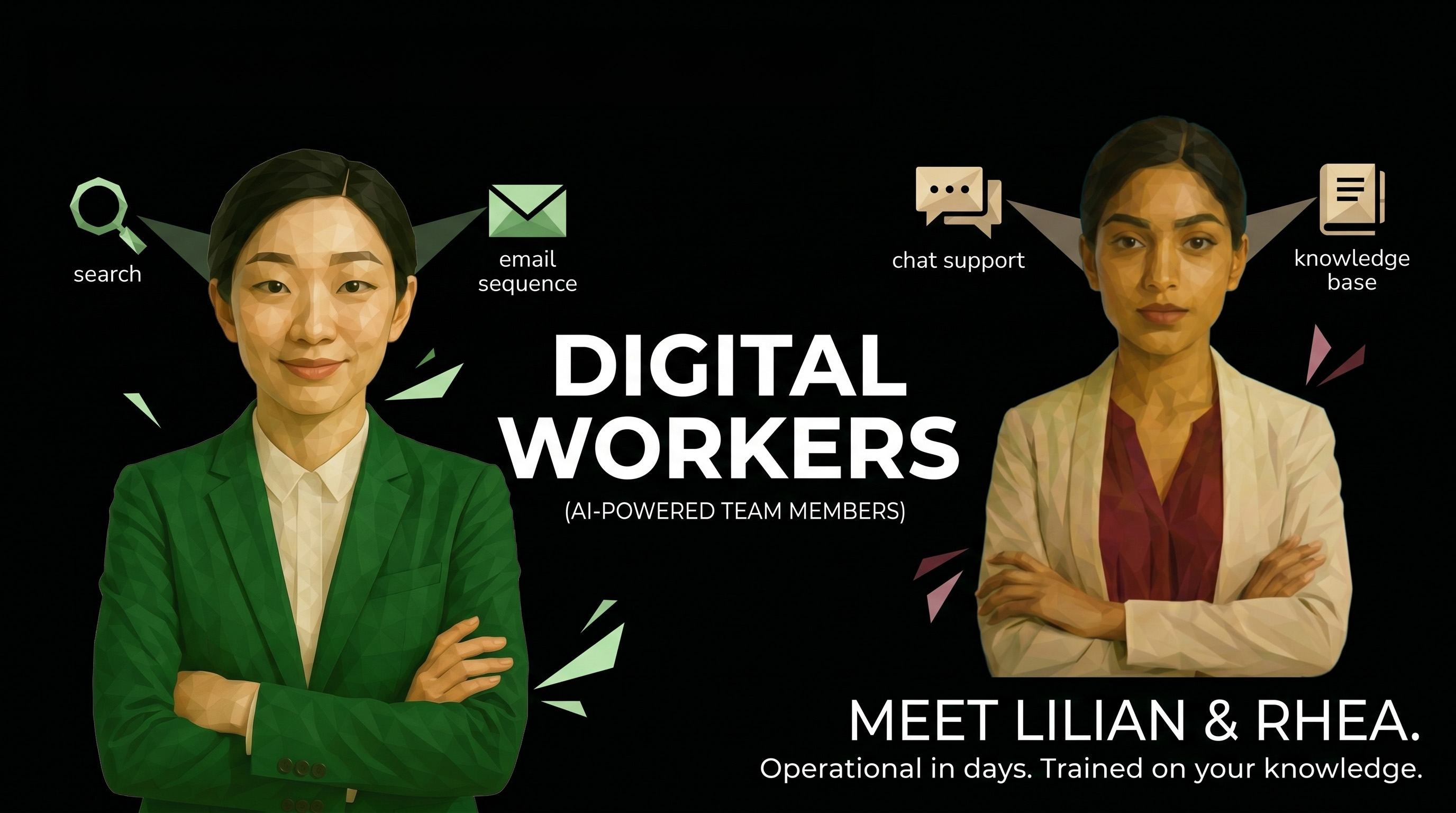
92% of companies plan to increase their AI spending over the next three years. But investment and results are not the same thing. In fact, only 1% describe themselves as “operationally mature”, meaning AI is fully integrated into workflows and actively driving business outcomes.
Most businesses still use AI to assist their teams. The companies pulling ahead are using AI to staff them. That is where digital workers come in.
This guide explains what a digital worker is and how it differs from the automation tools you may already use. It also covers where digital workers are deployed, what they cost compared to a human hire, and how to get one running.
The term has been used in two different ways, and the older definition still causes confusion. It once referred to human employees with digital skills, such as remote workers or knowledge workers who used software to get things done. That definition is now obsolete.
Today, a digital worker is an AI-powered system that performs a defined business role autonomously from end to end. It is also called a digital employee or digital colleague, depending on the context, but the concept is the same. It is an AI system with a specific function, a set of outputs, and accountability for results. It does not assist a human in completing a task. It owns the task from start to finish.
The “worker” framing is deliberate. A digital worker has a role. It gets hired for a function. It can be trained, evaluated, and improved over time. That is very different from a tool you configure and forget. The technical term for the underlying technology is “AI agent.” Digital worker is the workforce framing of the same thing, and it is the framing that most accurately describes how these systems operate inside a real business.
Most businesses have already tried some form of automation. The confusion comes from assuming a digital worker is simply a more advanced version of the tools they have already used. It is not.
The difference comes down to scope. Traditional automation tools handle individual tasks. A digital worker owns a complete function from initiation through to resolution. It adapts its behaviour based on context and inputs along the way. Here is where most of the confusion comes from:
These aren't semantic differences. They change the ROI calculation entirely. The question shifts from "does this tool save my team time?" to "does this worker deliver this function?"
The two most common deployment areas are sales and customer support because both involve high volumes of structured but variable work that currently consumes significant human hours.
In sales, a digital worker owns the full outbound prospecting cycle. That includes account targeting, contact research, personalised outreach, multi-touch follow-up, lead qualification, and CRM enrichment. The human sales team picks up at the conversation stage with leads that are already warm and already qualified. Nothing gets handed off midway through the process.
In customer support, a digital worker handles inbound queries across channels, resolves issues using a trained knowledge base, operates across multiple languages, and routes edge cases to human agents. For standard interactions, there is no human involved in the process.
Beyond these two areas, digital workers are being used across finance, HR, legal, and operations. They are most effective wherever work is high volume, context-dependent, and consuming human hours that could be better spent elsewhere. Finance teams use them for invoice processing and payment reconciliation. HR teams deploy them for CV screening and onboarding administration.
The logic is consistent across every department. Repetitive and judgement light work moves to the digital worker. Strategic and relationship-driven work stays with the human team.
One of the main barriers businesses mention when evaluating automation is implementation time. That barrier does not really apply to modern digital workers.
AI native digital workers can be deployed in days instead of months. There is no need for a major IT infrastructure overhaul, system replacement, or a long onboarding project. The process usually comes down to three decisions: which function to start with, what knowledge base to train on, and which tools to connect.
Integration happens through API connections with platforms that are already in place. CRM systems, helpdesks, and communication tools can all connect directly to the existing stack. Training is based on company-specific content, including documentation, previous customer interactions, and product knowledge. It does not rely on generic internet data, which helps keep outputs accurate and aligned with the brand.
There is also a human management layer involved. Someone on the team is responsible for the digital worker’s performance. That includes reviewing outputs, adjusting scope, and deciding what should be escalated. The deployment model is less like installing software and more like onboarding a new team member with a defined role, a clear scope, and someone accountable for results.
Vector Agents builds AI-native digital workers designed to plug directly into existing business operations, integrating with 700+ applications and delivering measurable results from week one.
Lilian, AI sales agent: Lilian handles outbound prospecting end-to-end. She researches accounts, personalises outreach, manages multi-touch sequences, qualifies responses, and enriches your CRM. Your sales team picks up at the conversation, ready to close.
Rhea, AI customer support specialist: Rhea handles inbound support across email, chat, and social channels, in 100+ languages, 24 hours a day. She resolves tickets using your company's knowledge base and past interactions, not generic internet data. Her average results include a 90% reduction in first response time and 2x improvement in ticket resolution speed. Your support team stops doing triage and starts doing the work that actually needs them.
Both Lilian and Rhea are workers, not tools. They have defined roles, measurable outputs, and they get hired the way you'd hire anyone else. The difference is they're operational from day one.
The commercial case for digital workers becomes much clearer once you compare them against the right benchmark. The comparison is not software licence versus software licence. It is a digital worker versus a human hire.
In sales, a human SDR costs between $75,000 and $110,000 per year in salary alone, before factoring in benefits, management overhead, ramp time, and employee churn. A digital worker can engage thousands of leads per month from day one, without onboarding delays or attrition risk.
In customer support, a human support specialist can cost between $35,000 and $50,000 per year per hire. A digital worker can operate around the clock, across multiple channels and languages simultaneously, while handling large volumes of customer conversations without increasing headcount at the same rate. For businesses managing thousands of support interactions each month, the operational savings can be substantial.
Buyers who evaluate digital workers against the cost of a SaaS licence will underestimate the value. The correct comparison is always the same: what does this function cost with a human in the role, and what does it cost with a digital worker handling the same job?
The businesses pulling ahead with AI are not simply running more experiments. They are making workforce decisions. They are deciding which functions should be handled by digital workers and what that allows their human teams to focus on instead.
The question is no longer whether to automate. The question is which role to fill first. Vector Agents builds digital workers that are operational from week one, trained on your company’s knowledge, and integrated into the tools your team already uses. Lilian handles sales prospecting. Rhea handles customer support. Both deliver measurable results without increasing headcount.
Book a demo with Vector Agents to see how Lilian and Rhea can take on your highest-volume roles free your team to focus on higher-value work.
A digital worker is an AI-powered system that performs a complete business role autonomously. Unlike a bot or automation tool, it handles entire functions from initiation through to resolution without requiring human input at each step. It is also called a digital employee or digital colleague.
A chatbot responds when prompted. A digital worker acts proactively within a defined role. It can initiate tasks, follow up, make decisions, and complete work without waiting for instructions at each stage. The scope is a complete business function rather than a single conversational response.
A digital employee is another term for a digital worker. It is an AI system with a defined role, measurable outputs, and accountability for results, framed in the same way you would frame a human hire. The term emphasises that the system operates as part of the team rather than as a standalone tool.
In sales, a digital worker owns outbound prospecting end-to-end: account targeting, contact research, personalised outreach, multi-touch follow-up, lead qualification, and CRM enrichment. The human sales team picks up at the conversation stage, with leads already researched and qualified.
In customer support, a digital worker handles inbound queries across channels, resolves issues using a trained company knowledge base, operates in multiple languages, and routes complex cases to human agents. It runs 24/7 with no wait time for standard interactions.
A digital colleague is a term used for a digital worker that emphasises its role alongside the human team. It is an AI system that handles defined tasks within a shared workflow, taking on repetitive and high volume work so human colleagues can focus on higher value activities.
Modern AI-native digital workers deploy in days. They connect to existing tools via API, train on company-specific knowledge, and don't require infrastructure changes. The main setup decisions are which function to start with, what to train on, and which platforms to integrate.
“AI agent” is the technical term, while “digital worker” is the workforce framing. They refer to the same underlying technology, which is an autonomous AI system capable of planning, deciding, and acting. The term digital worker describes the system through the lens of a defined role with measurable outputs and accountability inside a real business.

.svg)


.svg)
Vector AI All rights reserved. © 2025


.jpeg)